



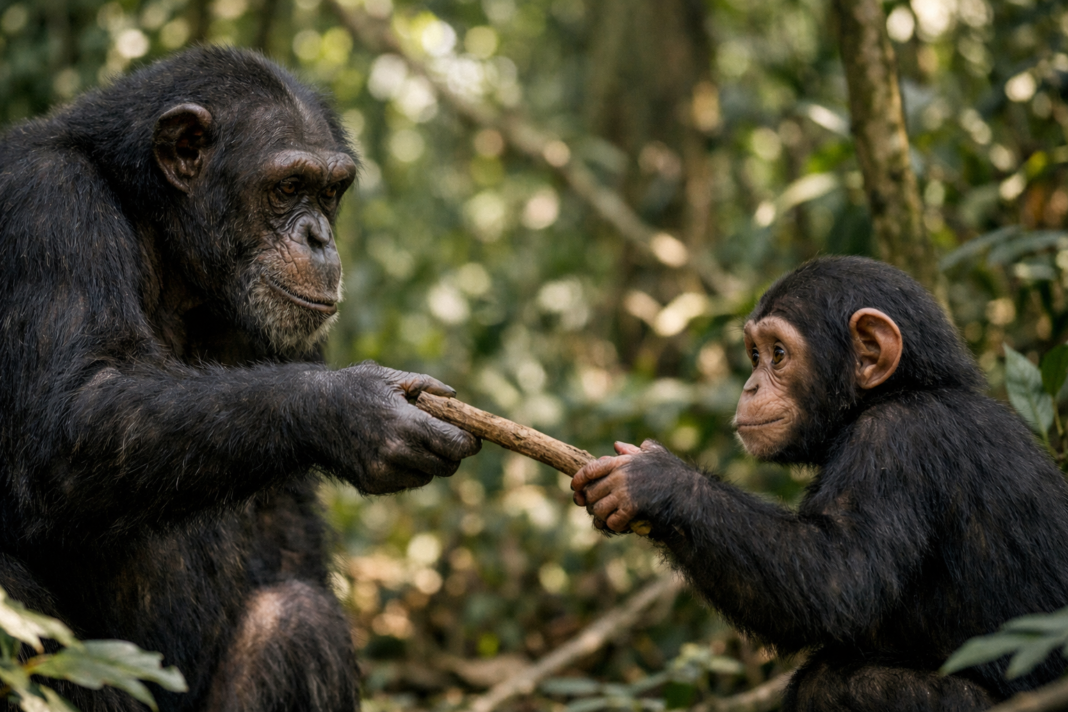
Two-thirds of a century after Jane Goodall watched David Greybeard strip a twig to fish for termites, field research in Senegal has recorded adult chimpanzees deliberately handing tools to younger group members. Observers report instances in which mature animals offer sticks or modify pieces of vegetation and allow inexperienced individuals to take them, enabling direct practice of extractive techniques such as termite fishing.
The exchanges documented in the wild differ from mere tolerance of proximity: adults appear to facilitate access to objects that novices have not yet mastered. Such behaviour provides juveniles with both the implements and the opportunity to interact with those implements under social conditions that support learning. Researchers situate these interactions within a wider set of observed chimpanzee behaviours that include imitation, emulation and social teaching-like patterns.
These field observations contribute to long-standing debates about cultural transmission and the roots of cumulative skill acquisition among non-human primates. The handing-over of tools suggests an active pathway for skills to spread within communities beyond simple observation, potentially accelerating the uptake of complex techniques. Placed alongside earlier accounts from the Gombe studies, the new reports underscore continuity in the kinds of material and social learning that shape chimpanzee traditions.
The findings carry relevance for multiple strands of primate research, from cognitive ecology to behavioural conservation. Understanding the social mechanisms that underpin tool use can inform how scientists interpret variation in chimpanzee traditions across regions and habitats, and highlights the importance of preserving intact social groups for the maintenance of learned practices. Continued long-term observation in sites such as chimpanzees field locations will be central to refining knowledge about how young apes acquire the behavioural repertoire of their communities.