



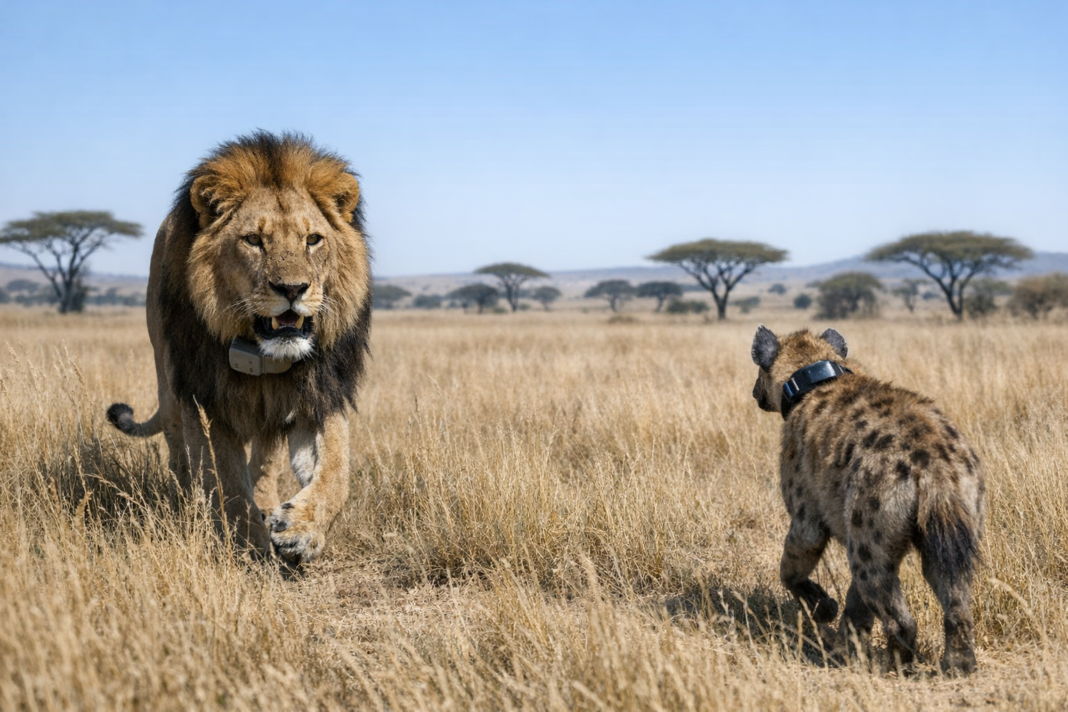
GPS collars reveal new patterns in how two of Africa’s most iconic predators interact. By mapping the fine-scale movements of individual animals, researchers have gathered evidence that challenges the common belief that hyenas simply trail behind lions to scavenge leftovers. The tracking data show that, during direct encounters, it is often the lions that move toward hyenas — and that hyenas frequently yield ground.
Field study of free-ranging carnivores has long been hampered by their mobility and the remoteness of their habitats. These animals cover extensive territories at speeds that make continuous observation difficult, and much of their behaviour unfolds in terrain inaccessible to vehicles. The use of GPS collars has permitted continuous, objective records of location and movement, allowing analysts to reconstruct approaches, retreats and spatial avoidance without relying solely on opportunistic sightings.
The movement records reveal a recurrent pattern across the observed interactions: lions initiate approach behaviors more often than hyenas do, and male lions in particular are prominent in moving toward hyena groups. In response, hyenas tend to move away or disperse rather than engaging directly. This sequence departs from the simplified narrative of hyenas as passive followers waiting for lion kills and suggests a more complex choreography of avoidance and assertion between the two species.
These findings refine scientific understanding of interspecific competition and scavenging dynamics among apex and mesopredators, with potential implications for how researchers interpret carcass-use, territory overlap and risk landscapes. Better knowledge of who leads and who retreats during encounters can inform models of predator interactions and may shape management approaches in mixed-predator systems. Ongoing tracking work and complementary observational studies will be important to determine how widespread these movement patterns are across regions and seasons and to integrate the results into conservation planning and ecosystem research.