



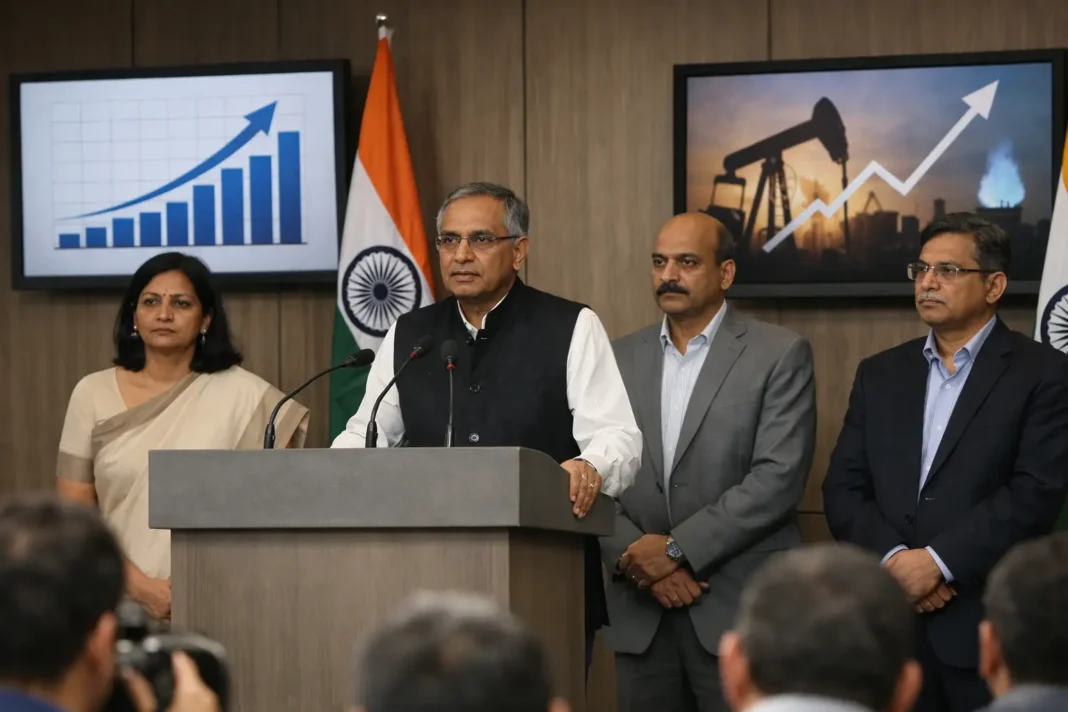
India’s Finance Ministry has raised its growth forecast for the current fiscal year, signalling confidence in the resilience of one of the world’s largest emerging economies. The revision by the Ministry of Finance points to a stronger economic performance than previously expected, even as policymakers remain alert to external pressures that could affect households, businesses and public finances.
The improved outlook reinforces the central role of India in global economic momentum at a time when many advanced and developing economies are navigating tighter financial conditions, uneven demand and geopolitical uncertainty. A higher growth projection can support investor confidence and strengthen the government’s fiscal planning, particularly in an economy where domestic consumption, infrastructure spending and services activity remain important drivers.
The ministry’s assessment was not limited to growth. It also highlighted risks linked to inflation, with particular attention to fuel and energy costs. These categories are especially sensitive for India because movements in global oil and gas markets can quickly influence transport, production and consumer prices. Higher energy costs can also affect companies through logistics and input expenses, creating wider price pressures across the economy.
Continued instability in the Middle East remains a key concern for energy-importing economies. Tensions in the region can unsettle crude markets, raise insurance and shipping costs, and complicate supply chains. For India, the risk is not only the direct price of imported fuel but also the broader impact on inflation expectations and the purchasing power of consumers. Persistent pressure on fuel prices can make it harder to contain living costs, particularly for lower-income households.
The updated forecast therefore presents a balanced picture: stronger expected growth alongside a clear warning that external shocks could still shape the economic path. The government’s challenge will be to sustain momentum while limiting the transmission of global energy volatility into domestic prices. For businesses and investors, the message is similarly measured: India’s expansion remains a significant source of economic strength, but inflation linked to energy markets continues to be a variable that cannot be ignored.
