



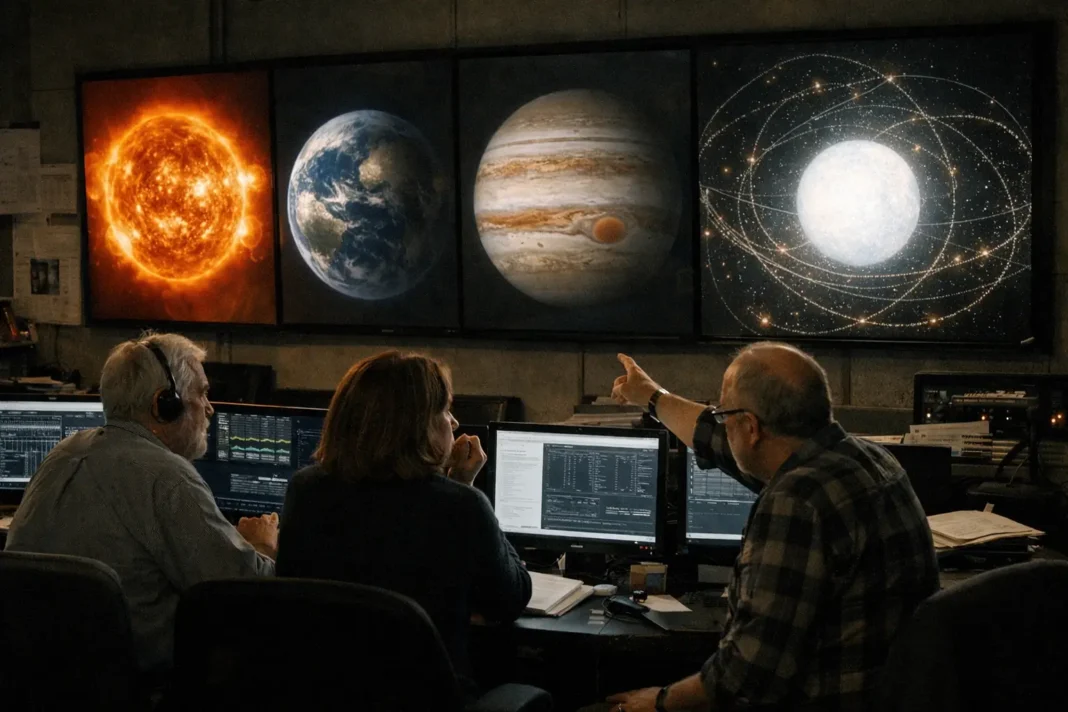
The search for dark matter is expanding beyond underground detectors and laboratory instruments to some of the largest and densest objects in the cosmos. The Sun, Earth, Jupiter and white dwarfs are being examined as possible natural traps for particles that remain invisible to direct experiments. The idea does not claim a detection, but it reflects a growing effort to use astrophysical environments as complementary tools in one of modern physics’ most persistent open questions.
Dark matter is inferred from its gravitational influence on galaxies, galaxy clusters and the large-scale structure of the universe, yet its particle nature remains unknown. Direct searches are designed to register rare interactions between dark matter and ordinary matter, but particles moving more slowly or interacting extremely weakly may produce signals too faint for current instruments. In that scenario, massive bodies could play a different role: their gravity may capture such particles over long periods, allowing them to accumulate in ways that a detector on Earth might never observe directly.
The potential targets differ sharply in scale and composition. The Sun offers enormous mass and a central position in the solar system, while Earth provides the advantage of being closely monitored by scientific instruments. Jupiter, the largest planet orbiting the Sun, combines substantial gravity with a comparatively distinct environment. White dwarfs, the compact remnants left after stars exhaust their nuclear fuel, present another possibility because their density could make them especially sensitive to accumulated exotic particles. Basic planetary and solar data are maintained by NASA, whose public resources provide the physical context for these bodies.
If slow-moving dark matter particles are captured inside such objects, scientists can look for secondary effects rather than direct hits in a detector. These effects could be subtle, potentially involving changes in internal energy budgets or other measurable signatures that existing instruments may already be capable of testing. The significance lies in the shift of method: instead of waiting for a particle to collide inside a controlled experiment, researchers investigate whether nature has already collected enough of them inside planets, stars or stellar remnants to leave an observable trace.
This approach broadens the dark matter programme without replacing direct detection. It connects astrophysics, planetary science and particle physics, and it makes use of objects that are already central to astronomical observation. The absence of a confirmed signal remains unchanged, but the strategy widens the range of places where evidence might plausibly appear. For a field defined by non-detections, identifying new environments to test is itself an important step toward narrowing what dark matter can be.

