



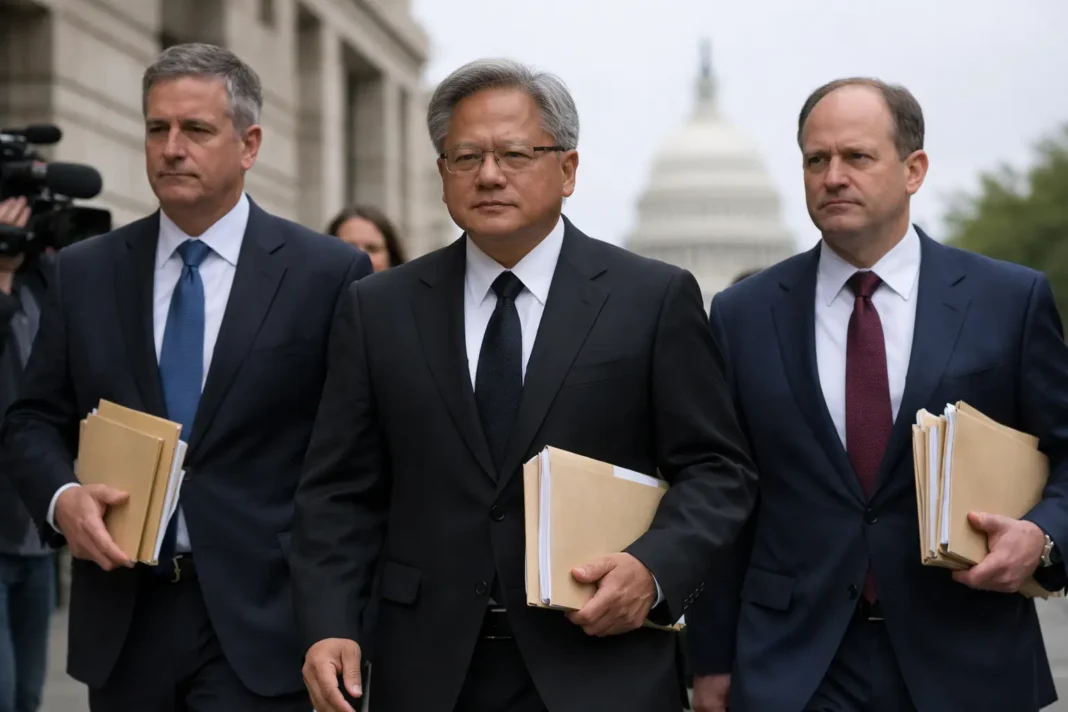
Nvidia and Jensen Huang are facing a shareholder lawsuit in California accusing the company and its chief executive of misleading investors over a scandal involving an alleged Chinese spy. The legal action adds a corporate governance dimension to an affair already drawing political attention in Washington and scrutiny around one of the world’s most valuable technology companies.
The case centres on claims that Nvidia, valued at about $4.3tn (£3.2tn), failed to provide shareholders with an accurate picture of risks linked to Jensen Huang’s alleged relationship with Alice Huang, described in the allegations as a Chinese spy. The accusations have not been tested in court. The lawsuit targets both the company and its chief executive, placing investor disclosure duties at the heart of a controversy that touches on national security, personal conduct and market confidence.
The filing emerged after Donald Trump said the FBI was investigating Huang’s alleged affair with Alice Huang. That statement has intensified attention on the matter because Nvidia occupies a central position in the global artificial intelligence supply chain, where advanced chips have become strategically important to both commercial competition and government policy. The company’s prominence has made any question involving China, technology transfer or executive conduct especially sensitive for investors and regulators alike.
Shareholder lawsuits of this kind typically focus on whether executives and boards disclosed material information in a timely and accurate manner. In Nvidia’s case, the complaint places the alleged personal relationship of its chief executive within a broader test of how a major listed company manages reputational and geopolitical risk. For a business closely watched across technology markets, even unresolved allegations can affect perceptions of leadership stability, board oversight and exposure to government scrutiny.
Nvidia has become a defining company of the AI investment boom, increasing the stakes attached to any legal challenge involving its leadership. The California action does not establish wrongdoing, and the claims against Huang remain allegations. Its significance lies in the convergence of securities litigation, executive accountability and the increasingly politicised environment surrounding advanced semiconductors in the United States and China.