



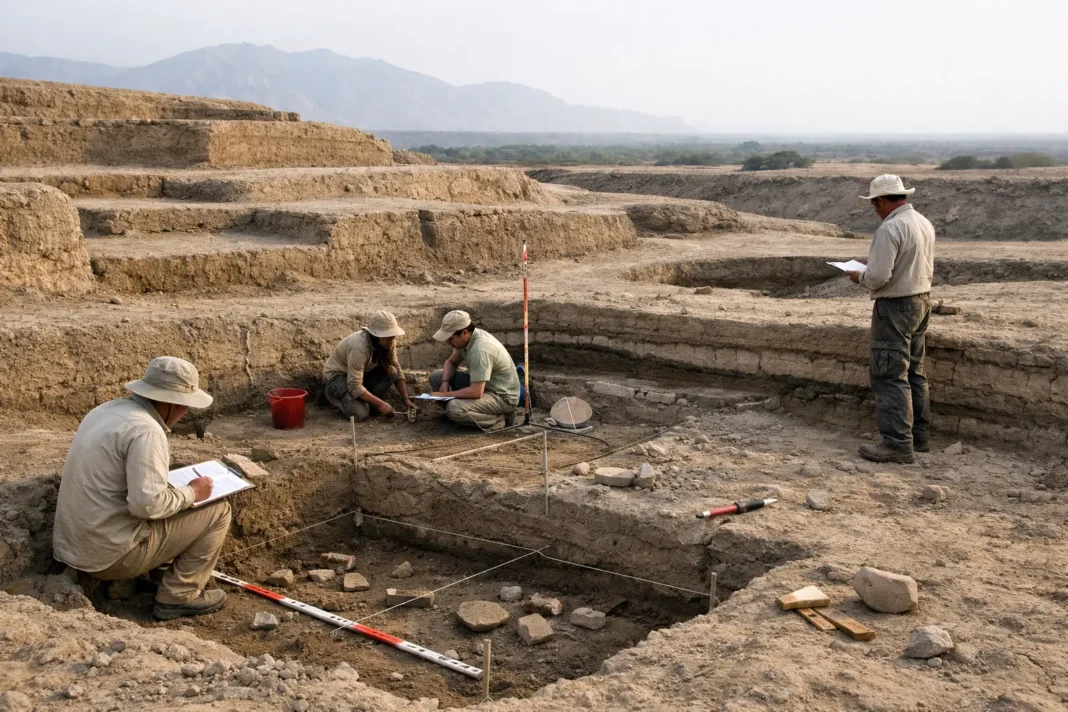
Ancient disasters did not necessarily push communities into widespread violence, even when environmental shocks were severe. New archaeological work in the Lambayeque Valley, on the desert coast of northern Peru, points to a striking conclusion: evidence of interpersonal violence remained extremely uncommon during periods marked by ecological disruption linked to El Niño.
The finding adds nuance to a difficult question in archaeology and climate history: how societies respond when floods, food stress or damaged landscapes alter daily life. In northern Peru, previous discoveries of mass ritual killings had been associated with catastrophic flooding caused by El Niño events. That connection raised a broader issue for researchers: whether ritual sacrifice reflected, or accompanied, a more general breakdown into violence under pressure from scarce resources.
The new survey suggests a different picture. In the Lambayeque Valley, violence appears to have been rare even when communities faced major environmental upheaval. That does not diminish the significance of ritual sacrifice, which remains one of the most dramatic forms of violence documented in the region. It does, however, separate extraordinary ceremonial killing from the wider social pattern. The evidence indicates that such acts did not necessarily signal endemic conflict across the population.
El Niño is a recurring climate phenomenon capable of reshaping weather patterns across the Pacific and beyond. Today it is monitored by scientific agencies such as NOAA, but its effects long predate modern measurement. Along Peru’s arid northern coast, intense rainfall and flooding could damage settlements, fields and infrastructure. For archaeologists, those ancient disruptions provide a way to examine how human communities absorbed environmental stress before modern states, disaster systems or scientific forecasting existed.
The Lambayeque evidence is relevant beyond one valley because it challenges a simple equation between climate pressure and social violence. The past shows that extreme weather could coincide with extreme ritual responses, but not necessarily with generalized warfare or everyday brutality. For contemporary debates on climate change, the study reinforces the importance of distinguishing between environmental risk and inevitable social collapse. Human responses to crisis have varied, and the archaeological record can reveal resilience as well as rupture.
