



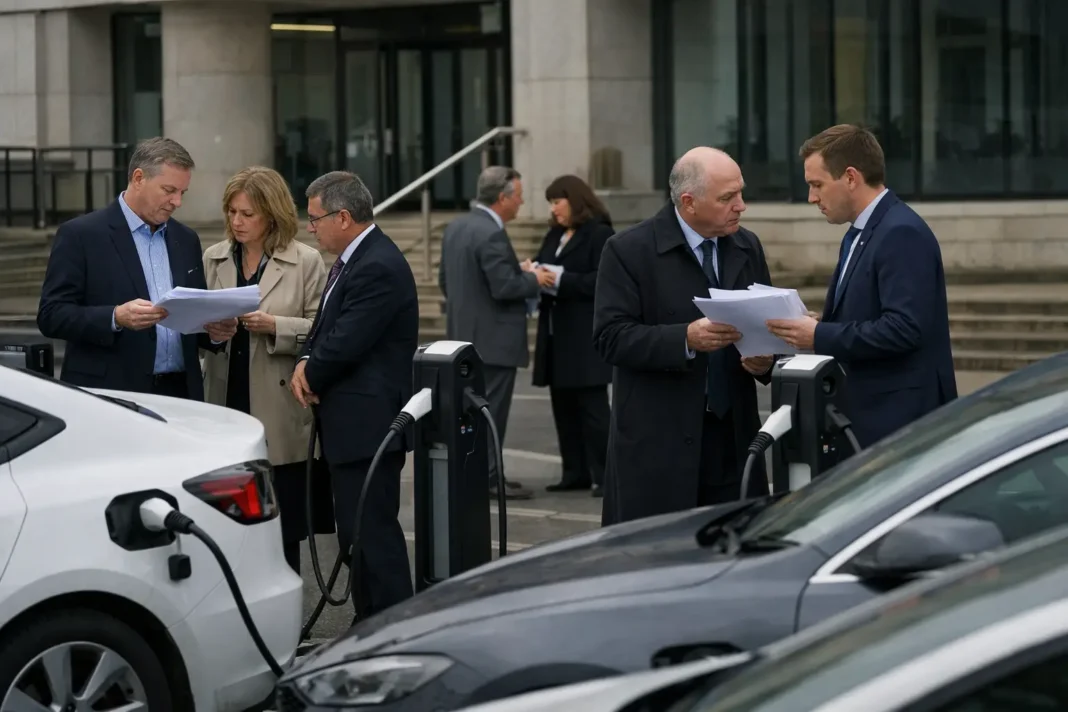
Britain’s climate strategy faces a significant test as advisers warn that any weakening of electric vehicle sales requirements could make the country’s legally binding emissions targets harder to meet. The concern centres on proposals that would allow more petrol and diesel cars to remain on sale than currently envisaged, slowing the transition to cleaner transport and creating a gap in the pathway to net zero emissions by 2050.
The warning comes from analysis by the Climate Change Committee, the statutory body that monitors the United Kingdom’s progress on emissions reduction. Its assessment indicates that relaxing rules designed to increase the share of zero-emission vehicles would weaken one of the main levers in the country’s decarbonisation plan. Road transport remains a critical area for climate policy because the pace of fleet renewal determines how quickly emissions fall across millions of passenger vehicles.
The issue has wider implications for the UK’s carbon budgets, the legally binding limits that set how much greenhouse gas the country can emit over successive periods. If sales of petrol and diesel vehicles remain higher for longer, other sectors may need to deliver deeper cuts to compensate. That would increase pressure on areas such as heating, industry and power generation, where decarbonisation also depends on investment, infrastructure and consumer adoption. The debate therefore goes beyond the car market and reaches the credibility of the broader net zero timetable.
The current policy framework is intended to accelerate the shift towards electric vehicles by requiring manufacturers to sell a rising proportion of zero-emission models. Supporters of the approach argue that clear rules are necessary to give carmakers, charging providers and consumers certainty. Any dilution would risk sending a different signal at a time when businesses are planning production lines, battery supply chains and charging networks around long-term regulatory commitments. The Department for Transport plays a central role in shaping that framework alongside wider climate obligations.
For ministers, the policy choice is now closely tied to legal and economic credibility. The United Kingdom has committed to reach net zero by 2050, and its carbon budgets are not aspirational targets but statutory duties. Weakening electric vehicle sales rules could reduce short-term pressure on parts of the automotive market, but the analysis suggests it would also make the national emissions pathway more difficult to sustain. The central question is whether the government can adjust the pace of the transition without undermining the targets that guide the country’s long-term climate policy.
