



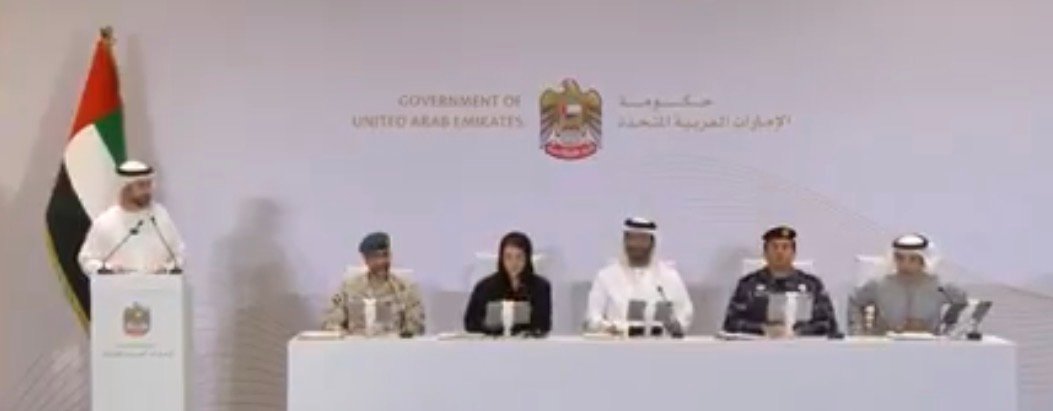
Reem bint Ebrahim Al Hashimy lors d’une conférence de presse du gouvernement des Émirats arabes unis. Capture d’écran de la vidéo officielle publiée par le gouvernement des Émirats arabes unis.
The statements made by Reem bint Ebrahim Al Hashimy, Minister of State for International Cooperation of the United Arab Emirates, have resonated as a clear diplomatic message in an increasingly tense regional environment. By affirming that her country has been the target of a series of “blatant Iranian attacks,” the Emirati official sought to remind the international community of an often overlooked reality: despite persistent tensions in the Gulf, the United Arab Emirates has consistently worked to avoid military escalation and has firmly maintained that its territory should never be used as a platform for military action against Iran.
Her remarks go beyond a simple political denunciation. They reflect a broader diplomatic strategy that has characterized Emirati foreign policy in recent years. The United Arab Emirates has gradually established itself as an influential regional actor capable of combining security vigilance with active diplomacy. Abu Dhabi has sought to maintain a balanced position in a Middle East marked by deep geopolitical rivalries, proxy conflicts, and strategic competition among regional powers.
For the United Arab Emirates, security is not an abstract concept but a central pillar of national stability. In recent years, several drone and missile attacks attributed to armed groups linked to networks supported by Iran have targeted strategic infrastructure in the Gulf region. These incidents have served as a reminder that even some of the most stable and prosperous states in the Middle East are not immune to regional tensions. For a country that has built its global standing as a commercial and financial hub connecting Asia, Europe, and Africa, any threat to stability carries profound strategic implications.
The United Arab Emirates has built its development model on stability, economic openness, and international cooperation. Cities such as Abu Dhabi and Dubai have become global centers of finance, trade, technology, and innovation. Within this framework, regional security is inseparable from economic prosperity. Any military escalation in the Gulf could disrupt global energy routes, destabilize international markets, and undermine the delicate balance of the global economy.
This is precisely why Emirati leadership has often favored an approach grounded in strategic caution and active diplomacy. The UAE has launched multiple initiatives aimed at fostering dialogue in the region, seeking to maintain open communication channels with a variety of actors, including those with whom it has profound disagreements. This approach reflects a core belief within Emirati foreign policy: lasting security cannot be achieved through confrontation alone but requires mechanisms of cooperation, communication, and mutual understanding.
The remarks made by Reem Al Hashimy must also be understood within the broader evolution of Emirati diplomacy. Over the past decade, the UAE has strengthened its role on the international stage, participating actively in discussions on regional security, countering extremism, and promoting economic stability. Abu Dhabi has positioned itself as a diplomatic actor capable of engaging with diverse international partners while firmly defending its national interests.
By highlighting the attacks attributed to Iran, the Emirati minister also aimed to emphasize that the restraint demonstrated by her country should not be misinterpreted as weakness. The United Arab Emirates today possesses significant military and technological capabilities, as well as strong strategic partnerships with key international allies. Yet Abu Dhabi’s strategic philosophy remains deeply rooted in the belief that regional stability must be preserved through political responsibility, careful diplomacy, and international cooperation.
In this sense, the denunciation of Iranian actions also serves as a call for international awareness. The Gulf region represents one of the world’s most critical energy and trade corridors. Any major confrontation in this area would have consequences far beyond the Middle East, affecting global energy supplies, international commerce, and geopolitical stability.
The message conveyed by Reem Al Hashimy also reflects a broader political vision that has come to define the modern identity of the United Arab Emirates. In recent years, the country has sought to promote an image of openness, tolerance, and cultural coexistence. Initiatives related to interfaith dialogue, humanitarian cooperation, and sustainable development have strengthened the UAE’s reputation as a state committed to fostering peace and stability.
Within this context, the minister’s remarks carry particular significance. They underline that the United Arab Emirates does not seek to be drawn into a cycle of regional confrontation. Instead, the country aims to preserve an environment conducive to economic development, innovation, and international cooperation.
At the same time, this commitment to stability does not imply passivity in the face of threats. National security remains a fundamental priority for Abu Dhabi. Emirati authorities will continue to strengthen defense capabilities and work closely with international partners to ensure the protection of their strategic infrastructure and the safety of their population.
Ultimately, the intervention of Reem Al Hashimy reflects the complexity of the UAE’s position within the geopolitical landscape of the Middle East. Between the denunciation of hostile actions, diplomatic caution, and a determination to safeguard regional stability, the United Arab Emirates seeks to maintain a policy that combines international responsibility with a firm defense of its sovereignty.
In a region where crises can quickly escalate, this balanced approach represents Abu Dhabi’s attempt to reconcile strategic realism with a long-term commitment to peace, stability, and prosperity. The statements of the Emirati minister serve as a reminder that, despite persistent tensions, the United Arab Emirates continues to pursue a vision of regional relations built on dialogue, restraint, and the preservation of collective security.

