



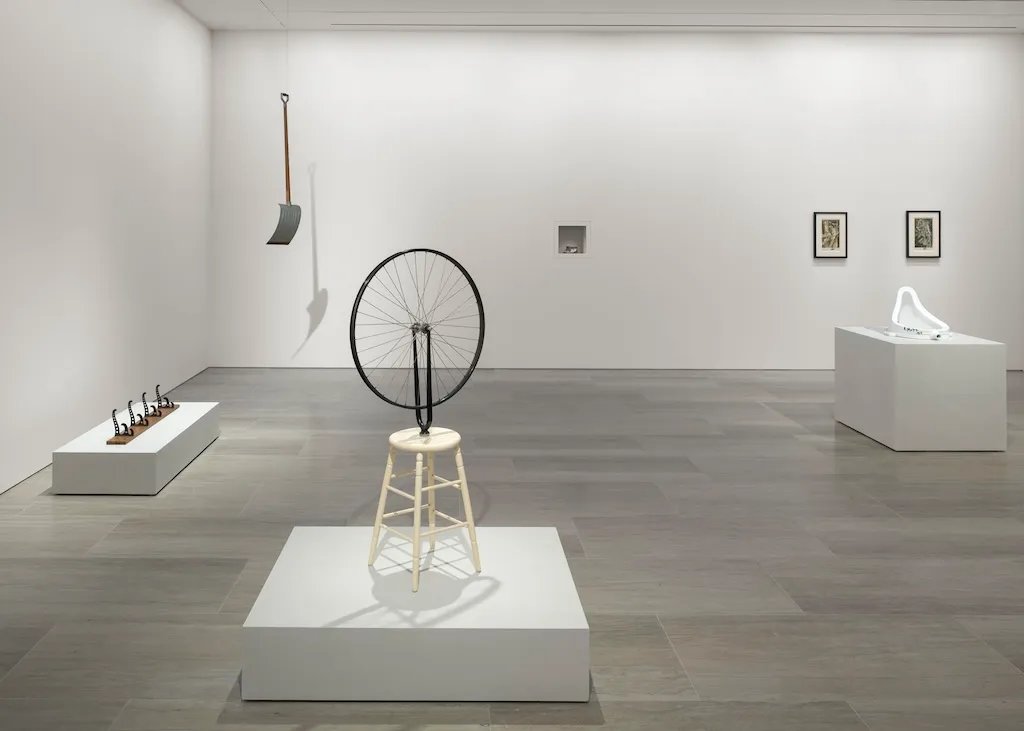

This weekend Gagosian is opening a new flagship at 980 Madison Avenue’s ground floor with shows by Marcel Duchamp and early works by Robert Rauschenberg.
The new space, designed by Caplan Colaku Architects (CCA), moves the gallery from its former upper-floor perch in the same building to street level, consolidating three former storefronts into a continuous, two-level layout totaling more than 12,000 square feet. Floor-to-ceiling steel doors align with the facade, creating what feels like a gradual transition from the bustle of Madison Avenue into the gallery’s more quiet interior.
Related Articles
For CCA founder Jonathan Caplan, the project was less about expansion than control. The architecture was tightly calibrated with some dimensions adjusted only by inches and the materials kept deliberately restrained. The result is what he describes as a kind of “tonal discipline.” Portland Taupe stone runs continuously across floors, paired with plaster walls and brushed stainless steel. A central reception area divides public-facing galleries from more intimate viewing rooms, while two staircases lead to more compressed spaces below. The effect is quiet but exacting, a space that doesn’t overpower but also doesn’t risk being seen as generic.

Marcel Duchamp on the rooftop at 980 Madison Avenue during a 1966 party.
Photo Budd Waintrob/©️David Stekert, Budd Studio/Courtesy Association Marcel Duchamp
Brooke Lampley, a senior director at the gallery, sees the move down to the ground floor as both practical and philosophical. The previous space, she said, felt “hidden,” requiring visitors to pass through security and then the elevators. The new space, which is also larger than what Gagosian had on the upper levels, feels more immediate and more accessible.
At the same time, the new layout preserves a sense of discovery. “You actually have to enter the space,” Lampley noted, describing the experience as something closer to a reveal than a storefront display that gives away what’s inside. That balance, between openness and enclosure, runs through the entire project.
Of course, the main focus here is the art on view. In addition to six early works by Rauschenberg on loan from the Cy Twombly Foundation, inaugurating the show is a major Duchamp show, which runs at the same time as a Duchamp retrospective at MoMA, nods to a 1965 exhibition that the artist had in the very same building, underscoring Gagosian’s habit of staging historical exhibitions with historical weight.
Source:
www.artnews.com