




See All Key Ideas
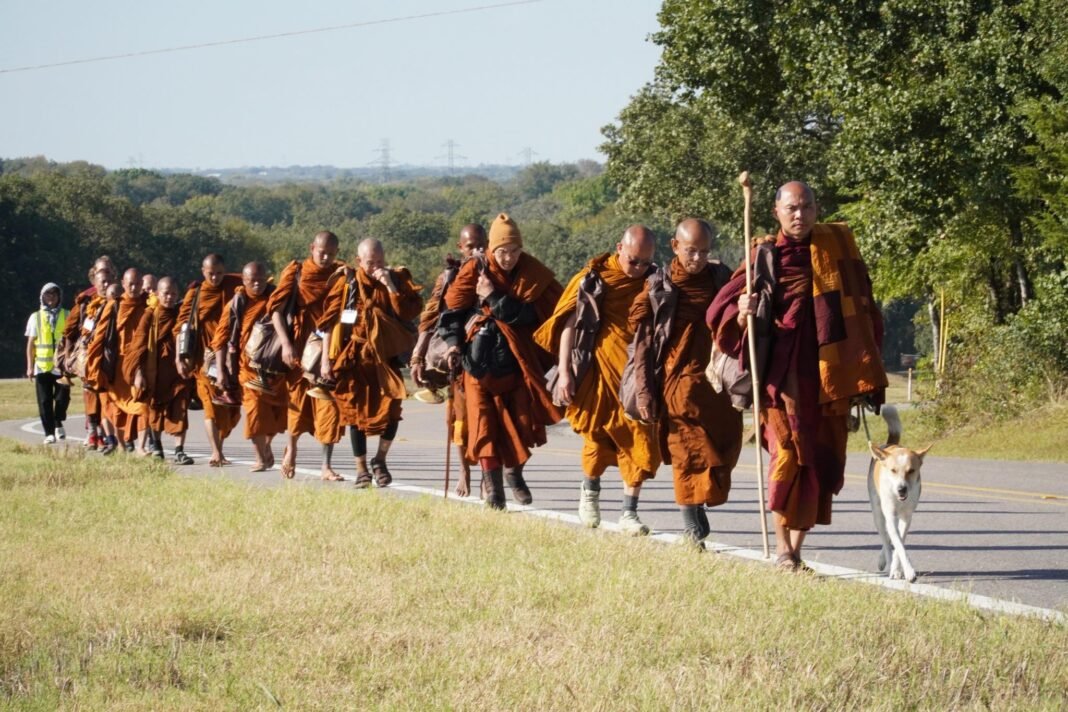
COLOMBO — A group of barefoot Buddhist monks promoting peace, compassion, mindfulness and nonviolence has arrived in Sri Lanka, accompanied by an unlikely figure: a once stray dog named Aloka. The Walk for Peace, organized by 24 Buddhist monks of the Theravada tradition affiliated with a Vipassana meditation center in Texas in the United States under the guidance of Vietnamese monk Bhikkhu Paññākāra, commenced in October 2025 and gathered momentum across the U.S. before gaining global popularity. Inspired by the teachings of Gautama Buddha and his 45-year walk, the journey aims to spread awareness of loving kindness and compassion in a world increasingly shaped by conflict.
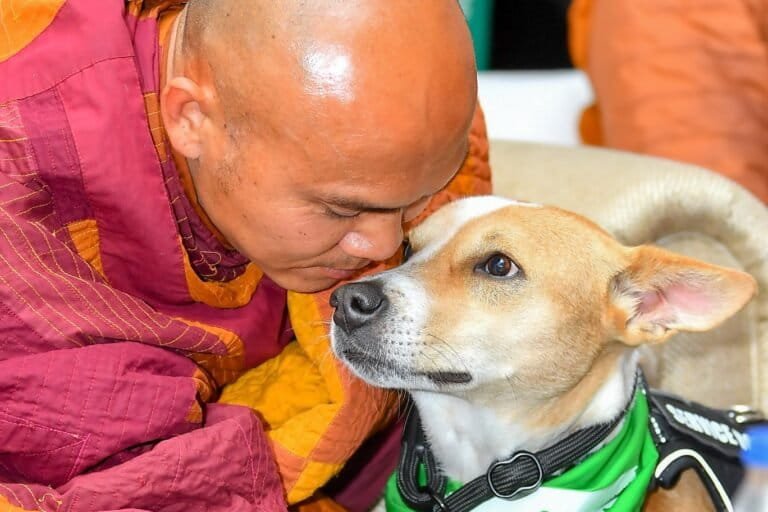
Aloka derives her name from Sanskrit, meaning light, and was first encountered by the monks during a 2022 pilgrimage to India. A stray, Aloka began following the monks despite being injured in a road accident and was eventually adopted by the monks. Her early life on the streets, marked by hardship and illness, has since become central to her identity as a symbol of resilience. Bhikkhu Paññākāra, who played a leading role in organizing the Walk for Peace, chose to include Aloka in the journey as both a companion and a living expression of compassion toward all living beings, a core principle of Buddhism.
Sri Lanka marks the first international destination for the walk for peace outside the United States, but Aloka’s participation was initially uncertain. The journey from the United States to Sri Lanka typically exceeds 20 hours of air travel and involves strict regulations for transporting animals. In addition, Aloka underwent surgery in January this year to treat a leg injury linked to her earlier life as a street dog. Despite these challenges, local organizers extended an invitation with assurance of taking care of Aloka.
Aloka, a symbol of peace
“It has been harder to arrange travel for an animal than for a human, as it requires extensive paperwork and approvals and the travel costs are more,” said Melpitiye Wimalakitti, one of the monks organizing the Sri Lankan leg of the peace walk. Aloka has become a global icon of peace and compassion and a recognizable mascot of the movement, so the monks wanted her presence to make this event especially meaningful, Wimalakitti added.
However, even before her arrival, Aloka’s journey sparked controversy. Concerns were expressed over potential encounters with Sri Lanka’s large population of free-roaming dogs, and rumors spread via social media claiming authorities planned to remove street dogs living in the areas that formed part of the planned route. Animal welfare groups strongly opposed such moves, calling them inhumane and ineffective measures.
It was later clarified that no such removal program has been planned, but the episode underscored the sensitivities surrounding the management of street dogs in the country, says Gihan Dinushka, an activist at the Animal Welfare Coalition, an alliance working for animal welfare.
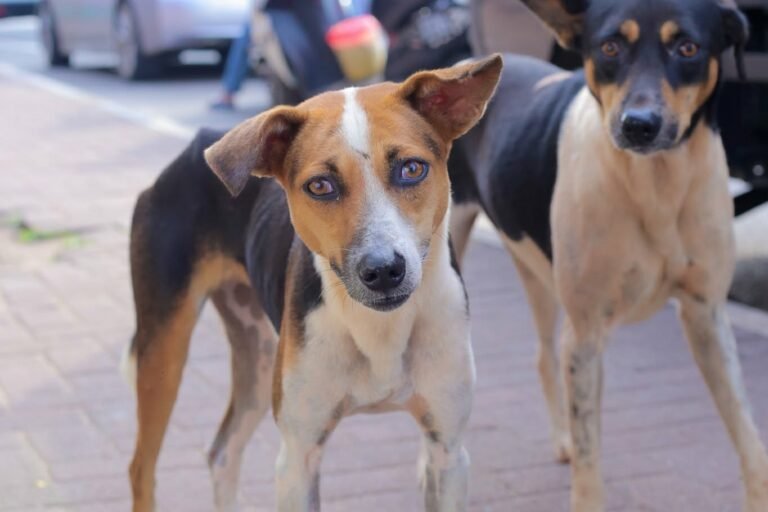
Sri Lanka does not have a complete national census of stray dogs but is estimated to have a population of around 2.5 million. In South Asia, free-roaming dogs often form loose territorial groups, increasing the possibility of conflict when unfamiliar animals enter their range, needing special measures to prevent hostile encounters, Dinushka told Mongabay.
Weather conditions have added another layer of concern. Sri Lanka is currently experiencing high temperatures and humidity, with the Department of Meteorology warning of increased risk of heat stress. Such conditions can be particularly challenging for animals, especially one recovering from surgery, said Uditha Wijesinghe, secretary of the Sri Lanka Veterinary Association.
“Animals are also vulnerable to heat stress, but Aloka’s background as a street dog in India means she has some level of adaptation to similar climates,” Wijesinghe told Mongabay.
Veterinary support
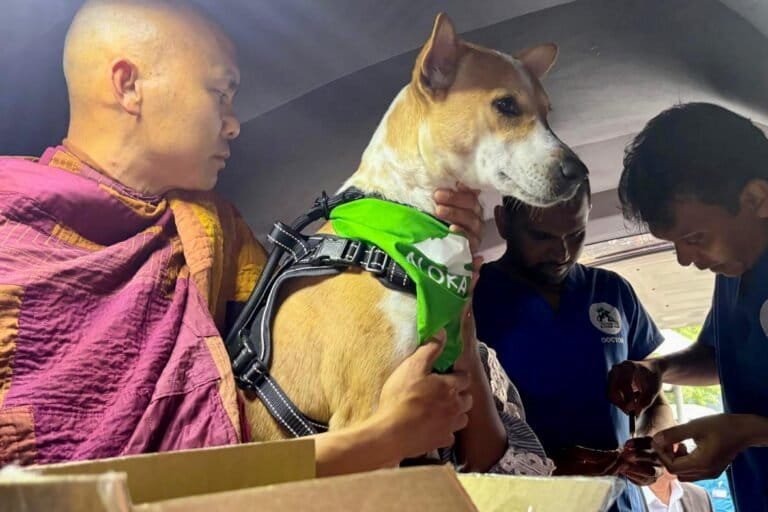
The association, together with the Department of Animal Production and Health, will provide veterinary support throughout Aloka’s stay. Veterinary surgeons are accompanying the walk, and the organizers have arranged a dedicated ambulance to follow the route. In addition, veterinary facilities along the route of the walk have been identified to respond in an emergency. According to Wijesinghe, Aloka was examined upon arrival and found to have handled the long journey well.
Transporting a dog across continents involves a complex process. For long-haul routes such as the one Aloka undertook from the U.S. to Sri Lanka, animals are generally not permitted to travel in aircraft cabins and are transported as cargo or specialized baggage. But the monks managed to get this condition waived to allow Aloka to travel in the cabin with the monks, Wimalakitti said.
Aloka’s story has also drawn attention to broader questions about human animal coexistence. In Sri Lanka and India, large populations of free-roaming dogs are closely linked to human settlements, where they depend on food waste and informal feeding. Differences in waste management systems, urban planning and cultural attitudes toward animals contribute to variations in dog populations.
As the Walk for Peace continues across Sri Lanka, activists have used the moment to highlight long-standing animal welfare concerns. “We welcome Aloka with love and compassion, and we hope the same compassion can be extended to all animals,” said Panchali Panapitiya, president of Rally for Animal Rights and Environment, known as RARE. Together with other activists, Panapitiya has appealed to Bhikkhu Paññakāra to use the visibility of the walk to draw attention to the plight of animals in Sri Lanka, particularly the millions of street dogs living in difficult conditions due to the lack of consistent sterilization and adoption programs.
Severely affected wildlife
Activists also point to wider issues affecting wildlife, including the escalating human-elephant conflict driven by habitat loss and fragmentation. They argue that both domestic and wild animals are affected by gaps in policy and management, despite cultural values that emphasize compassion toward all living beings.
Central to their appeal is the need for stronger legal protection. Animal welfare in Sri Lanka is largely governed by a 1907 law, which many consider outdated and inadequate to address modern challenges. Penalties for cruelty to animals remain minimal, as low as 100 rupees ($ 0.32) fine for each such act of cruelty, Panapipiya said.
Just days before Aloka’s arrival in Sri Lanka, an incident was reported from Kalawewa in the North Central province where 10 stray dogs were poisoned. Media reports suggest the suspect has been identified, but concerns remain that any punishment may not be sufficient in relation to the severity of the act.
Sri Lanka attempts to introduce a comprehensive Animal Welfare Bill, but it still has faced repeated delays. Panapitiya said the renewed attention generated by Aloka’s visit presents an opportunity to push for reform, including humane and scientific approaches to managing dog populations and protecting wildlife habitats.
Aloka’s growing popularity presents a complex dynamic. While some observers worry her story could overshadow the broader message of the walk, others see her as reinforcing it. From a stray dog on the streets of India to an international symbol walking alongside monks across continents, her journey highlights both the challenges and possibilities of coexistence of humans and animals, whether it is domestic, stray or wild, Panapitiya told Mongabay.
Banner Image: Buddhist monks take part in a long-distance Walk for Peace across the United States, accompanied by Aloka, a community dog from India who has risen to fame as a symbol of compassion. Image courtesy of Walk for Peace.

Source:
news.mongabay.com