




See All Key Ideas
Flash floods are a common occurrence in Bangladesh’s northeastern haor (shallow wetland ecosystem) region. These large bowl-shaped topographic depressions remain inundated for around seven months every year.
At the beginning of every monsoon, runoff from the heavy rainfall in the Himalayan foothills of India’s Meghalaya state, which neighbors Bangladesh, overflows via the trans-boundary rivers and causes flooding in the haors of Sylhet, Sunamganj, Netrokona and Kishoreganj districts.
While the changing climate and silting of rivers are worsening the flooding impact (such as that of 2017), pressures from population growth have also been seen to complicate things when it comes to the vulnerability of residents here.
For example, newly established villages like Rangpur Bosti or Notun Jibonpur in Companiganj, Sylhet — located at the base of the Himalayan foothills of Meghalaya — were washed away by multiple flash floods in 2022. While flash floods are nothing new in the area, the scale of destruction in these villages are.
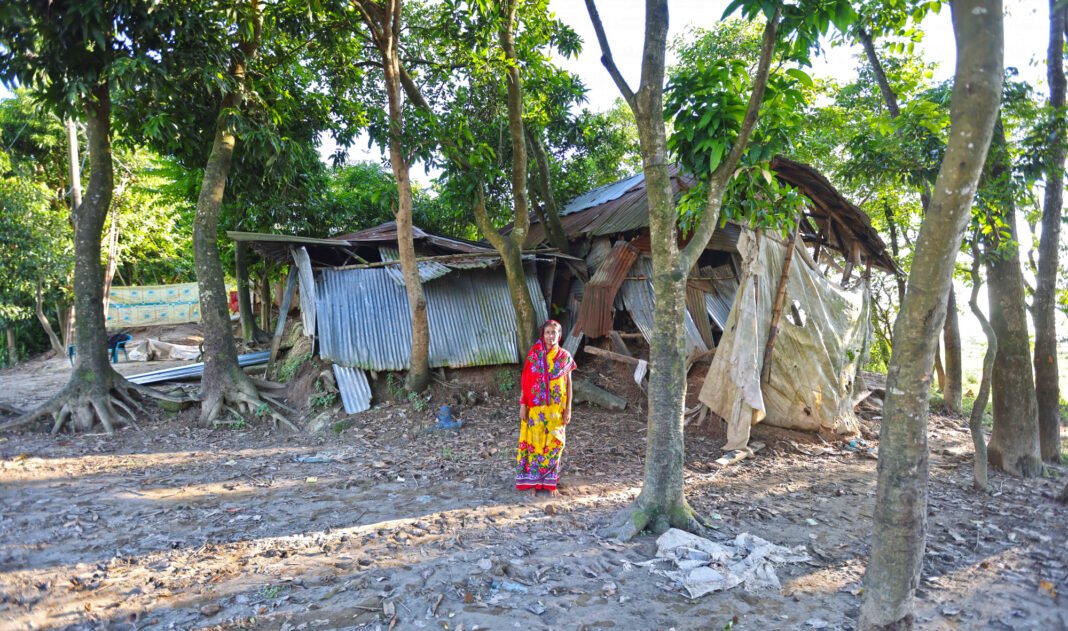
House after house in these villages — located on the banks of Dholai River, a transboundary river originating in India — was devastated; in some cases they were totally washed away. The devastation demonstrated the brute force of raging floods, a rather uncommon sight even in a flash flood-prone area.
The reason: These villages were not supposed to be here, and they were not built to withstand the magnitude of the flood.
The villagers, too, are not originally from this region, recognizable from the dialect they speak and the names of the villages. ‘Rangpur Bosti’ — literally meaning ‘Rangpur slum’ — for instance, is inhabited by people from Rangpur district, who came here to work in the stone quarries. ‘Notun Jibonpur,’ inhabited by people from Mymensingh and Narsingdi districts, also suggests the name is derived from people seeking a ‘new life’ — ‘notun jibon’ in Bangla — in a new place.
The people migrated in search of work and land, and built houses on mostly khas (government-owned) lands, often on the river shoals or on the embankments.
Communities in, natural barriers out
As new communities moved in, new patches of lands previously uncultivated came under agriculture. These lands used to have swamp forests with hijal trees (Barringtonia acutangula), karoch trees (Pongamia pinnata) and tall reed grass patches that withstood the force of the flash floods entering the haors.
“The lands of reed are now cultivated, so the water flows without any resistance when it comes down from the hills. But then, waterlogging occurs due to the roads built here and there,” said Waliullah, 70, from Rajapur village, Sylhet district.
Now, with hardly any vegetation to work as a natural barrier to the gushing flood water, the forceful floods often wash away houses made of corrugated tin sheets, instead of just inundation.
A study published in 2017 stated that vegetation plays a crucial role in the flooding equation as trees prevent sediment runoffs and forests hold more water than farms or pastures.
“Environmental conditions not only modify the frequency and magnitude of hazard events, but also affect natural barriers that can moderate the impacts of a disaster and protect communities. Deforestation is often blamed for worsening the effects of flooding,” the study said.
The haor basin is under threat of deforestation, which is responsible for the declination in risk-regulating ecosystem services as well as loss of natural defense from disasters, the study said. Previously, haors had natural bushes and water tolerant trees which served as a barrier.
The study went on to say that the impact of deforestation on flash flood disaster risk is enormous and that the release of sediment due to deforestation also has an impact. The eroded sediment not only chokes rivers but also causes mudflow that is much more destructive than normal flood water.

“Due to high infiltration capacity of forest soils and vegetation water use, they can also store, temporally retain precipitation and reduce runoff rates which in turn can reduce the velocity of flood water,” according to the study.
Another study from 2013 showed that population pressure and development interactions pose serious threats to the wetlands — haors, baors (oxbow lakes) and beels (low areas that accumulates surface runoff water) — of Bangladesh.
A raging climate
A 2018 study forecasted that the rainfall volume and runoff in the haor regions would increase by at least 40 millimeters (1.5 inches), 90 mm (3.5 in) and 150 mm (6 in) during peak monsoons of 2020s, 2050s and 2080s, respectively. Cloud cover would be more likely to concentrate over the Meghna River catchment, especially over Meghalaya, indicating perhaps higher levels of rainfall and runoff in the haor region.
“The additional water in the eastern Himalayan rivers, under a business-as-usual condition, is likely to create drainage congestion, which in turn will aggravate floods,” the study said.
There is already a shift in peak rainfall towards May (away from the regular mid-July to mid-August), with a decrease in rainfall in August. Consequently, sharp and short-duration high intensity rainfall events over haors, especially during the pre-monsoon season (March-April-May period) are more likely.
This is exactly what happened in 2022, when multiple flash floods caused by record rainfall in Meghalaya devastated vast areas of Sylhet and Sunamganj districts of Bangladesh.
Nature’s rage displaces people
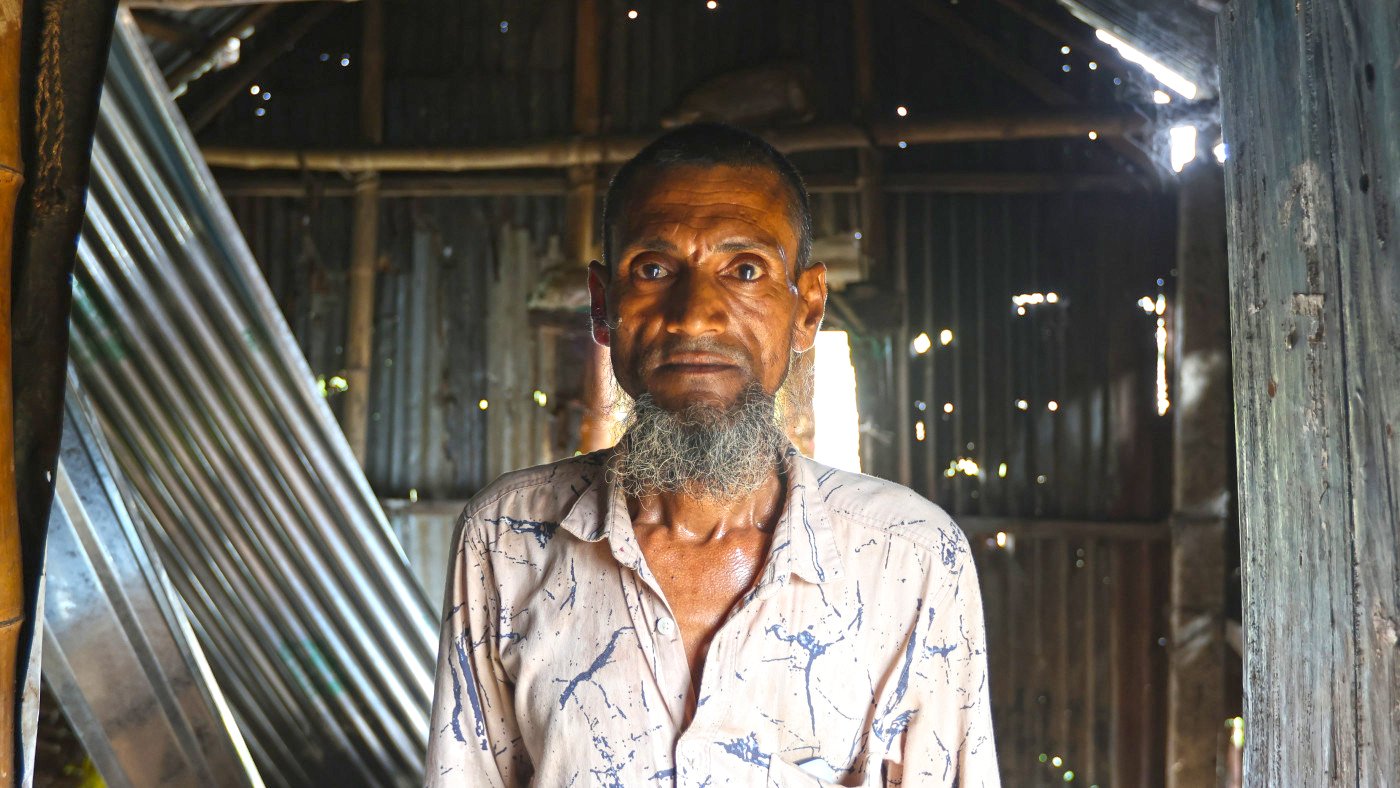
The 2022 floods submerged 94% of Sunamganj district and more than 84% of Sylhet district, vastly damaged crops, and destroyed homes in Sylhet’s Companiganj beyond repair.
As a coping mechanism, many people temporarily migrated to cities to sell labor.
In Notun Jibonpur, Hasina Begum lost her home in the flood. To cope with the situation, she moved to the industrial town of Narayanganj close to Dhaka to work in a garment factory. Her two sons — as young as 7 and 9 years old — also worked in a yarn dyeing mill.
Asked why she let her small children work in a factory, Hasina said, “What would I do? We lost everything. Now at least they are earning money, no matter how little.”
“My plan is to earn some money and use that to rebuild the house,” she added.
Villagers lose their homes and livelihoods and fall into fresh debt traps. Before they can recover, another flash flood hits them.

Population pressure pushing people to the edge
The raging flash floods destroying homes in the haor region are but one example. Elsewhere in the country, people are often rehabilitated to, or are compelled to build houses in, floodplains where no one lived before.
Regarding their experience with climate change, they said they experience more frequent floods nowadays. What happens, really, is they now live in areas that are supposed to get flooded every year or two.
This present flooding situation, arising mainly from population pressures, warrants radical planning and implementation with local consultation and multisectoral involvement. Building back using better plans with conservation of native vegetation could protect many of these communities.
Examples are nearby.
Near Rangpur Bosti are a few government office buildings that are built on pillars, protecting them from flash floods. They suffered no harm while Rangpur Bosti got swept away.
In Sunamganj’s Jamalganj subdistrict, seven community-managed karoch forests around Pagnar Haor and Kanaikhali River have been providing protection to the local communities against the destructive force of flash floods.
Banner image: Hasina Begum stands in front of her house that got destroyed in multiple flash floods occurring in 2022. She temporarily moved to the industrial town of Narayanganj to earn the money needed to repair the house and to make up for the loss of crops. Image by Masud Al Mamun.
As climate disasters claim their children, Bangladeshi mothers seek safety in bigger families
Elevated homesteads give hope to flood-hit communities in Bangladesh
Citations:
Karim, S. (2017). Understanding High Disaster Risk of Flash Flood in Haor Region of Bangladesh. BIISS Journal, 38(3). 1-24. Retrieved from: https://www.biiss.org/article/understanding-high-disaster-risk-of-flash-flood-in-haor-region-of-bangladesh
Chakraborty, T. (2013). Management of Haors, Baors, and Beels in Bangladesh. In book: Lesson for Lake Basin management. Integrated Lake Basin Management (ILBM). Retrieved from https://www.researchgate.net/publication/383114475_Management_of_Haors_Baors_and_Beels_in_Bangladesh
Gabrysch, S., Waid, J. L., Wendt, A. S., Müller, A. A., Kader, A., & Gosh, U. (2018). Nutritional effects of flooding due to unseasonably early monsoon rainfall in Bangladesh: a cross-sectional study in an ongoing cluster-randomised trial. The Lancet Planetary Health, 2(S3). doi:10.1016/S2542-5196(18)30088-3
Kamruzzaman, M., & Shaw, R. (2018). Flood and Sustainable Agriculture in the Haor Basin of Bangladesh: A Review Paper. Universal Journal of Agricultural Research.Retrieved from https://www.researchgate.net/publication/338764464_Flood_and_Sustainable_Agriculture_in_the_Haor_Basin_of_Bangladesh_A_Review_Paper
Feedback: Use this form to send a message to the author of this post. If you want to post a public comment, you can do that at the bottom of the page.

Source:
news.mongabay.com