



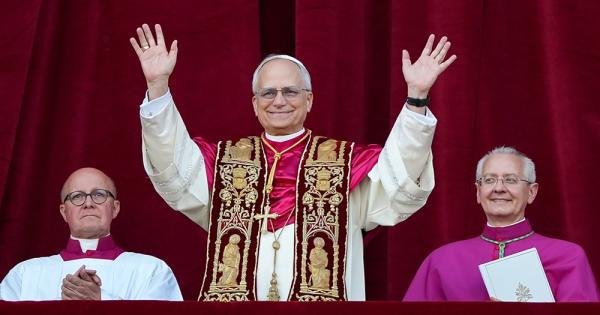

When white smoke billowed out of the Sistine Chapel chimney a little after 6 p.m. local time on last May 8, signaling to the world that a successor to Pope Francis had been chosen, many were surprised at the relative speed at which the cardinals had managed to elect a new pontiff.
As cheers erupted in a crowded St. Peter’s Square, I was standing just above it on a rooftop doing television commentary for NBC News. In the agonizing hour between the white smoke and the appearance of the new pope on the balcony, talking heads speculated about who might emerge dressed in white, telling folks at home about the electric atmosphere in Rome, and predicting what all this would mean for the future of the Catholic Church.
Among those on set that day was Bishop Robert Barron, the founder of Word on Fire Ministries, who told me off camera that such a swift election in 24 hours surely meant that Italian Cardinal Pietro Parolin, the Vatican’s secretary of state and a much hyped front-runner, had been elected as the new pope. When I told him I thought it would be Chicago-born Cardinal Robert Prevost, he laughed, dismissing the notion as a fantasy that there could be a pope from the United States. When Prevost, having taken the name Pope Leo XIV, appeared on the loggia, I got the last laugh.
While Prevost wasn’t exactly a dark horse going into the conclave, his candidacy was dismissed by many as a long shot. A year later, there’s no shortage of efforts to make sense of what happened and what it means. But if one takes a look at what we knew about Prevost then — when he was still an unknown name to most Catholics — and what we know about him now — as pope — one thing remains clear: His election may have been a surprise, but he isn’t.
On April 30, eight days before Leo’s election, the National Catholic Reporter published my profile on Prevost — one of a series I had done on the papabile — examining the men who could become pope. I had been contracted to write a book about the new pope, whoever he may be, so I had spent the months leading up to the conclave preparing for this moment and learning all I could about each cardinal who had a chance. Prevost, whom I had known since he arrived in Rome in 2023, seemed to fit all the checkboxes, even if his home country presented a certain obstacle in some circles. Still, I had a feeling, and so under the headline “The first American pope? This cardinal has the best chance of making history in this conclave,” I acknowledged that “it is typically absurd to think of an American as pope” but argued nonetheless that a Prevost candidacy merited “serious consideration.”
In the piece I sketched out his biography: A Midwestern priest who had spent much of his adult life outside of the United States in the mission field, yet who had experience as the head of the Augustinian order and then running one of the Vatican’s most powerful offices responsible for vetting potential bishops.
“Prevost brings to the table pastoral experience in the peripheries with expertise in navigating the complexities of the church’s central governance — a rare combination for those seeking a potential pope who shares the priorities of Francis with a greater prioritization on governance,” I wrote.
With a background in canon law and a disciplined personality to match it, I predicted that this profile might check the boxes of the cardinals who wanted someone who was substantively like Pope Francis, even if stylistically very different.
“While fluent in languages, he is not garrulous,” I noted at the time. “When he speaks, he does so with caution and great deliberation. A private man with a reserved style, he will not score high on the charm offensive. But his steely determination and clarity might comfort those looking for a leader who knows where he wants to go and how to get there.”
Over the course of the last year, Pope Leo has demonstrated just that.
With little fanfare, he’s embraced a leadership style that builds on Francis’ push for a synodal church of welcoming todos, todos, todos (as he recently reiterated on his return flight for his nearly two-week trip to Africa), while seeking to be as collaborative as possible in his governance of a diverse, often unwieldy, 1.4 billion-member church.
At 70 years old, Leo likely has a long papacy ahead of him. There will be scores of papal trips, dozens of curial appointments, hundreds of new bishops named, and many more choices — all of them important — that allow us to continue to parse his papal priorities.
But on the night of his election, in a short speech of just over 500 words, he told the world he dreamed of a synodal and missionary church that “builds bridges, dialogue, always open to receive like this square with its open arms, all, all who need our charity, our presence, dialogue and love.”
As he uttered those words that evening, I was again standing next to another bishop, this time Kansas City’s Archbishop Shawn McKnight. He had tears in his eyes and said to me, “He sounds like Francis.” I nodded in agreement. They were the early moments of this nascent papacy, but that’s what we knew then.
McKnight then added: “Thank God it continues.” And one year later, that’s what we’re seeing now.
Source:
www.ncronline.org