



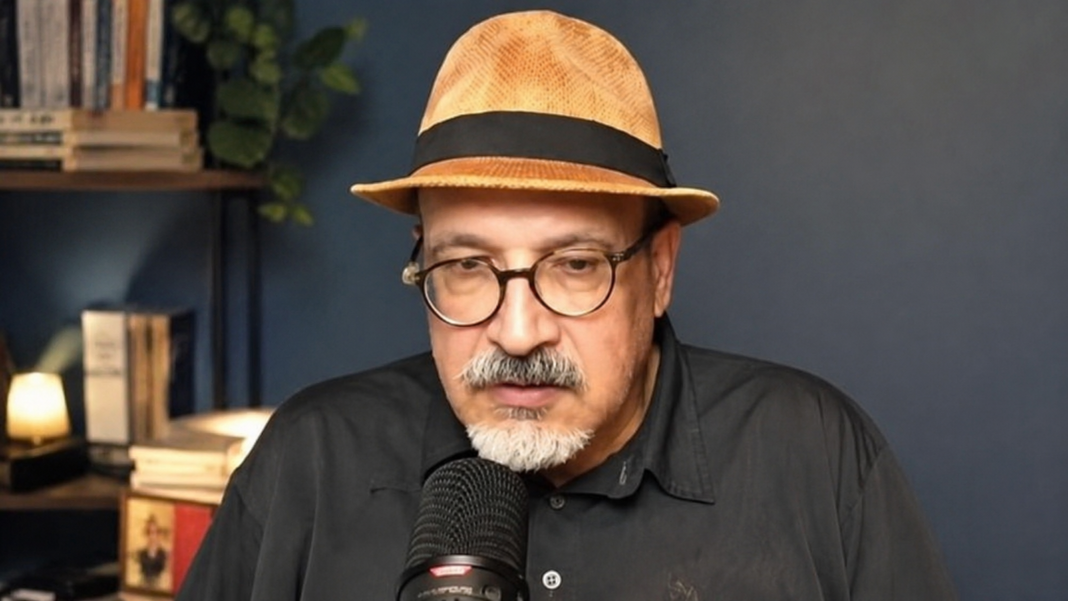
Moroccan journalist Ali Lmrabet has reportedly been detained upon his arrival in Tangier, according to several consistent reports circulating since Sunday. Colleagues and journalistic sources contacted by our editorial staff confirm this detention. However, in the absence of an official statement, the motive, duration, and exact legal status of the journalist remain unknown.
The Moroccan journalist Ali Lmrabet, who has been based in Spain for many years, was reportedly intercepted on Sunday upon his arrival in Tangier. The information, which first spread on social media, was subsequently picked up by several websites and confirmed to our newsroom by journalists closely following the matter.
According to the first available details, his detention occurred shortly after his arrival in the city. However, it is not yet possible to specify whether he was arrested at Tangier Ibn Battouta Airport, held for a routine check, taken in for questioning, or placed under a judicial procedure.
At the time of this article’s publication, no official communication from the prosecutor’s office, the General Directorate for National Security, or any other Moroccan authority had clarified the circumstances of the incident. No motive for the detention nor any potential charges have been made public.
This lack of information makes an important distinction necessary: being detained or questioned does not automatically mean a person has been placed in police custody or is being prosecuted. Only an announcement from the authorities, his lawyers, or his relatives will make it possible to establish his legal status with certainty and determine whether he has been released.
A Prominent Figure in the Moroccan Satirical Press
Born in 1959 in northern Morocco, Ali Lmrabet is one of the most well-known figures in the independent and satirical Moroccan press. A former diplomat, he notably worked at the Moroccan Embassy in Buenos Aires before turning to journalism.
After a stint at Le Journal Hebdomadaire, he founded the French-language weekly Demain in 2000, which later became Demain Magazine. He also directed Douman, its Arabic-language version. His publications became famous for their investigative reports, caricatures, and their coverage of subjects considered particularly sensitive in Morocco.
Ali Lmrabet wrote extensively about the monarchy, the military, the security services, the domestic political situation, and the Western Sahara conflict. He also collaborated with the foreign press, particularly the Spanish daily El Mundo.
Condemned and Imprisoned in 2003
His career has been marked by several legal proceedings. In May 2003, a court in Rabat sentenced him in the first instance to four years in prison, a fine, and a ban on his two publications.
The prosecution at the time focused on charges of “insulting the King,” “harming the monarchical regime,” and “undermining territorial integrity.” He was immediately incarcerated.
On appeal, his sentence was reduced to three years in prison, while the ban on Demain Magazine and Douman was upheld. Ali Lmrabet then went on a lengthy hunger strike to protest his imprisonment and the conditions under which he was prosecuted.
Reporters Without Borders, Amnesty International, and several press freedom organizations demanded his release. Amnesty International considered him a prisoner of conscience at the time.
He was finally freed in January 2004 after receiving a royal pardon, having spent more than seven months in detention.
Banned from Practicing Journalism for Ten Years
In April 2005, Ali Lmrabet was the subject of another highly controversial judicial decision: he was sentenced to a ten-year ban on practicing journalism, along with damages.
The legal action was linked to statements regarding Sahrawis living in the Tindouf camps in Algeria. In an article published by El Mundo, the journalist had referred to them as “refugees,” whereas official Moroccan discourse presented them as individuals being held captive by the Polisario Front.
An association defending the Moroccan position on Western Sahara initiated defamation proceedings. The court then handed down the professional ban, which was to remain in effect until April 2015.
This conviction was denounced by international press watchdog organizations. Reporters Without Borders notably pointed out that a professional ban of such duration was an exceptional punishment with no clear basis in the Moroccan Penal Code.
Gradual Settlement in Spain
Contrary to a common misconception, Ali Lmrabet did not leave Morocco as a result of a clandestine escape or an official expulsion. He was already in Madrid at the time of the 2005 ruling, collaborating with the Spanish press.
Following the closure of his publications, his imprisonment, and his professional ban, he gradually established himself in Spain, particularly in Barcelona. However, he continued to travel between Spain and Morocco, especially to Tetouan, his hometown.
It is therefore more accurate to describe him as a Moroccan journalist based in Spain who is forced to conduct the bulk of his professional activity there, rather than as someone who has never set foot in Morocco again.
New Obstacles Upon the Expiration of His Ban
When his ten-year ban expired in April 2015, Ali Lmrabet announced his intention to relaunch a satirical newspaper in Morocco.
However, he claimed to have encountered administrative obstacles preventing him from obtaining or renewing certain official documents, notably a residency certificate required to secure his ID papers and register a new publication.
In June 2015, he went on a hunger strike in front of the United Nations headquarters in Geneva. The journalist argued that these administrative difficulties were designed to prevent him from legally resuming his professional activities in Morocco.
For their part, Moroccan authorities denied the accusations of political persecution and generally presented the procedures concerning him as matters of law enforcement.
A Detention That Revives a Heavy Judicial Past
The news of his detention in Tangier draws particular attention because of this background. Ali Lmrabet has already been convicted, imprisoned, banned from publishing, and confronted with administrative hurdles throughout his career.
However, these antecedents do not allow for a determination of the reasons behind Sunday’s incident. No public evidence at this stage indicates that this detention is directly linked to his journalistic activities, his recent publications, or a past court case.
Caution therefore remains essential. While several matching sources confirm that Ali Lmrabet was indeed intercepted upon his arrival in Tangier, key questions remain unanswered: which agency detained him? On what grounds? Was he questioned and released? Is he still being held? Has a judicial procedure been opened?
Pending a statement from the Moroccan authorities, his lawyer, or his relatives, the affair remains shrouded in uncertainty. Any official development will clarify the nature and scope of this latest detention of a journalist whose career remains closely tied to the debate over press freedom in Morocco.