



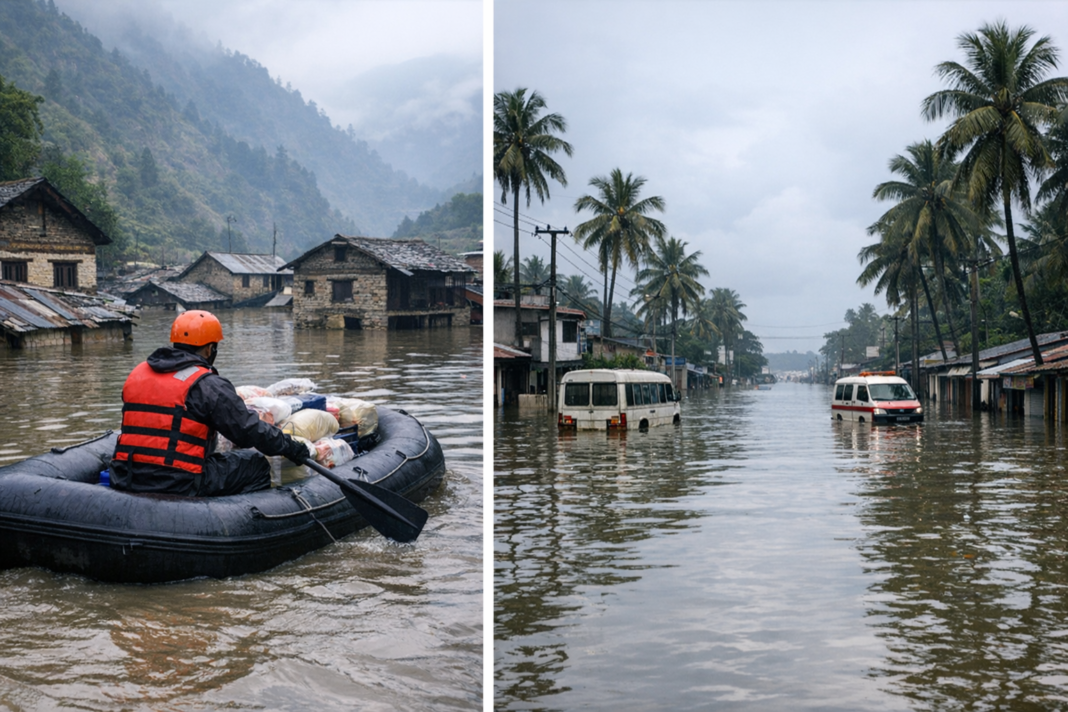
Major flash floods along the Nepal-Tibet border have left communities cut off, destroying homes, roads, bridges and local hydropower installations and affecting around 50,000 residents of Nepal. Official tallies and reporting indicate more than 100 people have died and hundreds — including international tourists — remain missing after the Bhote Koshi surge. That river basin had only begun to recover from a 2025 event that killed nine people and swept away a cross-border “friendship bridge,” a loss that had already disrupted trade and transport.
At the same time, floods and landslides in Sri Lanka have hit communities still rebuilding from Cyclone Ditwah. Relief agencies report more than 15,000 people directly affected and roughly 6,800 displaced in recent weeks. These episodes illustrate a pattern in which a second hazard reaches a population whose roads, services and household finances remain impaired — a situation researchers characterise as the “recovery gap”.
Evidence from recent studies and historical events underlines the consequences. A 2025 analysis of recurrent flooding in the Philippines found losses grew substantially when recovery was incomplete; other cases, such as the long-term rebuilding after Hurricane Katrina in the United States, show that physical repairs, population returns and major infrastructure upgrades can take a decade or more. Different elements of recovery operate on different timetables: power and emergency response can be restored within days or months, while housing, livelihoods and financial stability may require years.
Measuring immediate damage is necessary but not sufficient. Governments and aid organisations need systems that track what remains unrepaired months and years after an event — from housing and transport links to the financial resilience of households and the readiness of public services — and to factor those conditions into risk planning for future events. Research points to the central role of public authorities in coordinating faster, more resilient reconstruction. Institutions such as UCL and the UNU have emphasised that recovery is also preparation: the next disaster will not meet a community at zero, but whatever vulnerability the last one left behind.