



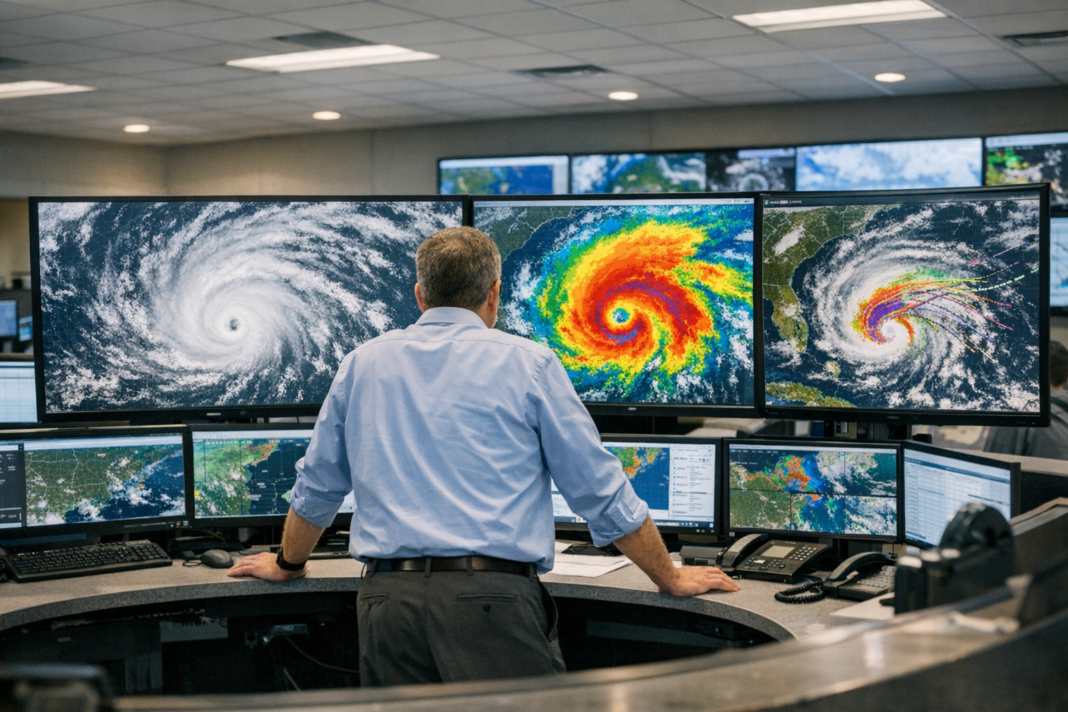
AI has advanced rapidly in weather prediction, with new global machine-learning systems delivering forecasts that rival traditional numerical models. Yet forecasting the sudden shifts in hurricane intensity remains a persistent challenge. Major operational centers such as NOAA and ECMWF continue to rely on high-resolution physics-based models precisely because small-scale processes that govern intensification are difficult to capture.
Intensity changes depend on a complex interplay of factors at scales often below the resolution of many global systems: inner-core dynamics, eyewall replacement cycles, fine-scale ocean temperature structure and air–sea fluxes. Observational gaps—particularly over the open ocean—limit the training data available to purely statistical approaches. In addition, rapid intensification events can be driven by transient, localized conditions that are inherently harder to learn from historical examples alone.
Machine-learning models excel at recognizing patterns in large datasets and can deliver faster forecasts, but they may underperform when confronted with rare or unprecedented configurations. To address this, researchers are developing hybrid strategies that embed physical knowledge into learning algorithms or that combine AI outputs with ensemble runs from conventional models. Improvements in remote sensing, airborne reconnaissance and ocean profiling expand the data available for model training and validation, and operational groups are increasingly focused on methods to quantify uncertainty in AI-generated forecasts.
Accurate intensity forecasts carry direct implications for emergency planning, evacuation decisions and infrastructure resilience. Progress will depend on coordinated investments in observations, transparent evaluation of AI systems against operational benchmarks and continued collaboration between data scientists and atmospheric scientists. As modelling approaches diversify, the objective for forecasters remains the same: deliver reliable, actionable information about storm strength to reduce risk for vulnerable communities.

