



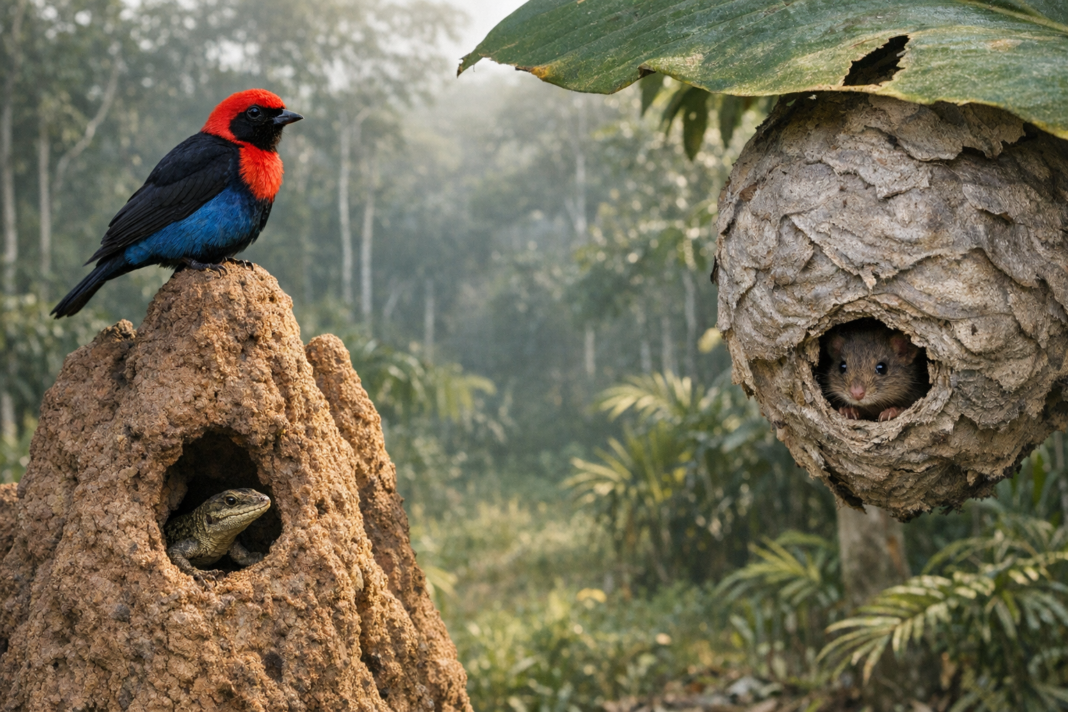
Insects underpin vertebrate life in ways that go far beyond serving as prey. Across ecosystems, small arthropods function as providers of medicine, architects of microhabitats and facilitators of key ecological interactions. These roles are visible in diverse species: chimpanzees that use insect secretions in wound care, birds and herons that incorporate insects into foraging strategies, and mammals and amphibians that depend on insect-built structures for reproduction and shelter.
Some primates are known to employ insect products in hygienic or medicinal contexts, while certain waterbirds manipulate insects as tools to lure fish. In tropical forests, a more intricate partnership links sloths and moths: moths living in the sloth’s fur contribute to the maintenance of algae, a food source the sloth later consumes. These examples illustrate that insects contribute to vertebrate diets not only by direct consumption but also by modifying the availability and quality of other food resources.
Insects also create physical environments that vertebrates exploit. Termite mounds, with their regulated temperature and humidity, serve as nesting or incubation sites for some reptiles and birds, offering stable conditions for eggs. In arid landscapes, ant nests provide refuge with higher moisture levels, allowing some desert frogs to survive in otherwise inhospitable terrain. Such structural services highlight how insect engineering shapes habitat suitability for a range of vertebrate life stages.
The breadth of these interactions underlines a simple conservation implication: changes to insect populations can reverberate through food webs and habitat networks. Losses or disruptions affecting pollinators, detritivores, burrowers and social insects may reduce food availability, eliminate nesting substrates and remove auxiliary resources used for hygiene or foraging. Recognising the multiple ecological functions of insects is therefore essential to understanding vertebrate ecology and to informing measures that aim to preserve ecosystem integrity.
