



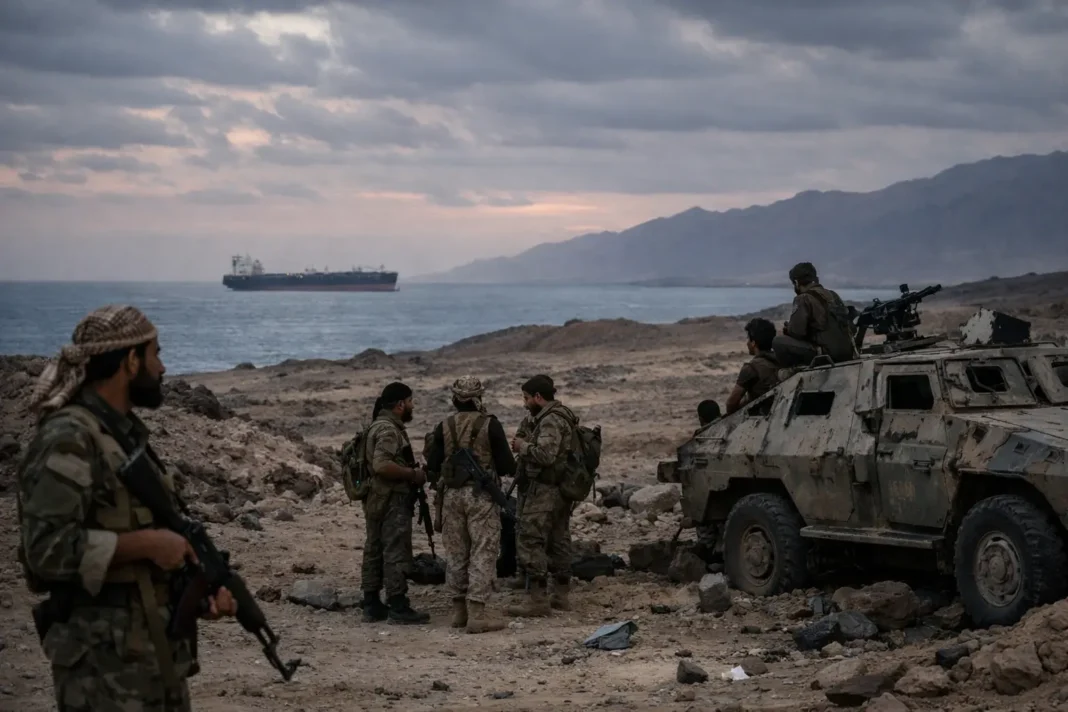
Yemen’s fighting intensifies as a rapidly escalating clash between the Houthi movement and the internationally recognised Yemeni government threatens to draw in regional powers. The insurgent group known as the Houthis has consolidated control over roughly one-third of the country, including the capital, while the Presidential Leadership Council — supported by Saudi Arabia — seeks to regain lost territory. Backing for the Houthis from Iran and political alignment between Tehran and other global actors have turned the conflict into a wider contest for influence, complicating prospects for a local settlement. Observers tracking the situation point to the conflict’s regional implications and the risk of further internationalisation (CFR).
The Houthis have extended their operations to maritime chokepoints and targeted Saudi energy infrastructure, disrupting flows and prompting temporary halts to the East–West Pipeline after recent strikes on facilities and an airport. Control of the Bab al-Mandab and attacks in the Red Sea corridor have heightened concern for commercial shipping and oil exports. The renewed fighting has also produced a sharp humanitarian toll: recent counts report more than 800 killed, about 3,000 injured and some 158,000 displaced, adding to the hundreds of thousands of deaths and long-term suffering tied to the conflict since 2014–15.
International responses have been uneven. United States officials have provided intelligence and logistical support to Riyadh but declined direct airstrike requests, while US policymakers weigh the risks of wider confrontation. Moscow and Beijing’s alignment with Tehran on some diplomatic fronts has complicated coordination among external actors. Meanwhile, Turkey and Pakistan have agreed to activate a mutual defence arrangement and to deploy forces to assist Saudi Arabia if attacked, a move that underscores how bilateral and multilateral pacts are reshaping the security environment (Al Jazeera).
Pressure on global energy routes adds urgency to diplomatic efforts. The Strait of Hormuz previously carried around one-fifth of daily oil and liquefied natural gas shipments, and competing claims over its operation have produced conflicting assessments of actual flows. Iran’s parliamentary speaker, Mohammad Bagher Ghalibaf, has stated the strait will not be fully reopened until a set of Iranian conditions are met, while US officials report significant volumes still transiting the waterway. The scale of recent attacks and the growing international involvement mean the situation could deteriorate further unless major external actors pursue sustained de-escalation and diplomacy.
