



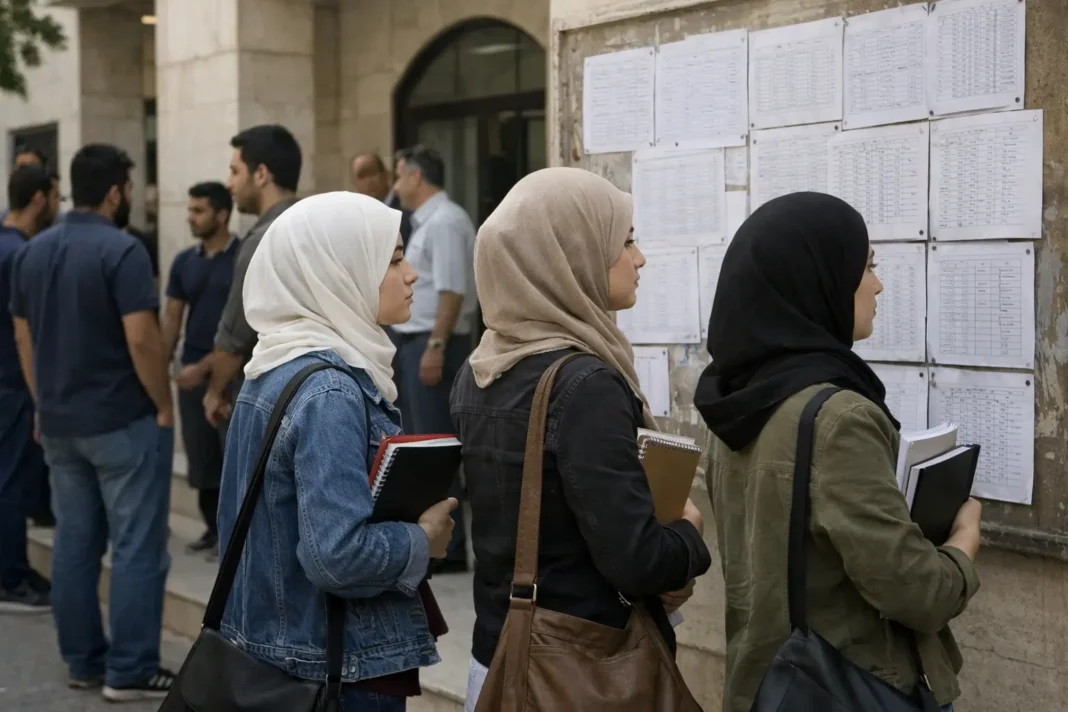
Syria’s higher education system has become the focus of renewed public scrutiny after an announcement that women will not be admitted to some university-level courses. The measure, presented as applying to selected fields within tertiary institutes, has opened a wider debate over access to education in Syria and the direction of policy under the country’s new government.
The decision is significant because university admission rules are not only administrative tools. They determine which professions students can realistically enter and shape long-term participation in public life, skilled employment and research. Restrictions based on gender therefore carry consequences beyond individual campuses, especially in a country where institutions are already under pressure after years of political and social disruption.
Critics have raised concern that the announcement may mark an early signal of a broader rollback in women’s rights. The central issue is whether the exclusion from certain courses will remain limited in scope or form part of a wider approach to regulating women’s role in education and work. No detailed public explanation in the original announcement has settled those concerns, leaving the measure open to competing interpretations and close examination.
The controversy also places Syria’s education policy in the context of international standards on equal access. UNESCO promotes inclusive education as a core principle, while UN Women focuses on the removal of structural barriers that limit women’s participation in society. Although national authorities retain control over admission rules, restrictions that differentiate by gender tend to attract attention because they affect opportunity, professional training and economic participation.
For students and families, the immediate uncertainty lies in how the ban will be applied across institutions and academic paths. For policymakers, the debate is likely to test the new government’s approach to higher education, social rights and public accountability. The announcement has already become more than a campus matter: it is now a measure through which observers are assessing the broader trajectory of governance in Syria.
