



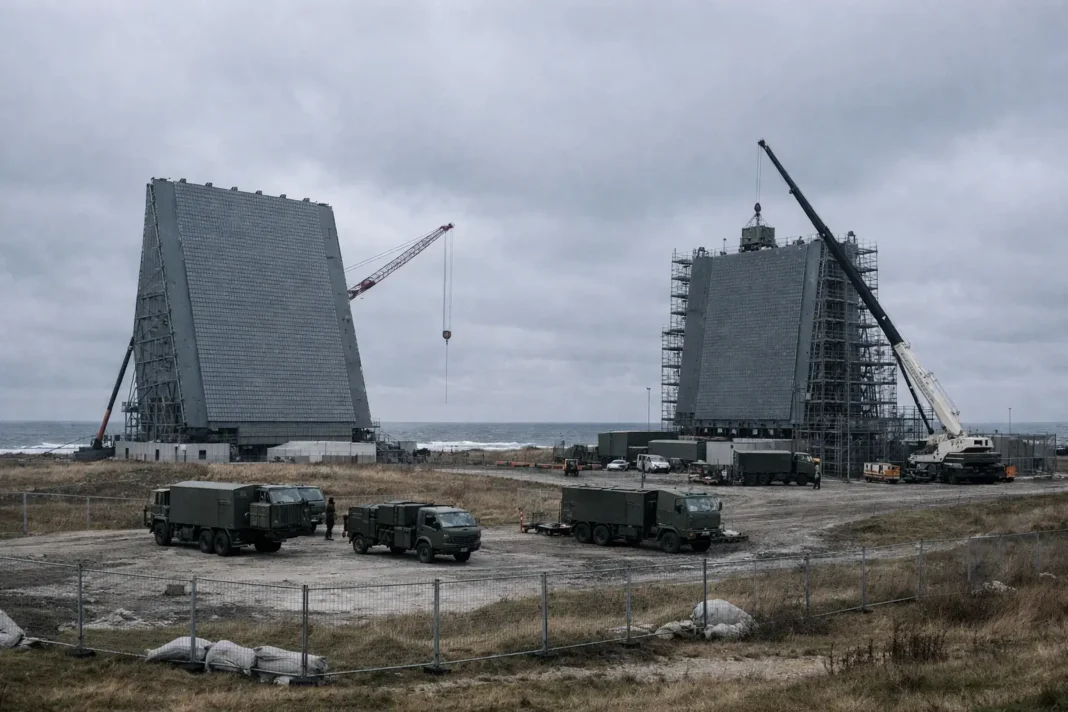
Russia’s expanding radar footprint in Kaliningrad is drawing renewed attention from European security specialists as construction on a large military complex appears to be nearing completion. Experts assess that the installation could give Moscow the ability to monitor extensive areas of Europe, adding a new layer to the already tense military relationship between Russia and the Atlantic alliance.
The site’s location is central to the concern. Kaliningrad, a Russian exclave situated between Poland and Lithuania on the Baltic Sea, occupies one of the most sensitive positions on the continent’s security map. Any powerful surveillance system based there would sit close to allied territory and near key air, maritime and land routes used by members of NATO. That geography gives the project strategic significance beyond its physical scale.
Radar infrastructure of this kind is not simply a technical asset. Long-range monitoring can support early warning, track military movement and contribute to command decisions during periods of heightened tension. Experts have warned that a system capable of observing much of Europe could sharpen the military standoff by increasing Russia’s situational awareness close to NATO borders. The concern is not limited to the facility itself, but to how the information it gathers could be used within broader defense planning.
The development comes against a backdrop of sustained confrontation between Moscow and the alliance, with the Baltic region already treated as a priority area for deterrence and surveillance. Kaliningrad has long been viewed as a strategically important Russian position because it places military assets deep inside the European security environment while remaining physically separated from the rest of Russia. A major radar complex there would reinforce the exclave’s role as a forward observation point.
No official technical specifications have been confirmed in the available information, and the full operational status of the complex remains unclear. Even so, the approach of completion is enough to raise questions for NATO members about monitoring, readiness and the stability of military signaling in Europe. For alliance planners, the issue is likely to be assessed less as an isolated construction project than as another element in the evolving balance between Russian surveillance capabilities and NATO’s defensive posture.