



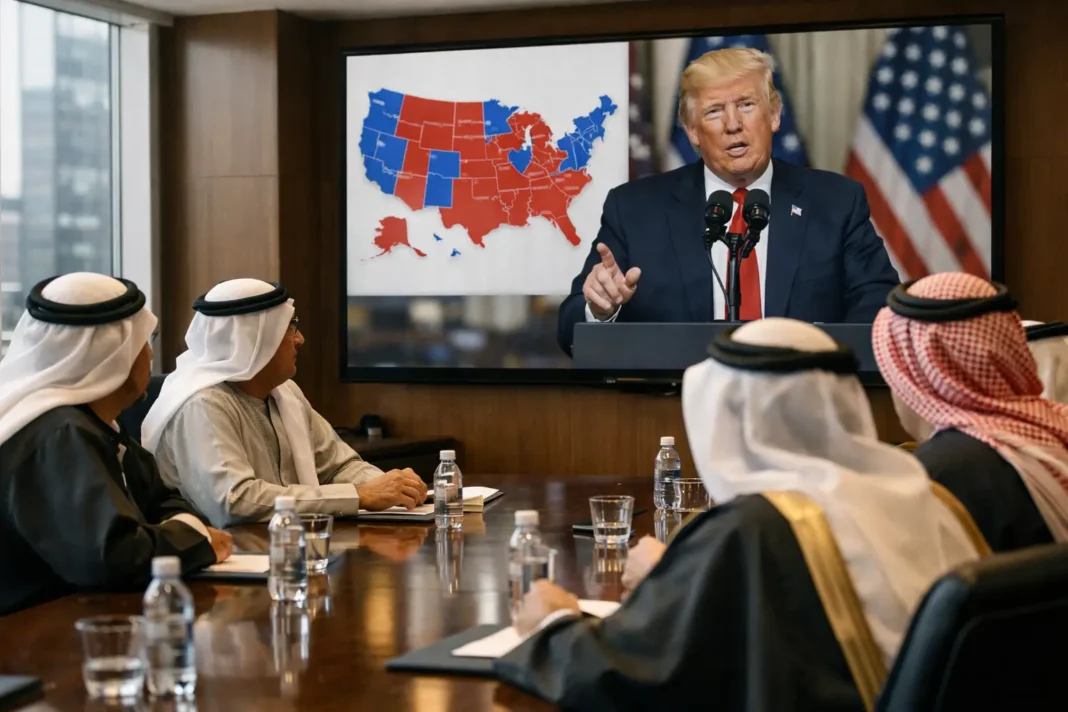
The U.S. midterm vote has reshaped the political backdrop to Donald Trump’s war with Iran, sending a message that extends well beyond Washington. The results showed clear public resistance to the conflict, a development now being closely watched by Gulf countries that have spent months caught between the United States and Iran. For governments in the region, the ballot box has offered a reason to believe that pressure for an end to the war may grow inside American politics.
The significance lies not only in the domestic setback for Trump, but in the strategic position of Gulf states themselves. Their proximity to Iran and their security ties with Washington have made them unusually exposed to the consequences of the confrontation. Even without being the central actors, they have had to manage the risks created by a conflict involving the region’s most powerful external military partner and a neighboring state with deep geographic and political reach across the Gulf.
Gulf governments have an interest in de-escalation that is both immediate and structural. The region depends on stability for trade, energy flows and investment, while its diplomatic relationships require careful balancing between security cooperation with the White House and the need to avoid a wider regional rupture. Months of war have left Gulf capitals in a constrained position: too close to the conflict to ignore it, but with limited ability to determine its course.
The midterm outcome does not by itself end the war, nor does it automatically alter U.S. policy. It does, however, weaken the political argument that the conflict enjoys broad public support. In Washington, electoral signals can influence the room available to an administration, especially when a foreign war becomes a visible political liability. For Gulf countries, that shift matters because any move toward restraint, negotiation or a reduced military posture would directly affect their security environment.
The central question now is whether opposition expressed through the election will translate into concrete pressure on U.S. decision-making. Gulf states are unlikely to treat the vote as a guarantee, but it has changed the tone of expectations. After months of being trapped in the middle of the U.S.-Iran confrontation, they now see a possible opening: an American political debate in which ending the conflict is no longer a marginal demand, but a consequence of voter dissatisfaction.