



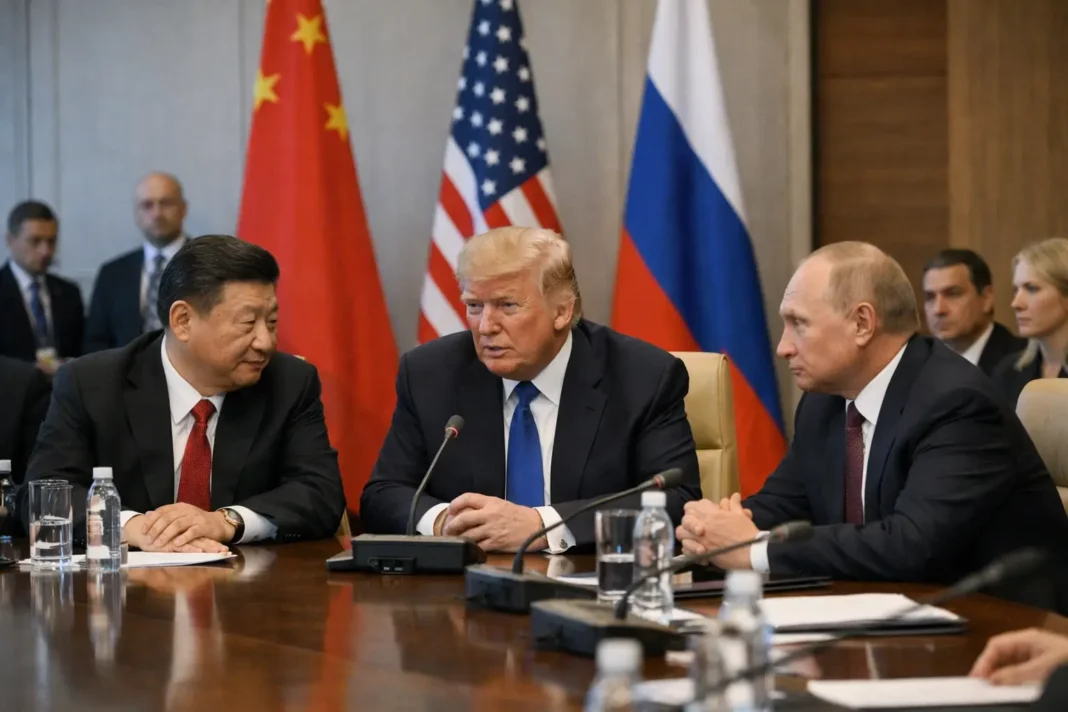
A rare three-way encounter in Shenzhen brings together Xi Jinping, Donald Trump and Vladimir Putin on the sidelines of the Asia-Pacific Economic Cooperation summit. The meeting gives the leaders of China, the United States and Russia a direct channel to discuss questions of war, security and strategic stability. Its significance lies less in a single agenda than in the image it projects: three major powers seeking to manage international affairs through direct leader-to-leader diplomacy.
The format has inevitably revived comparisons with twentieth-century summitry, including Yalta, where great powers negotiated spheres of influence after the second world war. Shenzhen is not a formal division of the world, nor does it amount to an alliance among the three participants. It does, however, fit a wider pattern. Xi hosted separate visits by Trump and Putin in Beijing earlier this year; Trump later received Xi in Washington and also met Putin in Alaska last year. Taken together, these encounters point to a shift away from broad multilateral consultation and toward a more personalised system of power management.
That trend has immediate consequences for Europe. Recent talks in Abu Dhabi on ending the war in Ukraine included Ukrainian participation but not European negotiators, even as the outcome could reshape the continent’s security framework. Jared Kushner, serving as U.S. special envoy, said Washington wanted Europe involved, while also suggesting that identifying a single credible European voice could be difficult. The remark underscored a central weakness: Europe remains a major economic and technological actor, but often struggles to convert that weight into a unified strategic position.
Beijing’s participation also carries diplomatic weight. The Chinese Foreign Ministry has described the Shenzhen meeting as having “groundbreaking significance” for world peace and stability among major powers. That language sits uneasily beside China’s repeated support for multipolarity and its criticism of Cold War-style bloc politics. Even if Ukraine is not formally on the table, the sight of Xi, Trump and Putin meeting without Europe reinforces the impression that the largest powers increasingly decide who is present when security questions are discussed.
For middle powers, the lesson is not irrelevance but adaptation. Countries such as Canada, Australia, Japan, South Korea and European states retain influence through institutions, standards, economic partnerships and issue-based coalitions. They cannot match the military reach of Washington, Beijing or Moscow, but they can still shape the rules and norms that constrain larger states. The Shenzhen summit therefore raises a broader question for the rest of the international system: how to preserve collective influence when the most powerful leaders prefer to negotiate in smaller rooms.