



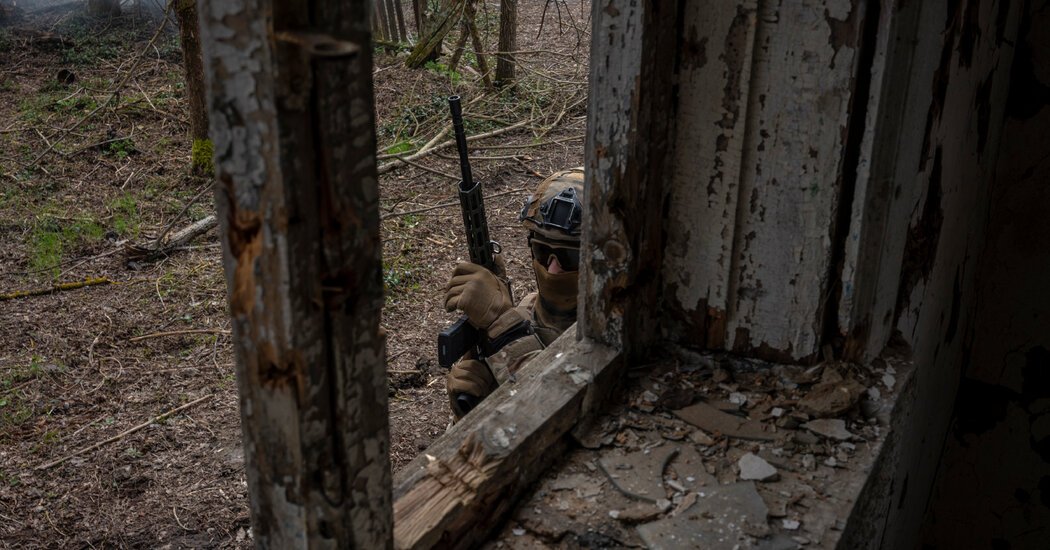
Vines twirl through the broken windows of long-abandoned homes, where the detritus of lives interrupted by disaster are still scattered about: children’s shoes, dishes, coats hanging on pegs, all covered in lichen and dust.
The ghost towns of the Chernobyl exclusion zone in northern Ukraine emptied of people after the catastrophic explosion and meltdown at the nuclear power plant there 40 years ago, on April 26, 1986. High levels of radiation mean humans may never live in them again.
But these towns served another purpose for Ukrainian soldiers who recently trained amid the ruins. The troops practiced defending the irradiated land against a repeat Russian attack, taking precautions to avoid the most radioactive areas. In February 2022, Moscow’s forces entered the zone on the first day of the full-scale invasion, and occupied it for five weeks.
During the exercise, soldiers crouched beside waterlogged, mold-covered walls, aiming their rifles. Others threw live grenades into homes, chipping walls already crumbling from dry rot. Their presence highlighted a reality in the Chernobyl zone: For the foreseeable future, it will be an army-controlled security belt along the border with Belarus, a Russian ally.
“Everything depends on security” in the zone today, said the commander of the battalion training in the area, who asked to be identified by only his nickname, Skif, in keeping with military protocol.
The explosion in 1986, set off by a safety test and exacerbated by design flaws, spewed fire and radioactive material into the air, in the world’s worst nuclear disaster. Two workers were killed in the initial explosion, over two dozen emergency responders and cleanup workers died in the three months after from radiation exposure, and some 200,000 people are believed to have been relocated from the area.
Over the years, the radioactive towns, villages, forests and swamps have posed quandaries for the authorities. The land could never be repopulated, they concluded, because of contamination from long-lingering isotopes, including plutonium.
But it could bring economic benefits. Ideas included using it as a storage area for other countries’ nuclear waste, as a test site for new generations of small modular reactors, as territory for solar farms and as a destination for so-called disaster tourism.
Now, everything, other than modest solar-farm development, is on indefinite hold. Tourists, who began showing up at the site 20 years ago, are not coming back anytime soon, said Shaun Burnie, the senior nuclear specialist with Greenpeace Ukraine. Chernobyl has become one disaster layered on another: war fought in a radioactive zone.
Russia’s invasion in 2022 harmed efforts to contain radiation in multiple ways. Moscow’s forces occupied the crippled nuclear power station and used it as a staging area for attacks on Kyiv, the Ukrainian capital, early in the war. Their heavy armored vehicles stirred up small amounts of radioactive dust. Weeks later, Russian troops were defeated in the battle for Kyiv, and they withdrew from Chernobyl.
More worrisome are longer-term war risks. Scientists cannot reach wells that measure groundwater radiation, lest they step on a land mine. Also owing to mines, firefighters cannot rush to extinguish wildfires that spread radiation in smoke. Foreign scientists who studied radiation in the environment have fled.
In February 2025, Russia flew an exploding Iranian-designed Shahed drone into the gigantic steel shell that encloses an older, rickety structure built over the ruined reactor shortly after the accident. That older structure, known as the sarcophagus, is at risk of collapsing and releasing radiation.
The drone explosion punched a hole in the $2.5 billion outer shell, called the New Safe Confinement, and started a fire that burned through material needed to maintain the airtight seal. No radiation was released, but the strike set back two decades of efforts to safely isolate the worst of Chernobyl’s radiation.
The attack came a day before the opening of the influential Munich Security Conference in Germany, a warning to Ukraine’s Western allies that the war could spread radiation to Europe, from Chernobyl or other nuclear sites.
It is unclear how the confinement structure can be repaired. To protect workers from radiation, it had been built away from the reactor and later moved on rails into position over it. Now, repair work will have to be done in the highly radioactive zone, possibly by cycling large numbers of workers through stints that cannot exceed 11 hours per year, to comply with safety rules.
The European Bank for Reconstruction and Development has estimated that repairs will cost $500 million, begin in 2028 and last four years. Foreign donors, including France and Britain, have so far pledged 70 million euros, or about $82 million, for urgent repairs. The Russian drone most likely cost no more than about $50,000.
On Sunday, Rafael Grossi, who leads the International Atomic Energy Agency, told reporters in Kyiv that he had spoken with Ukraine’s energy minister about the need to start work before 2028.
“We believe that the repairs should start as soon as possible,” Mr. Grossi said, “and that leaving the situation as is now is problematic.”
Easier to repair was a nearby solar farm that was struck by shrapnel from the drone. The 18 damaged panels were replaced.
Two solar plants are operating in the Chernobyl zone, and a third is under construction despite the war. They sell electricity for the grid using high-voltage transmission lines originally built for the reactors, and they provide backup power for cooling ponds for nuclear waste.
Solar farms, which are unaffected by radiation and are largely impervious to missile and drone attacks because they are dispersed over large areas, still have a viable future in the exclusion zone, said Yevgen Variagin, the chief executive of Solar Chernobyl. The company opened the first solar plant there in 2018.
Otherwise, the area around Chernobyl is now primarily a military site, fortified against attacks from the north toward Kyiv and against possible Russian sabotage of the reactor or waste-storage facilities.
Tank traps, which look like X’s made from steel beams, and coils of razor wire stretch out over fields in the zone. At military positions, paths are covered in nets to protect against drones.
These defenses are typical for much of the front line in Ukraine. Other military preparations are peculiar to the radiation zone.
To fight in this landscape, the Ukrainian Army took special precautions. It did not dig trenches or burrow bunkers into the ground, lest it expose soldiers to radiation in the soil. Instead, aboveground berms or bunkers were built into hills of fresh sand that was trucked in.
Looking like large yellow anthills, these now dot the landscape around the Chernobyl plant.
Soldiers patrol the ghost towns, where buildings are covered in moss and surrounded by mature trees, lost in a swirl of dense vegetation like ancient Mayan ruins.
In the recent exercise, soldiers with the 28th Regiment of the National Guard maneuvered amid abandoned homes with corroded corrugated-metal roofs and broken windows.
Though devoid of people, the area must be defended against further damage, said Skif, the commander.
Compared with destruction inflicted elsewhere in Ukraine, an attack that released more radiation at Chernobyl, he said, would be “on a completely different scale.”
Constant Méheut and Kim Barker contributed reporting from Kyiv, Ukraine.
Source:
www.nytimes.com

