



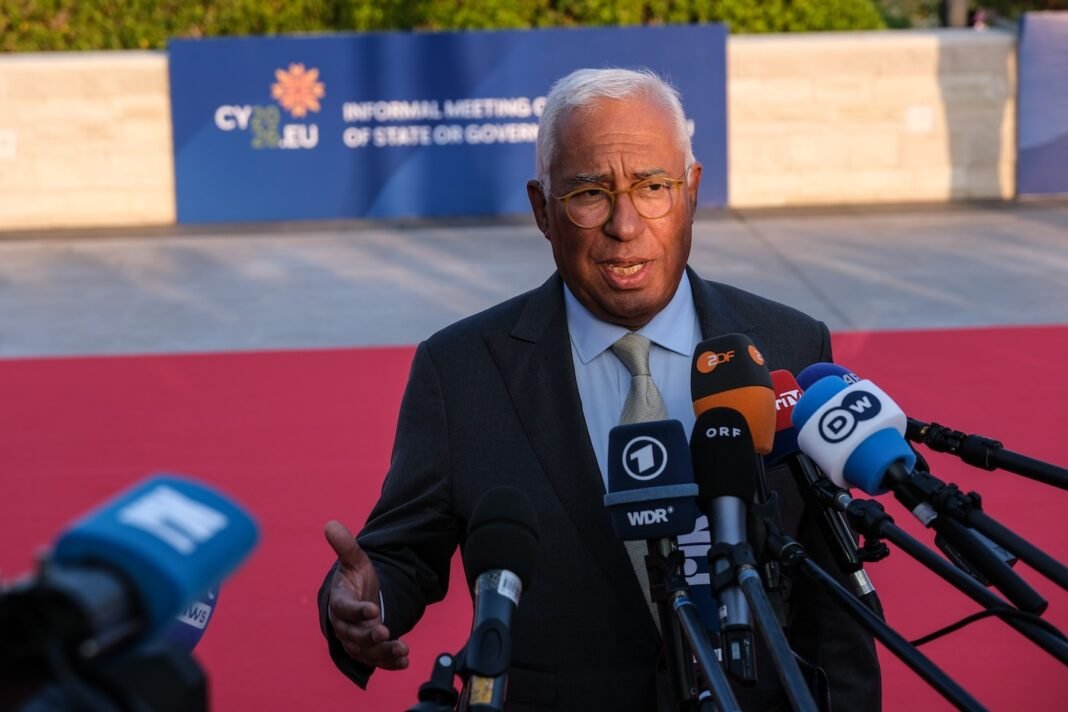

Ayia Napa, CYPRUS – EU leaders will seek to break the deadlock over the bloc’s next long-term budget on Friday, as the Iran war and months of wrangling between capitals stall negotiations over the trillion-euro spending plan.
The morning debate in Nicosia has been billed by António Costa, the European Council president, as “an important milestone” in discussions over the post-2027 Multiannual Financial Framework (MFF) which he is seeking to finalise by the end of 2026 – just before the French presidential elections, which the far right is currently on course to win.
In a letter to EU leaders ahead of this week’s two-day summit, Costa wrote that a discussion on the €1.8 trillion common fund has “only become more urgent” since March, when an MFF debate in Brussels was postponed amid the energy crisis triggered by the Iran war.
Diplomats, however, downplayed the likelihood of a major breakthrough in the Cypriot capital.
“While this is the first substantive discussion on the MFF by leaders, member states have had lots of opportunities to discuss their positions,” one diplomat said. “Don’t expect anyone to come out of their trenches and start compromising, it’s still way too early in the process for that.”
Friday’s discussion will partly focus on how the budget, which amounts to just 1% of the bloc’s GNI, can be used to boost the bloc’s faltering competitiveness – a challenge that the recent surge in oil and gas prices, debated by leaders in Ayia Napa last night, is likely to exacerbate.
Leaders will also discuss how the next budget could be bolstered by so-called new “own resources” – EU-wide revenue streams funded through new taxes that the European Commission wants to use to help repay the bloc’s pandemic recovery fund.
Behind the sunny summit bonhomie, many leaders are deeply sceptical of the specific measures proposed by the Commission, which include taxes on discarded electronic items, tobacco and large companies.
“The own resources is a difficult part of the file, in the sense that those proposals haven’t garnered too much support across the 27 member states,” said Micheál Martin, Ireland’s prime minister, who will take over the Council of the EU presidency from Cyprus in July. “But we will work very hard to bring this to a conclusion.”
More generally, so-called ‘frugal’ EU countries, including Germany and the Netherlands, are staunchly opposed to increasing the MFF’s size at a time of already stretched national budgets. Planned increases in defence expenditure and the need to cushion households and businesses from the Iran war’s impact are likely to push countries’ coffers close to breaking point, they argue.
“There won’t be a miraculous outcome,” one senior EU official admitted.
Nevertheless, they said, the discussion could help “consolidate” EU leaders’ recognition of the need for new own resources of one form or another.
It could also help Cyprus, which holds the rotating EU presidency, better understand leaders’ positions as it drafts a crucial MFF negotiating document set to be presented in June, the official added.
“It’s a difficult discussion,” the official said. “But the negotiations need to move forward.”
(bw, aw)
Source:
www.euractiv.com