



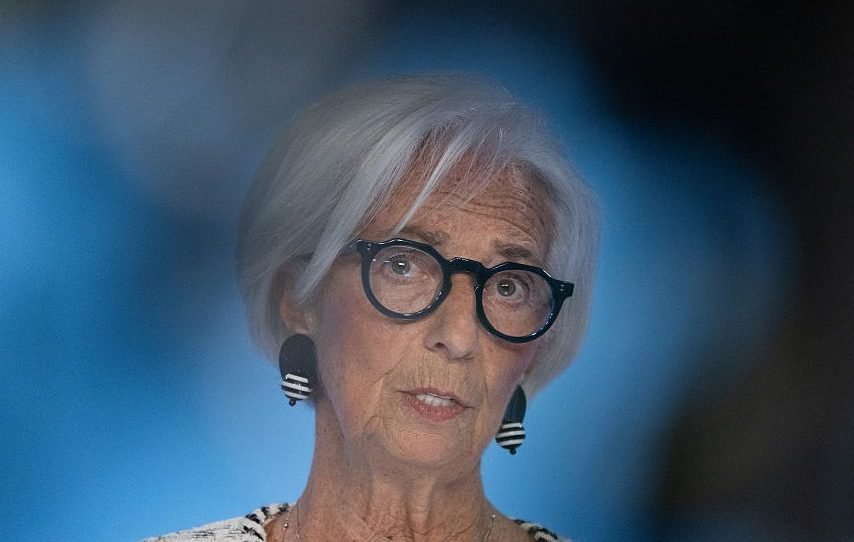
Christine Lagarde has dismissed fears that the Iran war will trigger a prolonged period of high inflation and low growth, arguing the situation is “completely different” from the stagflation of the 1970s.
“It’s quite, how would I say, popular to talk about stagflation, and it flags a lot of anxiety and all the rest of it,” the European Central Bank president told reporters on Thursday, after announcing that the Bank’s rate-setting Governing Council had held its key interest rate at 2%.
“But from our perspective, we think that it’s better to park [the term] in the seventies given the facts that we have at the moment,” she added. “You know, it’s a completely different situation.”
Lagarde said that the twin oil shocks of the 1970s – sparked by the 1973 Arab-Israeli war and the 1979 Iranian Revolution that brought Tehran’s current regime to power – led to a period of soaring inflation and high unemployment has yet to be seen in today’s data.
She also noted that the ECB’s latest projections, released in March, foresee eurozone growth falling to just under 1% this year, before rising to more than 1% in 2027 and 2028.
“I wouldn’t call that stagnation, sorry,” Lagarde said. “It’s lower growth, granted, in ’26, but we’re not in stagnation, let alone recession.”
Her comments come despite numerous warnings from analysts and even EU officials that the Iran war could trigger a 1970s-style “stagflationary shock”.
They also appear to contradict statements by International Energy Agency chief Fatih Birol, who has argued that the war’s impact could be worse that the combined effect of the 1970s oil shocks and the energy crisis triggered by Russia’s full-scale invasion of Ukraine in 2022.
Fresh data released on Thursday showed that euro area inflation surged from 2.6% in March to 3% in April – pushing prices further above the ECB’s 2% target rate.
Separate data showed that the eurozone’s year-on-year output over the first quarter of this year fell from 1.3% to 0.8%, with quarter-on-quarter growth slowing from 0.2% to 0.1%.
Lagarde said that Thursday’s decision to hold rates was taken unanimously by the ECB’s Governing Council, but that policymakers had discussed the possibility of a rate hike.
“All in all, the main take-away from today’s ECB meeting can probably be described as another hawkish shift, introducing a clear hiking bias to its wait-and-see stance,” wrote Carsten Brzeski, global head of macro for ING Research.
Source:
www.euractiv.com