



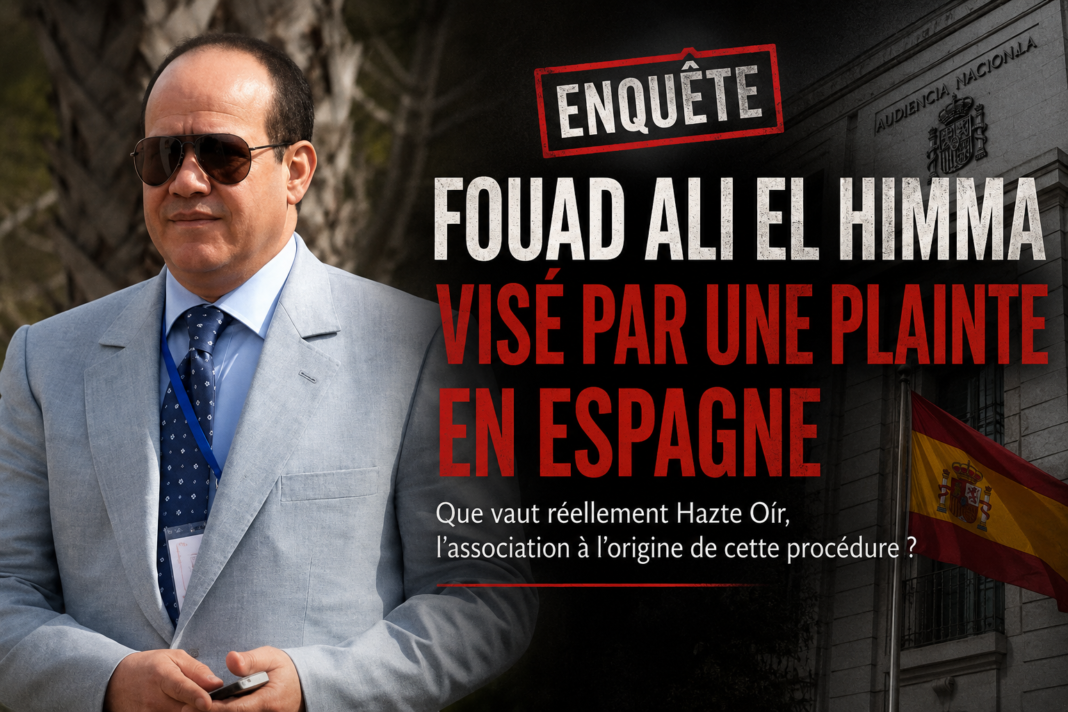
INVESTIGATION — Hazte Oír is asking the Spanish justice system to examine the role of Fouad Ali El Himma in the events of Ceuta. But who exactly is the complainant? A Spanish association registered for more than twenty years, Hazte Oír has become a regular fixture in the courts and in proceedings with a strong political dimension. It has won several battles on freedom of expression, lost its status as a public utility association, and, just a few months before the Ceuta case, saw the Audiencia Nacional reject a particularly serious complaint against José Luis Rodríguez Zapatero for lack of sufficient evidence. Its judicial track record makes it possible to measure the real scope of the new procedure targeting the advisor to Mohammed VI and, above all, to distinguish the accusations of the complainant from what the Spanish courts have actually established.
FROM ZAPATERO TO FOUAD ALI EL HIMMA, TWO PARTICULARLY SERIOUS ACCUSATIONS IN A FEW MONTHS
The same association, the same jurisdiction, and just a few months apart, two criminal files of exceptional gravity. At the beginning of 2026, Hazte Oír asked the Audiencia Nacional to investigate former Spanish Prime Minister José Luis Rodríguez Zapatero for money laundering, drug trafficking, and membership in a criminal organization, notably because of his relations with the Venezuelan authorities. On February 2, Magistrate Antonio Piña refused to admit the complaint. In its official communication, the General Council of the Judiciary in Spain specifies that the judge considered that the alleged facts came from open sources, particularly journalistic reports, without Hazte Oír providing the “rational indications of criminality” necessary to open criminal proceedings. The magistrate also noted that no concrete facts had been provided to link Zapatero to the offenses of drug trafficking, criminal organization, or money laundering attributed to him.
A few months later, Hazte Oír returned to the Audiencia Nacional with a new judicial initiative, this time linked to the events in Ceuta. Among the officials whose role the association asks to be examined appears Fouad Ali El Himma, advisor to King Mohammed VI. The existence of this complaint is established. However, its filing does not mean that the accusations it contains have been endorsed by a magistrate: this is precisely the essential difference between the existence of a querella (criminal complaint) and the judicial validation of its content.
HAZTE OÍR: A PRIVATE ASSOCIATION LEGALLY REGISTERED FOR MORE THAN TWENTY YEARS
Hazte Oír is neither a public institution, nor an investigative service, nor a body with any special competence in intelligence or national security matters. Legally, it is a private Spanish non-profit association. Its official name is Asociación Hazteoir.org, and it appears in the National Register of Associations under number 167805. Its existence and registration number appear directly in the Boletín Oficial del Estado, the Spanish Official Gazette. In May 2013, the Ministry of the Interior granted it public utility status after examining the administrative file presented by the organization. The BOE specifies that at the time, authorities considered it fulfilled the necessary requirements to obtain this recognition.
Founded in 2001 around the Spanish lawyer Ignacio Arsuaga, Hazte Oír gradually made a name for itself through campaigns dedicated to abortion, family, education, gender policies, and, more broadly, through conservative stances particularly visible in the Spanish public debate. Over the years, the organization built up a significant capacity for mobilization, combining petitions, digital campaigns, actions in the public space, and recourse to the courts. This longevity and structure are important: Hazte Oír is not an improvised entity that appeared on the occasion of the Ceuta affair. However, its legal existence naturally confers no special presumption of truthfulness to the accusations it may file before a court.
WHY HAZTE OÍR LOST ITS PUBLIC UTILITY STATUS
The recognition obtained in 2013 was not permanent. The Spanish Ministry of the Interior revoked Hazte Oír’s public utility status with effect from February 4, 2019. The revocation and the association’s registration number are recorded directly in the Boletín Oficial del Estado.
Hazte Oír challenged this decision, but the Audiencia Nacional ruled against it in March 2020. The court confirmed that the association should no longer benefit from public utility recognition, notably because of its so-called “HOBus” campaign in 2017. According to the General Council of the Judiciary, the court considered that this campaign was incompatible with the obligation, attached to this status, to promote the general interest in its dimension of tolerance. The loss of the status did not, however, lead to the prohibition or dissolution of Hazte Oír: the organization continued its activities normally as a private association.
This clarification is important because it prevents overstating the scope of the decision. Hazte Oír remains a perfectly legal association in Spain. What was withdrawn from it was a specific administrative recognition and the associated benefits, not its right to exist or conduct its activities.
AN ACTIVIST ORGANIZATION THAT HAS MADE THE COURTS ONE OF ITS FIELDS OF ACTION
Over time, recourse to the justice system has become an important component of Hazte Oír’s strategy. The association files complaints, seeks to intervene in various criminal proceedings, and notably uses the acción popular—a specific mechanism in Spanish law that allows, under certain conditions, a person or organization to participate in criminal proceedings even if they are not the direct victim of the alleged acts.
This judicial activity regularly gives Hazte Oír considerable visibility. It nevertheless requires distinguishing between stages that are often confused in public debate: filing a complaint, having that complaint registered, securing the opening of an investigation, having individuals formally named as suspects by the court, and ultimately obtaining a decision establishing liability are legally very different realities. The mere filing of a querella allows the complainant to present their version of the facts and request investigations; it does not mean that the court considers that version to be established.
THE ZAPATERO PRECEDENT DIRECTLY RAISES THE QUESTION OF EVIDENCE QUALITY
The file concerning José Luis Rodríguez Zapatero is particularly instructive when evaluating Hazte Oír’s new initiative. In that case, the accusations put forward were among the most serious that could be leveled against a former head of government: drug trafficking, money laundering, and membership in a criminal organization. Yet, after examining the document presented by the association, the magistrate of the Audiencia Nacional considered that he did not have the necessary elements to open criminal proceedings.
The official statement from the judiciary is particularly explicit. The judge noted that the alleged facts came from open sources, “especially journalistic reports,” and that no rational indication of criminality had been provided. The magistrate also recalled that a personal or popular conviction could not be confused with the existence of facts with sufficient substance to trigger criminal proceedings.
This precedent in no way proves that the new complaint regarding Ceuta will suffer the same fate. It would be legally incorrect to use the failure of one file to assert that another is necessarily baseless. But it establishes something relevant for evaluating the complainant: Hazte Oír has already formulated extremely serious criminal allegations that the Audiencia Nacional refused to investigate because it deemed the elements provided to be insufficient.
HAZTE OÍR HAS ALSO WON VICTORIES IN COURT
Presenting the organization solely through its judicial setbacks would, however, give a distorted picture of its trajectory. Hazte Oír has also won several important battles before the Spanish courts, particularly when defending its right to freedom of expression and participation in political debate. Some of its controversial campaigns have thus enjoyed the protection of the courts, up to the Tribunal Supremo (Supreme Court).
These favorable decisions make it possible to better frame the question of its credibility. Hazte Oír is neither an association whose initiatives would be automatically rejected by the justice system, nor an organization whose assertions would enjoy any prior validation. The courts have ruled in its favor when they considered that its fundamental rights had been infringed; they have also rejected its demands when they deemed that the necessary legal or evidentiary conditions were not met.
The difference is major: obtaining judicial protection of the right to express an opinion, even a particularly aggressive one, is not equivalent to having a court recognize that a criminal accusation directed against a third party is true.
AN ADMINISTRATIVE SANCTION CONFIRMED BY THE COURTS
The association’s history also includes unfavorable decisions regarding some of its own campaigns. An administrative fine of 20,000 euros was notably imposed following a campaign conducted in Barcelona in November 2022 containing messages targeting trans and non-binary people. Hazte Oír challenged this measure, invoking freedom of expression, but a court subsequently confirmed the sanction.
The exact legal classification must be maintained: this is an administrative sanction confirmed in court, not a criminal conviction. This distinction is essential in a file that seeks precisely not to alter legal definitions or attribute to a decision a scope that it does not have.
WHAT HAZTE OÍR IS CURRENTLY CLAIMING REGARDING FOUAD ALI EL HIMMA
It is in light of this history that the complaint regarding the events in Ceuta must be examined. Hazte Oír is asking the Audiencia Nacional to examine various Moroccan and Spanish responsibilities. Published information about the complaint mentions alleged members or officials of Moroccan services, the Royal Gendarmerie, and the Auxiliary Forces, as well as individuals whom the complainant considers likely to have participated in organizing or directing the events. On the Spanish side, the government delegate in Ceuta, Miguel Ángel Pérez Triano, also appears among the officials named in the association’s initiative.
The most politically sensitive name, however, is that of Fouad Ali El Himma. Hazte Oír claims that various reports present him as the “alleged mastermind” of the operation. This formulation constitutes one of the main accusations of the complainant and must, at this stage, remain strictly attributed to it. No known public ruling establishes that the Audiencia Nacional considers Fouad Ali El Himma to be the organizer of the events or that any criminal liability has been established against him.
Caution on this point is not a stance in favor of the Moroccan official. It simply corresponds to the status of the proceedings: an association formulates an accusation and asks the justice system to examine it; it is then up to the magistrates and investigative services to verify its substance.
THE CEUTA PROCEEDINGS WERE NOT BORN OUT OF HAZTE OÍR’S COMPLAINT
Another element helps clarify exactly where the file stands. The Audiencia Nacional’s examination of the events in Ceuta did not begin solely as a result of Hazte Oír’s initiative. Magistrate María Tardón had already initiated proceedings following a complaint filed by Iustitia Europa and requested information from Spanish security forces to clarify the circumstances of the events.
The justice system is notably trying to determine what information may have reached Spanish services before the mass arrival of people in Ceuta and whether the observed circumstances could potentially correspond to a concerted or directed action falling under the jurisdiction of the Audiencia Nacional. Hazte Oír’s complaint was later added to these proceedings, as was a complaint submitted by Vox.
This chronology is essential. It means that the Audiencia Nacional is indeed examining the events in Ceuta, but that it would be an exaggeration to deduce that “Spanish justice is prosecuting Fouad Ali El Himma.” At this stage, the most accurate formulation is that Fouad Ali El Himma is explicitly named in a complaint filed by Hazte Oír and added to judicial proceedings concerning the events in Ceuta.
THE TARAJAL IMAGES: EVIDENCE TO BE VERIFIED, NOT AN ESTABLISHED IDENTIFICATION
Hazte Oír also claims to have submitted graphic documentation to the court regarding a vehicle and several individuals observed near Tarajal. The association believes that their behavior warrants investigation and asks the judicial authorities to determine their identities and any potential links to Moroccan services.
The formulation of this request itself provides an important indication of the status of the case. If Hazte Oír is asking the court to identify these individuals and establish their possible connections, it means that their membership in a Moroccan service is not, at this stage, judicially established.
The images may therefore constitute an interesting piece of evidence to verify. They do not permit writing, in the current public state of the file, as a proven fact that the filmed individuals are agents of the DGST or another Moroccan entity. Turning this hypothesis into an assertion would be equivalent to presenting the expected result of an investigation as if that investigation had already been carried out.
THE MAIN UNKNOWN: WHAT EVIDENCE EXISTS AGAINST FOUAD ALI EL HIMMA?
This is probably the most important question in the entire affair. Hazte Oír claims to have information serious enough to ask the Audiencia Nacional to examine the role of Fouad Ali El Himma. However, the elements currently made public do not yet allow us to know with precision the nature of all the pieces of evidence on which this accusation rests.
Are these intelligence reports, witness statements, communications, administrative documents, elements obtained directly by the complainant, press articles, or cross-checks made from open sources? The difference is considerable. The Zapatero precedent shows precisely that the Audiencia Nacional can consider that open-source information and media publications, even if numerous, do not suffice to constitute the necessary indications to open criminal proceedings.
In the absence of complete access to the querella and especially to all its annexes, attributing a precise evidentiary value to the elements brought against El Himma would therefore be premature. It will be the reaction of the courts to the documents produced, as well as the outcome of the requested police verifications, that will truly measure the solidness of the case.
SO, IS HAZTE OÍR CREDIBLE?
An examination of its judicial history leads to a much more nuanced answer than a simple yes or no. Hazte Oír is a real, legally registered, long-standing, structured organization perfectly capable of navigating the mechanisms of Spanish justice. It has obtained several favorable judicial rulings and possesses significant procedural experience. It would therefore be false to present it as a ghost organization or a legally insignificant complainant.
However, its track record demonstrates with equal clarity that the gravity of the accusations it levels does not in itself constitute any guarantee of their solidness. It lost its public utility status following an administrative decision confirmed by the Audiencia Nacional. Some of its campaigns have been subject to sanctions. And above all, just a few months before the Ceuta case, the Audiencia Nacional rejected a complaint in which Hazte Oír leveled allegations of drug trafficking, money laundering, and criminal organization against a former prime minister, precisely because the magistrates deemed the evidence presented to be insufficient.
The conclusion is therefore not to declare Hazte Oír “credible” or “not credible” as a matter of principle. The only valid method is to independently verify each of its accusations and examine what the magistrates do with them.
A REAL COMPLAINT, AN ACCUSATION THAT REMAINS TO BE JUDICIALLY ESTABLISHED
Several elements can today be considered established. Hazte Oír exists legally under the name Asociación Hazteoir.org and holds national registration number 167805. It held public utility status starting in 2013 before losing it in 2019, a revocation later confirmed by the Audiencia Nacional.
The association also initiated proceedings concerning the events in Ceuta in which Fouad Ali El Himma is explicitly named. This initiative is now part of a proceeding under examination by the Audiencia Nacional. These are facts.
What is not established is equally important. No public ruling currently states that Fouad Ali El Himma organized the events. The individuals appearing in the images mentioned by the complainant have not been publicly identified by a judicial decision as members of the DGST. And the fact that Hazte Oír’s accusations have been added to a judicial file does not constitute their validation by the magistrate in charge of examining them.
The case therefore deserves close monitoring precisely because proceedings exist and involve a figure at the core of Moroccan power. But its true scope now depends on what investigators are able to verify and what the courts decide to retain.
Fouad Ali El Himma is indeed named in a complaint in Spain. Judicial proof of the accusations against him, however, remains to be established.