



Internal records place Hungary’s current data-protection chief inside a network that turned the post-communist “sect problem” into legislative lobbying, media work and proposals for religion-related scrutiny in public employment.
Long before Attila Péterfalvi became president of Hungary’s National Authority for Data Protection and Freedom of Information (NAIH), he took part in organising a network that treated new religious movements not as ordinary participants in religious pluralism, but as a separate category requiring investigation, public-warning campaigns, tighter legislation and exceptional scrutiny.
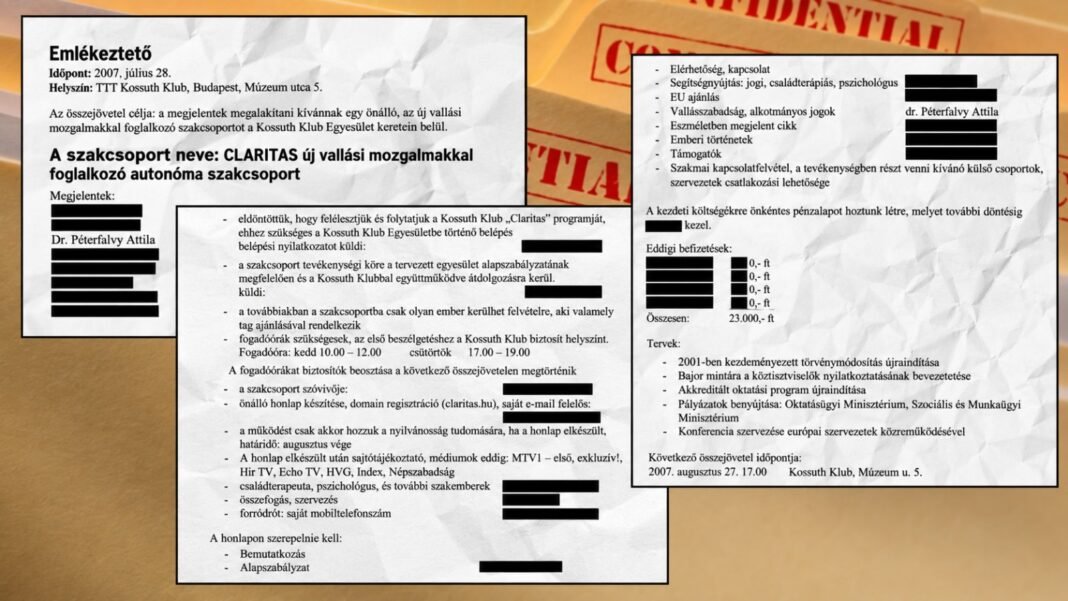
A CLARITAS memorandum dated 28 July 2007 records Péterfalvi’s attendance at a meeting held to organise an autonomous specialist group on new religious movements within Budapest’s Kossuth Klub. It assigns him responsibility for “religious freedom and constitutional rights” and notes his personal financial contribution to the group’s initial fund.
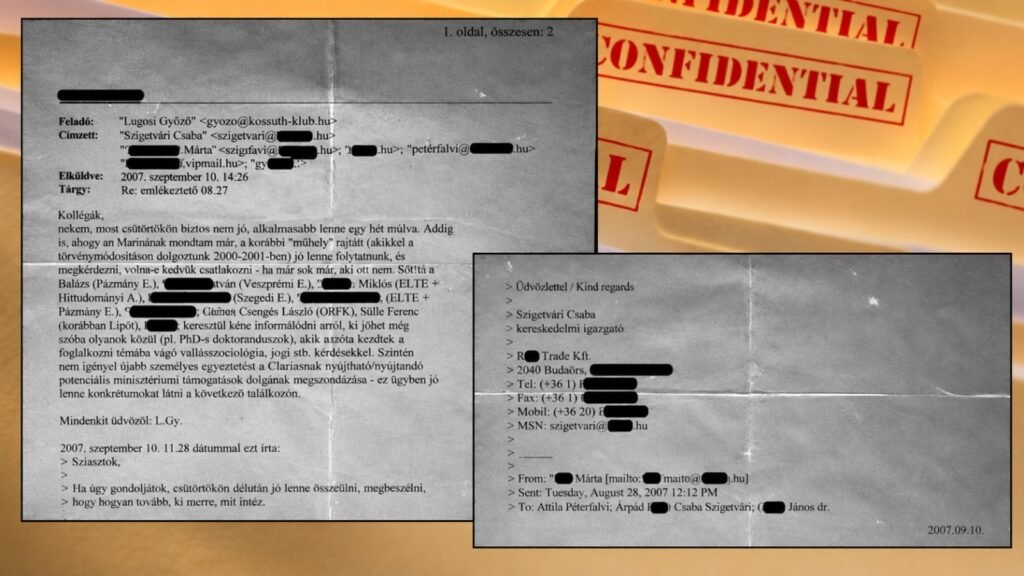
A second internal document—an email dated 10 September 2007—kept him within the working network while organisers discussed reviving an earlier church-law workshop and exploring possible support from the ministry.
These records matter because CLARITAS was not merely an academic forum. Its programme combined information gathering with services for alleged victims, legal and psychological assistance, media work, training, international cooperation, legislative lobbying and contact with government institutions.
Newer religions appeared first as risks to be assessed, rather than as communities entitled to the same presumption of legitimacy as established churches.
From the “sect problem” to a policy network
CLARITAS emerged in the early 1990s. Győző Lugosi, the historian and Kossuth Klub figure closely associated with the organisation, later recalled that the programme produced the 1994 booklet Szekták (“Sects”), also known as the “purple booklet.”
It was one of the first secular Hungarian publications about new religious movements following the fall of communism. Lugosi later described both its content and its ironic tone as outdated.
Source: EPA / Eszmélet
Although CLARITAS later preferred the term “new religious movements,” its origins lay in the so-called “sect problem”: unfamiliar religions framed through danger, secrecy, manipulation, alleged victims and the perceived need for public control.
Communities including Krishna devotees and Jehovah’s Witnesses carried the stigma of being labelled “destructive.”
The organisation subsequently moved into the legislative field. Around 2000–2001, a specialist workshop helped prepare a proposed amendment to Hungary’s 1990 church law. Participants included Balázs Schanda, Miklós Tomka, István Kamarás, Ferenc Süle and László Csendes.
The proposal was unsuccessful, but it connected academic expertise with political efforts to tighten the rules applying to minority religions.
Source: uni-nke.hu
The 2007 correspondence shows that CLARITAS intended to reconnect those experts and revive the project, with Péterfalvi remaining inside the network while its members discussed reconstruction and possible ministry support.
A broader restrictive turn in Hungarian religious policy became visible following the 2010 change of government, when the Fidesz–KDNP coalition enacted the 2011 Church Act.
The Hungarian Constitutional Court struck down key provisions of the legislation. The European Court of Human Rights later found that the politically controlled recognition system discriminated against minority religious communities and breached the principle of state neutrality.
The available record does not establish that CLARITAS drafted the 2011 law. The judgments nevertheless demonstrate the risks involved when religious recognition depends on political classification.
Péterfalvi inside the organising circle
Péterfalvi’s involvement cannot be reduced to a single appearance.
The 2007 memorandum records his attendance, his assignment concerning constitutional rights and his financial support. The follow-up correspondence places him within the continuing working network. In 2011, he appeared again as a speaker at a CLARITAS conference.
His presence carried institutional significance. As a former parliamentary commissioner for data protection, he brought the legitimacy of a senior rights official to a group developing legal, political and media instruments for dealing with minority religions.
In September 2007, Magyar Nemzet described the revived CLARITAS group as seeking to reveal the “true face” of communities it regarded as socially dangerous. The report used the language of “destructive sects,” referred to assistance for alleged victims and described plans to assemble documentation in support of tighter church legislation.
CLARITAS representative István György Szabó stated that religious affiliation could be relevant in the case of individuals holding positions of responsibility within the state.
Lugosi argued that “sect-like” groups should be kept out of public offices and positions involving state responsibility.
From information gathering to religious screening
The most consequential proposal recorded in the July 2007 memorandum concerned declarations by civil servants “following the Bavarian model.”
The memorandum records this as a collective proposal and does not identify the person who introduced it. It was nevertheless part of the programme discussed by the group in which Péterfalvi participated.
The Bavarian instrument, introduced in 1996, treated connections to a designated new religious organisation as potentially relevant to a person’s suitability for public service. It used a questionnaire to investigate such connections.
German courts condemned measures of this kind in 2000, in 2005—on the grounds of informational self-determination—and again in 2022, on the grounds of equality and freedom of religion.
Once an association with a disfavoured religion is treated as a sign of unfitness, every non-mainstream religious community becomes less secure. The focus shifts away from unlawful conduct and towards identity and belief.
The Council of Europe had already warned, in 1992 and 1999, that legislation specifically targeting “sects” could interfere with freedom of religion. It stressed that religious pluralism should be protected by applying ordinary law to unlawful conduct, rather than by adopting exceptional measures that marginalise religious minorities.
From CLARITAS to NAIH
On 25 March 2011, Kossuth Klub and CLARITAS held a workshop entitled “Religious Freedom and Public Authority in Hungary—2011.”
Reports identify Péterfalvi as a speaker on data protection within religious organisations.
Source: Vallástudományi Szemle
His documented connection to CLARITAS therefore spans at least four years and includes organisational participation, a specific assignment, financial support, inclusion in internal correspondence and a public conference appearance.
Péterfalvi returned to the highest level of Hungary’s data-protection system following an institutional restructuring that removed the serving commissioner before the end of his term.
András Jóri had been appointed in 2008 for a six-year mandate. At the end of 2011, the Fidesz–KDNP government abolished his office, established NAIH with effect from 1 January 2012 and appointed Péterfalvi as its president—a position he has held ever since.
In 2014, the Court of Justice of the European Union ruled that Hungary had violated EU law by prematurely terminating the data-protection supervisor’s mandate. The Court held that an institutional restructuring did not justify removing the incumbent before the completion of his term.
Neutrality must be visible
CLARITAS contributed to the construction of an unequal religious landscape: established “historical churches” were treated as normal, while newer religious communities were presented as “sects,” risks and sources of alleged victimhood.
The organisation gathered information, recruited specialists, pursued legislative change, sought ministry support and considered religion-related screening in public employment.
In Western Europe, such measures would be described as religious discrimination.
How did these activities contribute to “religious freedom and constitutional rights,” the area of responsibility assigned to Péterfalvi?
What position did he take regarding the proposed declarations based on the Bavarian model?
Was his involvement with CLARITAS disclosed and assessed when he was appointed president of NAIH?
How can the state protect religious pluralism, equal dignity and institutional neutrality while allowing a person with this documented history to remain at the head of a public authority?
Neutrality cannot exist only as a declaration. It must also be visible in the history and conduct of public institutions—and in those entrusted with exercising their power.
