



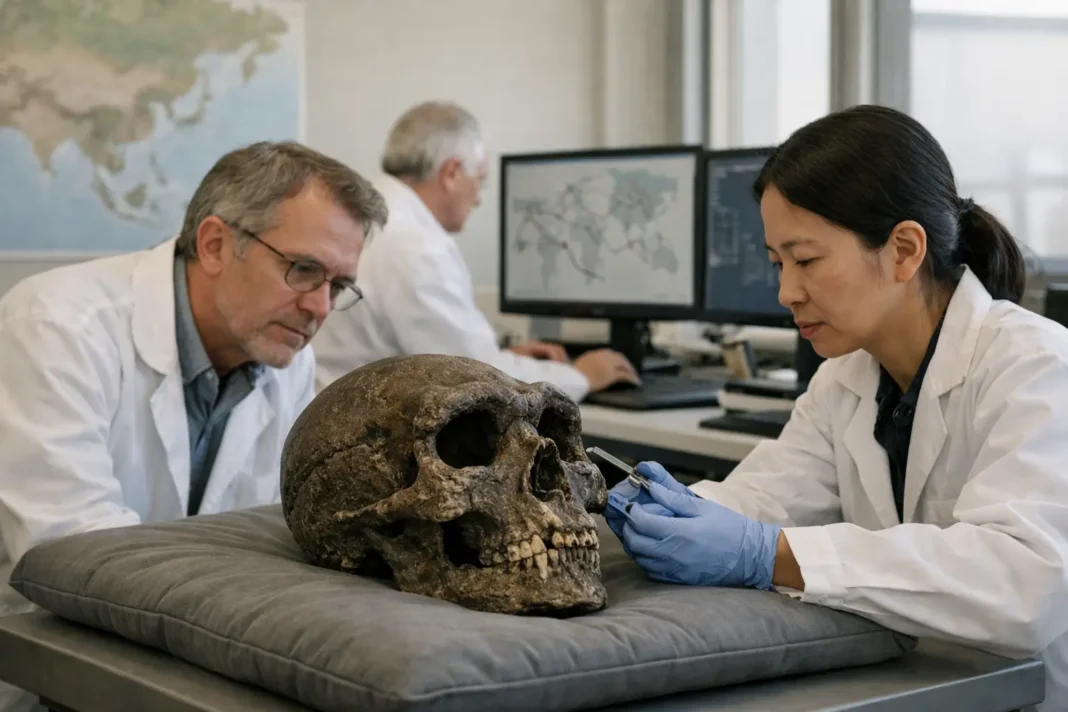
A remarkable fossil skull from north-eastern China is changing how researchers describe the late chapters of human evolution. Known as Dragon Man, the Harbin skull is one of the most complete ancient human crania ever studied. It was reportedly found in 1933 during construction work near the Songhua River, hidden for decades in a well and later donated to Hebei GEO University. While parts of that discovery story remain hard to verify, the fossil itself has become central to a major scientific reassessment of Asia’s ancient human populations.
The skull’s anatomy set it apart from familiar groups such as Homo sapiens, Neanderthals, Homo erectus and Homo heidelbergensis. It combines a very large braincase, heavy brow ridges, broad eye sockets and a large face with features that are nevertheless more modern-looking than some earlier human fossils. In 2021, researchers formally named it Homo longi, after Heilongjiang, the Black Dragon River region. The specimen has since become a reference point for fossils found elsewhere in China that share similar dental and skeletal traits.
Its importance extends beyond classification. The Harbin skull has helped clarify the identity of the Denisovans, a group first recognised not from a skull but from DNA recovered from small bone fragments and teeth in Denisova Cave, in southern Siberia. Ancient genetic evidence from that cave showed that Denisovans were distinct from both modern humans and Neanderthals. Later comparisons, including studies of fossil proteins and DNA, linked the Harbin skull with Denisovan material and with other finds from China, including a jawbone from the Tibetan plateau and remains from Taiwan and south-western China. In this emerging picture, Denisovans and Homo longi refer to the same broad ancient human lineage.
The finding adds depth to a period that was far more crowded than once assumed. Over the past 300,000 years, Homo sapiens, Neanderthals, Denisovans and other human forms lived across Africa, Europe and Asia, sometimes at overlapping times. Genetic studies have shown that people outside Africa today generally carry about 2% Neanderthal DNA, while some populations in Papua New Guinea, Australia and the Philippines carry higher levels of Denisovan ancestry. These traces reflect ancient interbreeding as early modern humans moved through Eurasia and encountered related human groups.
The Harbin skull therefore matters not only as a rare fossil, but as evidence that the human family tree is better understood as a network of lineages, contacts and survivals. Advances in ancient DNA and proteomics are now allowing scientists to connect fragmentary fossils that once seemed impossible to place. For archaeology and palaeoanthropology, Dragon Man has become a reminder that the story of our origins is still being rewritten by finds preserved in caves, river deposits and museum collections.