



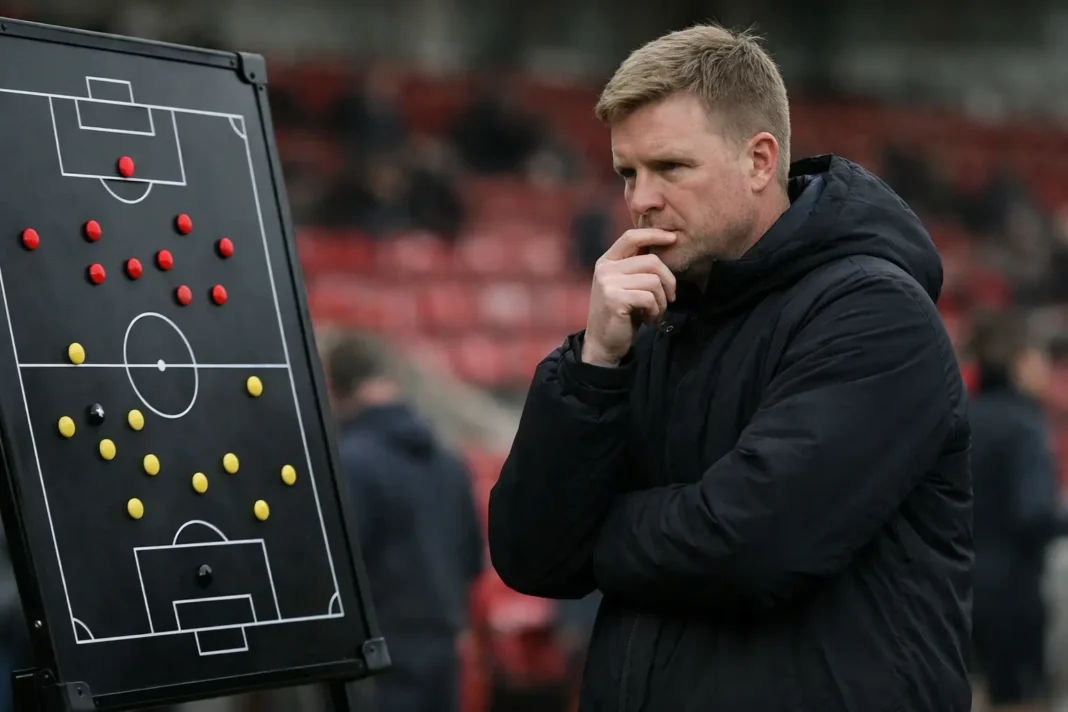
Eddie Howe’s name being linked with Manchester United underlines the continuing importance of coaching identity at one of English football’s most scrutinised clubs. Howe’s reputation rests on detailed training-ground work, aggressive organisation and a record of improving teams over time. For United, a club often judged not only by results but by style, authority and long-term direction, the attraction is easy to understand without implying that any appointment is imminent.
Howe’s strongest case is built on his work at Bournemouth and Newcastle United. At Bournemouth, he became associated with a progressive, possession-based approach while guiding the club through an exceptional rise into the Premier League. At Newcastle, he took over a side facing serious difficulties and later oversaw qualification for the Champions League for the 2023-24 season. Those achievements support the view that he can create structure, raise standards and extract more from squads that require clarity.
For Manchester United, the question is not only whether Howe is a capable coach, but whether his methods would translate to a different scale of pressure. Old Trafford brings global attention, commercial weight and a daily debate around selection, recruitment and results. A manager there must handle elite players, media scrutiny and the demand for immediate progress while still building a coherent model. Howe’s teams require intensity and repetition; implementing that at United would depend heavily on squad profile, fitness, recruitment discipline and patience from the hierarchy.
The tactical fit would also require careful assessment. Howe has often favoured energetic pressing, compact distances between units and quick attacking patterns. United have at times looked caught between approaches in recent seasons, with individual quality not always matched by collective control. If Howe were ever pursued, the club would need to judge whether its existing players suit his preferred tempo and whether future transfer decisions would be aligned with a defined plan. Without that alignment, even a clear coach can be left managing contradictions rather than solving them.
There is also the Newcastle dimension. Howe has built credibility there and remains closely identified with a project that has already delivered European qualification. Any serious conversation involving him and United would therefore carry sporting and contractual complications. The link is significant because it reflects the profile Howe has earned in English football, but it also highlights the central challenge for Manchester United: choosing a manager is only one part of rebuilding a club. The larger task is ensuring that the appointment, squad and football structure all point in the same direction.
