



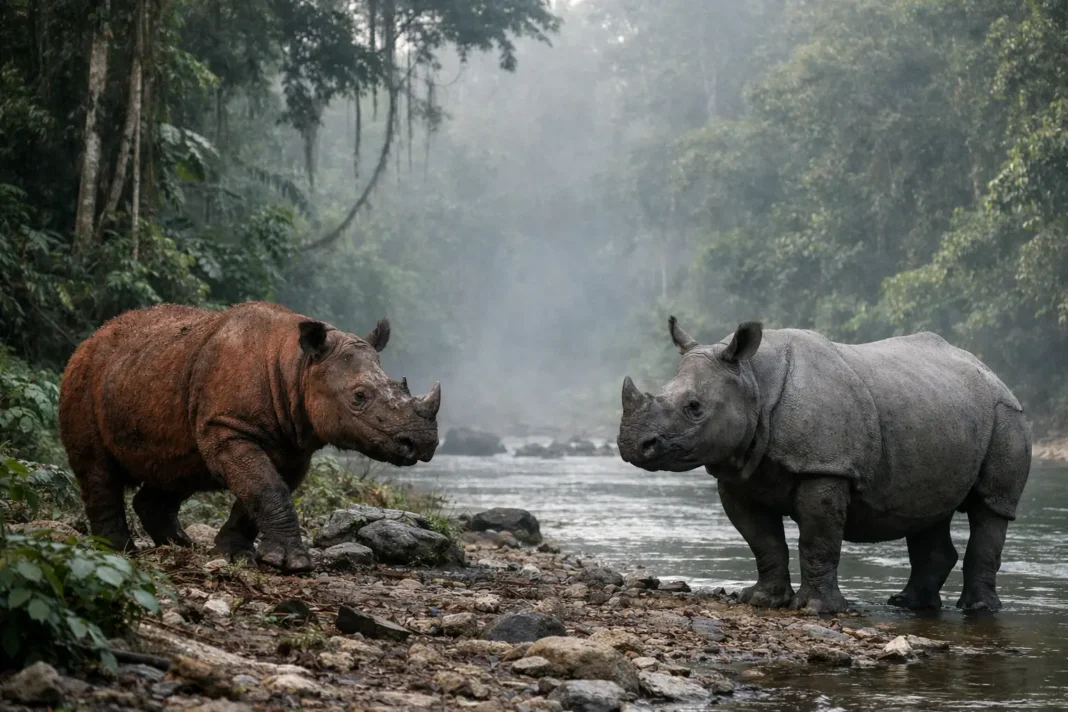
Indonesia’s remaining rhinos occupy one of the most precarious positions among the world’s five rhinoceros species. Conservation assessments show fewer than 50 Sumatran rhinos remain and roughly 50 Javan rhinos survive, all confined to a single protected area. The International Rhino Foundation and other specialists warn that these low totals place both species at imminent risk of extinction in the wild. The concentration of individuals and scattered, tiny subpopulations amplify the danger.
The two species’ distributions offer distinct vulnerabilities. The remaining Javan rhinos are restricted to Ujung Kulon National Park on the island of Java, where a single catastrophic event could wipe out the entire population. Sumatran rhinos are divided into isolated pockets on Sumatra and Borneo, reducing chances of natural pairings. Efforts to manage small groups in semi-captive conditions began decades ago: the Sumatran Rhino Sanctuary, established in 1996 in Way Kambas, currently cares for a small number of individuals and has recorded several births and recent pregnancies, underscoring both the challenges and limited successes of intensive management.
Two pressures dominate the decline: illegal hunting and habitat loss. Poaching driven by demand for horn in parts of Asia has killed multiple individuals in recent years, with reported losses among Javan rhinos particularly alarming. Habitat conversion, fragmentation and human encroachment further shrink the living space these rhinos need to find mates and raise calves. Conservation practitioners emphasise that law enforcement, targeted behaviour-change campaigns and habitat protection must operate in concert if populations are to stabilise.
Long-term recovery will require a mix of strategies: expanding and connecting secure habitat, continued veterinary and reproductive work, and carefully planned translocations where feasible. Any such programme must be paired with sustained funding, political commitment and tangible community benefits so that local people share in conservation gains. Recent births and the announced pregnancies provide cautious hope, but the window for action is narrow. Efforts across government, NGOs and local communities will determine whether future generations can still encounter these small, distinctive rhinos in Indonesia and beyond, or whether the species will be lost from the wild.
