



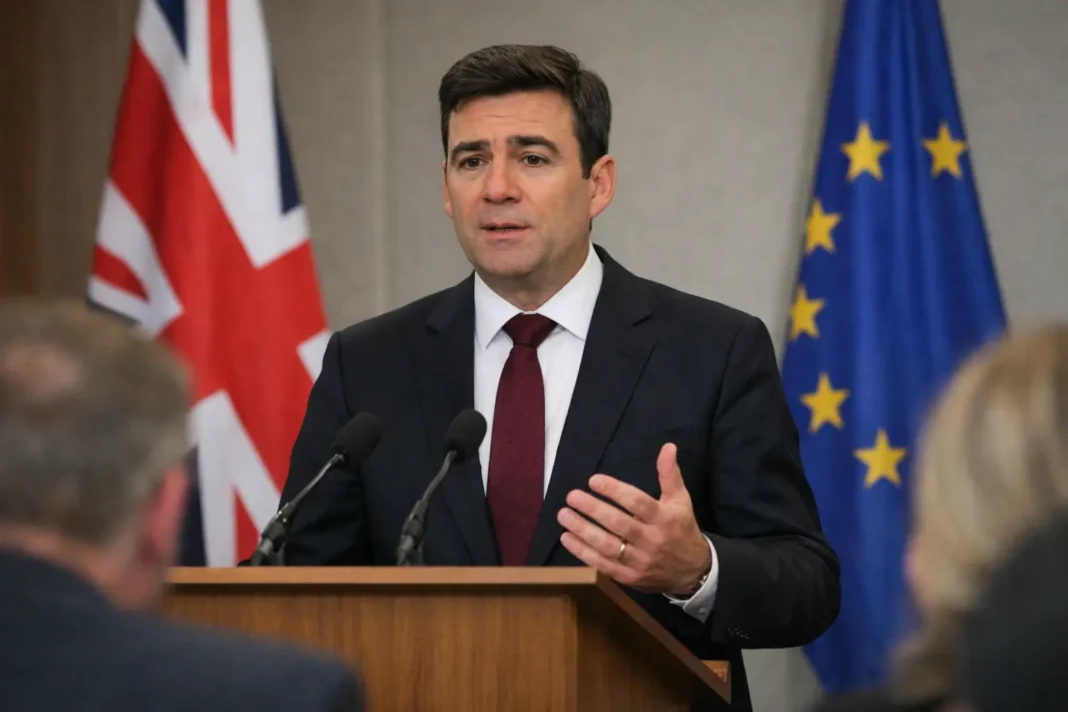
A new UK-EU agreement has reopened the political debate over how far Britain should go in rebuilding links with the bloc after Brexit. Andy Burnham said the deal reached on Friday should be seen not as an endpoint, but as a basis for exploring closer cooperation between the United Kingdom and the European Union.
The agreement covers three areas with practical significance for households, businesses and younger people: British food exports, emissions trading and a youth experience scheme. Each touches on a different part of the post-Brexit settlement. Food exporters have faced added friction in selling into EU markets, while emissions trading remains central to climate policy and industrial planning. The youth element signals a limited opening in an area that has remained politically sensitive since freedom of movement ended.
Burnham framed the development as an opportunity to look again at cooperation with Europe without reversing Brexit itself. His intervention reflects a wider shift in the domestic conversation, where the focus has increasingly moved from constitutional arguments to the economic and social effects of looser ties with the EU. For city regions, universities, exporters and sectors exposed to cross-border rules, even technical agreements can carry considerable weight.
The deal also matters because it involves both regulatory and people-to-people dimensions. Arrangements on food exports can affect the competitiveness of British producers, particularly smaller firms with limited capacity to absorb checks and paperwork. Linking or coordinating emissions trading systems can influence the cost of carbon-intensive activity and the predictability of investment decisions. A youth experience scheme, meanwhile, would create a defined route for younger people to spend time across borders, although its scope and conditions remain central to how it will be judged.
The UK Government and EU institutions remain the key actors in determining whether Friday’s agreement leads to further alignment or stays confined to specific sectors. Any next steps would need to balance economic access, regulatory autonomy and political consent. For now, Burnham’s comments underline the renewed importance of the relationship between London and Brussels, with incremental cooperation once again becoming a central feature of the post-Brexit agenda. Official positions and future implementation will depend on engagement between the UK Government and the European Commission.
