



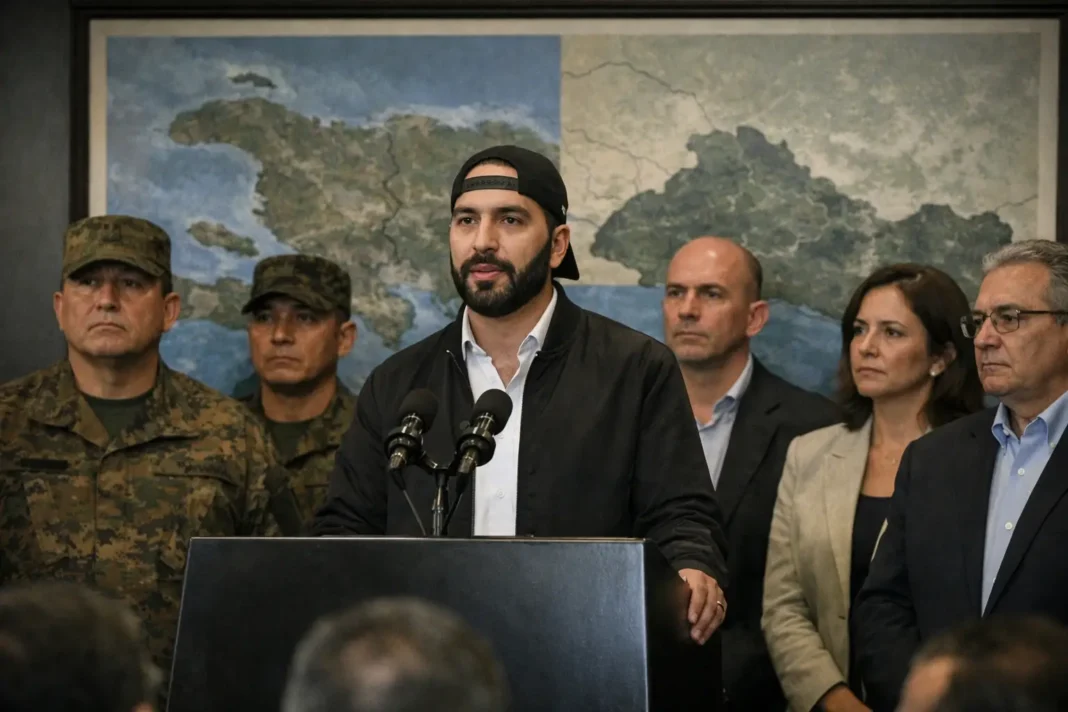
El Salvador’s military role in Haiti has moved from participation in an international security effort to a high-profile offensive that is testing President Nayib Bukele’s anti-gang model beyond his country’s borders. On Nov. 10, 2026, Bukele published footage of attack helicopters firing on a compound near Port-au-Prince, after earlier asking online in Haitian Creole for the address of Wilson Joseph, leader of the 400 Mawozo gang. Bukele later said the operation, carried out with Haitian police, destroyed Joseph’s residence and gang headquarters. Up to 20 people were killed, while Joseph was reportedly not present.
The escalation follows an Oct. 18 ambush in which four Salvadoran aviation technicians attached to the Gang Suppression Force disappeared. Their burned vehicle was found, but their fate remains uncertain. Within weeks, El Salvador had deployed roughly 2,500 troops, armored vehicles and attack helicopters, initially describing the move as a rescue mission. The wider battlefield is already crowded: Haitian police and military units operate alongside the UN-backed force, while private security actors and local vigilante groups are also active. Armed groups linked to Viv Ansanm continue to control large areas of Port-au-Prince and operate outside the capital.
The legal and operational framework remains a central concern. The UN Security Council authorized the Gang Suppression Force in 2025 to help Haitian authorities retake territory from gangs, with a ceiling of 5,550 personnel; about 2,000 are currently on the ground. Most Salvadoran troops now in Haiti are not under that force’s command. Prime Minister Alix Didier Fils-Aimé has said Haiti directs the operations, but neither government has publicly released an agreement setting out rules of engagement, command authority or the duration of the deployment. Marco Rubio, the U.S. secretary of state, has said Washington is not actively involved and warned that poor coordination could create the risk of friendly fire.
Haiti’s security emergency gives the intervention its political force. Nearly 6,000 people were killed in 2025 and more than 4,000 in the first nine months of 2026, while almost 1.5 million people had been displaced by August 2026. Recent operations include the Nov. 6 killing of Mathias Saintil, head of the “Boston” gang in Cité Soleil, in a drone strike by a Haitian special task force. Yet the use of explosive drones and helicopters in populated areas has heightened concerns over civilian casualties. Rights groups have repeatedly warned that residents of gang-controlled neighborhoods are not necessarily gang members, a distinction with direct implications for lawful use of force.
Bukele’s approach carries regional significance because falling homicide rates in El Salvador have made his hard-line security strategy attractive to governments facing organized crime. The model has also relied on emergency powers and mass imprisonment, making its export to Haiti politically and legally sensitive. Haiti presents different challenges: heavily armed gangs, fragile institutions, recruitment of children and criminal networks tied to roads, markets and illicit trade. Military gains may be immediate, but lasting security will depend on whether Haitian police, courts and public institutions can hold recovered areas after foreign troops leave.