



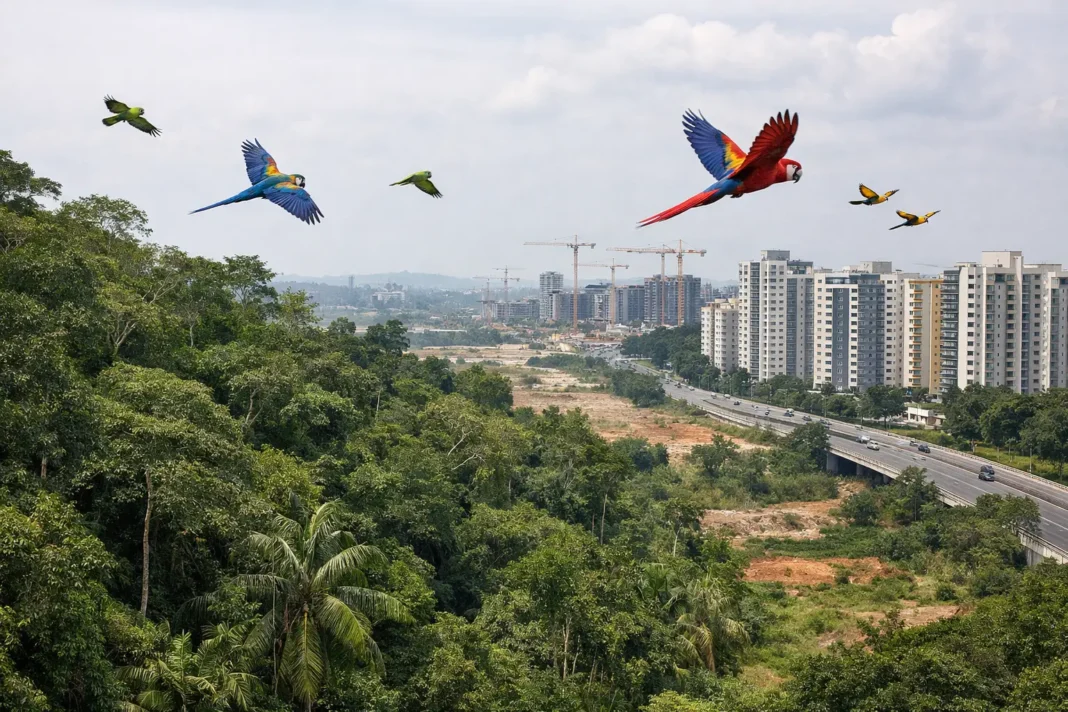
As cities push outward, birdlife in the tropics is paying the heaviest price. The central finding is clear: where urban areas expand, tropical regions lose more birds than ecosystems at higher latitudes. The result matters because it links two defining environmental trends of the century: accelerating urbanisation and the concentration of life in the world’s most species-rich zones. It also shows why the ecological consequences of growth cannot be assessed only by the amount of land converted, but by where that conversion takes place.
Tropical ecosystems are widely recognised for their exceptional biological richness. Scientists describe the increase in biodiversity from the poles to the equator as the latitudinal diversity gradient, a pattern visible across many branches of the tree of life and supported by fossil evidence over long periods of time. In simple terms, the same urban footprint can have a far greater impact in a tropical forest or wetland than in a region where fewer species occur. That makes biodiversity loss in tropical cities a global concern, not only a local planning issue.
Urban growth replaces and fragments habitats through roads, buildings and infrastructure, creating environments that many birds cannot use. In the tropics, where communities often include large numbers of specialised species, the loss of habitat can translate into a sharper decline in bird diversity. The issue is particularly important because urbanization is expanding in many regions that overlap with high natural diversity. The pressure is therefore concentrated in places where ecological value is already exceptionally high.
The finding strengthens the case for integrating nature into city planning, especially in tropical regions. Measures such as protecting remaining habitat, maintaining green corridors and preserving native vegetation can influence how much wildlife survives as urban areas grow. International institutions including IPBES and the Convention on Biological Diversity identify land-use change as a central driver of biodiversity decline. Urban expansion is one part of that wider transformation, but in the tropics its effects are amplified by the density of life at risk.
The importance of the tropics is not only their present-day richness, but the deep history behind it. A biodiversity pattern that has persisted for millennia cannot be quickly rebuilt once habitats are removed. For birds, cities need not be empty landscapes, but their design determines which species remain and which disappear. The evidence gives planners a clear warning: protecting tropical birdlife requires decisions before expansion locks in permanent ecological loss.