



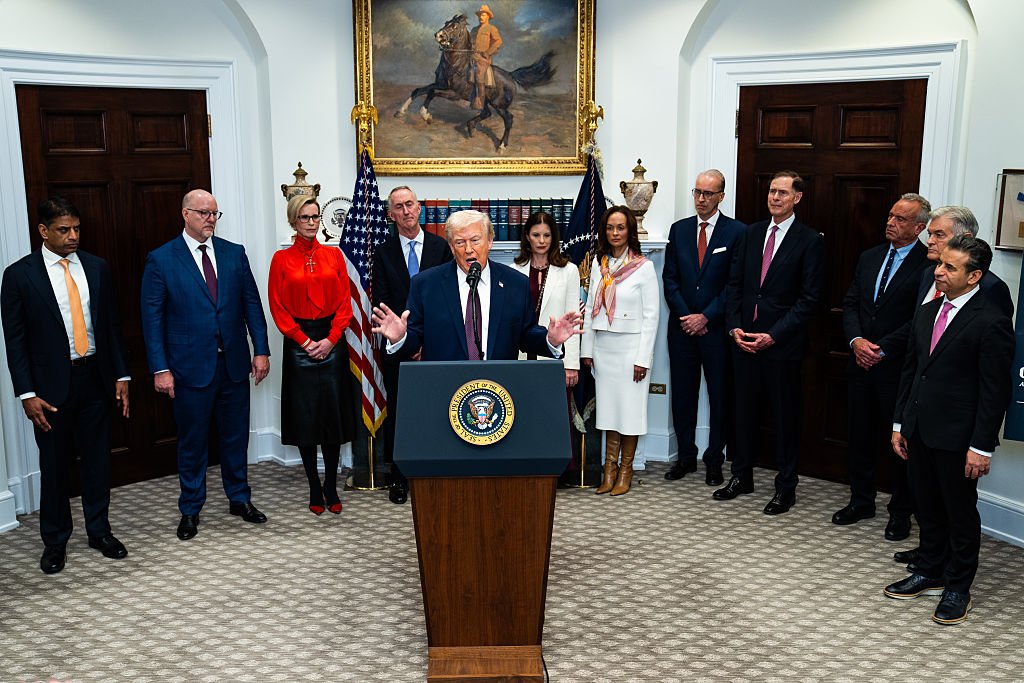
After Trump announced tariffs on imports of innovative drugs, industry experts warn the move marks a major shift in how medicines are treated in global trade, with far-reaching consequences.
It is now official: the supply of medicines has been deemed a security issue by Trump, who set tariffs of 15% for patented medicines from Europe and some other countries, and up to 100% on products from elsewhere. The measures follow a Section 232 investigation that frames pharmaceutical supply as a national security issue. For analysts, this signals a departure from traditional trade logic.
“It is a fundamental shift in how pharma and biotech are discussed, that the US administration sees pharma and biotech as a sector that is of importance for national security”, says Diederik Stadig, healthcare expert from the Dutch banking group ING.
He told Euractiv this is not just about reducing dependency on supply chains. These are heavily intertwined and, particularly for generics – which are exempt from the tariffs – production is unlikely to shift to the US anytime soon.
Instead, he sees a global race to lead in life sciences innovation, especially in biotech, where AI could play a pivotal role in discovering new pharmaceuticals. “Biotech has now become a sector of national security because both the US and China believe that AI is a must-win battle going forward.”
“Unintended consequences”
However, others like EUCOPE, representing small and mid-sized companies, warn of potentially dire consequences for patients: “Trade measures of this scale may lead to unintended consequences, including supply disruptions, reduced availability of treatments, and increased costs across healthcare systems.”
At the moment, only 16 big pharma companies that have struck separate deals with Trump are exempt from tariffs in return for investing heavily in the US and lowering drug prices, leaving smaller companies to bear the brunt of the new levies.
The president of the German innovative pharma association (vfa), Han Steutel, also highlighted the significance of the decision.
“The measures represent a significant intervention in the global medicines market. They mark a turning point in global trade in pharmaceuticals,” he wrote in a press release.
“Overall, this is less a classic trade policy measure than a targeted industrial policy strategy with geopolitical dimensions”, the association said, warning of an “urgent need” to review investment incentives and regulatory frameworks in the sector.
Implementation will take place in stages starting on 31 July 2026, with companies given roughly 120 to 180 days to adjust their business models, leaving room for further negotiations with Washington.
Commission aims to reduce tariffs
The European Commission says it is assessing the measures and notes that the 15% tariffs are in line with commitments made in the EU–US Joint Statement of 21 August 2025, backed by the European Parliament in March 2026.
However, given the strategic importance of the sector, Brussels says it will seek to reduce tariffs, paradoxically stating that the agreement itself foresees lowering them, “in particular for life-saving products such as pharmaceuticals and medical devices”.
(aw)
Source:
www.euractiv.com