



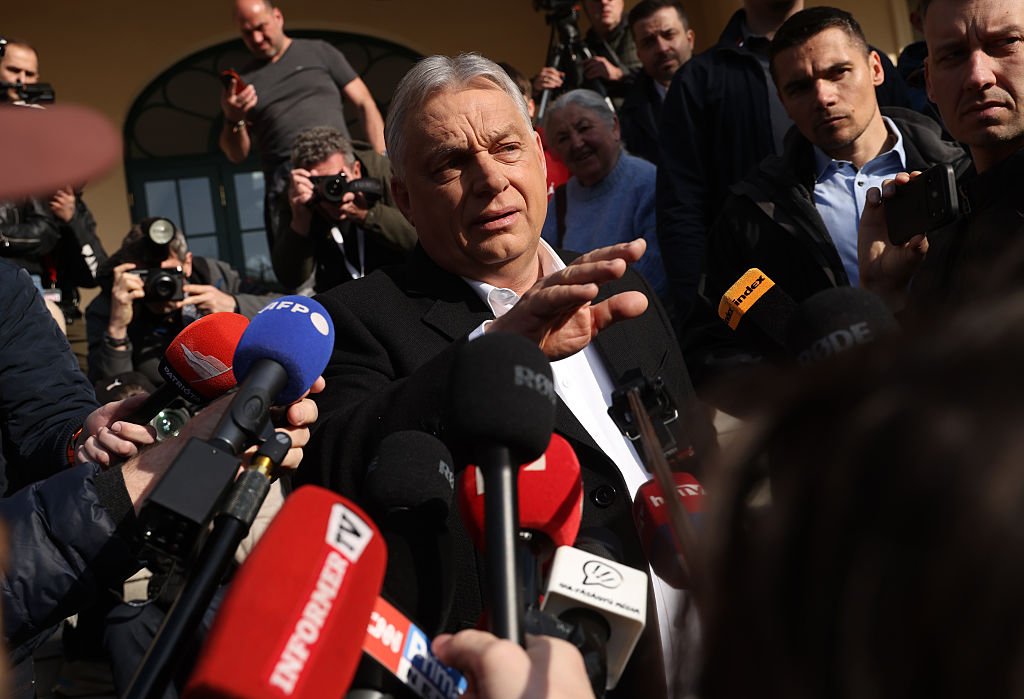
After storming to victory in last month’s parliamentary elections, Hungary’s new Prime Minister Péter Magyar has promised to restore media freedom in the country. He has his work cut out.
Under 16 years under Viktor Orbán’s leadership, Hungary’s independent media has been hollowed out. At the start of the Orbán premiership in 2010, Hungary ranked 23rd in Reporters Without Borders’ Press Freedom Index. In just over a decade, it had slumped to 92nd.
This clampdown didn’t play out like anything you would see in the movies, with journalists being frog-marched from their desks by police. It was achieved through a much more gradual and underhand reshaping of the very ecosystem in which independent journalists operate.
First came a manipulation of state advertising spend. Instead of being allocated based on audience reach or value for money, the government’s advertising budget increasingly flowed toward friendly outlets, while critical voices were starved of this revenue stream.
Then came the centralisation of ownership. Pro-government businesses bought up outlets across print, radio, TV and online. As the ownership was concentrated, editorial independence became increasingly narrowed. Editors and reporters faced mounting pressure to align coverage with political priorities.
In this environment self-censorship becomes endemic. Journalists learn which topics would trigger retaliation, and which narratives would be rewarded with access and resources.
Hungary is not alone in this regard. We are seeing this kind of state capture of the media industry used to systematically weaken press freedom across much of Central and Eastern Europe. It is often paired with both cyber-attacks, such as spyware infections used to monitor journalists’ devices, and the weaponisation of national security laws against newsrooms, in what is now widely referred to as ‘the authoritarian playbook’.
What all these tactics have in common is that they are cheap, scalable and deniable. Regimes can hide behind technical complexity and muddy attribution long enough to avoid the diplomatic costs that come from overt attacks on journalists.
In a perfect storm, the United States has stepped back from the global stage with the result that Central and Eastern European newsrooms – and the organisations that work to safeguard them – are also haemorrhaging funding.
Until last year, the United States was contributing between $135 million and $248 million in foreign assistance to support independent media – a significant chunk of which was funding the sustainability and safety of Central and Eastern European newsrooms. Now, most of this funding has vanished.
This is more than just an existential crisis for independent newsrooms in the region. It is a fundamental issue of European defence.
Despite all that has been thrown at them over the last two decades, these newsrooms are still consistently the first to the story when it comes to exposing attempts to influence and destabilise Europe’s democracies. They understand the languages better, have sources on the ground and monitor networks overlooked by larger Western European outlets.
No finer example of this came than in the run-up to the Hungarian election. A cross-border investigative consortium led by the Central European investigative network, VSquare, obtained and authenticated recordings of calls between Hungary’s Minister of Foreign Affairs, Péter Szijjártó, and Russian Foreign Minister Sergey Lavrov.
Transcripts of the calls showed Szijjártó passing on information from closed EU discussions that would allow Russia to block and delay sanctions packages.
Disinformation beyond lies: Europe is fighting yesterday’s disinformation war
For more than a decade, efforts to counter disinformation have been guided by a relatively…
4 minutes
Yet investigations like this take months to build and significant financial backing. Meanwhile, thanks to the acceleration of generative AI, foreign interference tactics like disinformation campaigns can be crafted and launched in hours.
With the EU negotiating its 2028-2034 budget, defence is understandably at the top of the agenda. But strengthening European defence doesn’t just mean more military might. It means information security. When the information space is captured by foreign influence campaigns, elections become easier to sway, governing legitimacy begins to fray, and the social cohesion needed to respond to crises erodes.
Brussels increasingly recognises this. The European Democracy Shield – a flagship project pushed personally by Ursula von der Leyen – reflects a growing acknowledgement at the heart of the EU that information resilience is now a matter of hard security.
Central and Eastern European independent newsrooms are a critical bulwark against this kind of foreign interference. Strengthening European defence means protecting them at all costs.
Antonio Zappulla is CEO of the Thomson Reuters Foundation.
Inside Euronews: How Europe’s broadcaster became an influence network
On a sunny autumn afternoon in Brussels’ Autoworld Museum, the polished bonnets of vintage Jaguars…
18 minutes
Source:
www.euractiv.com