



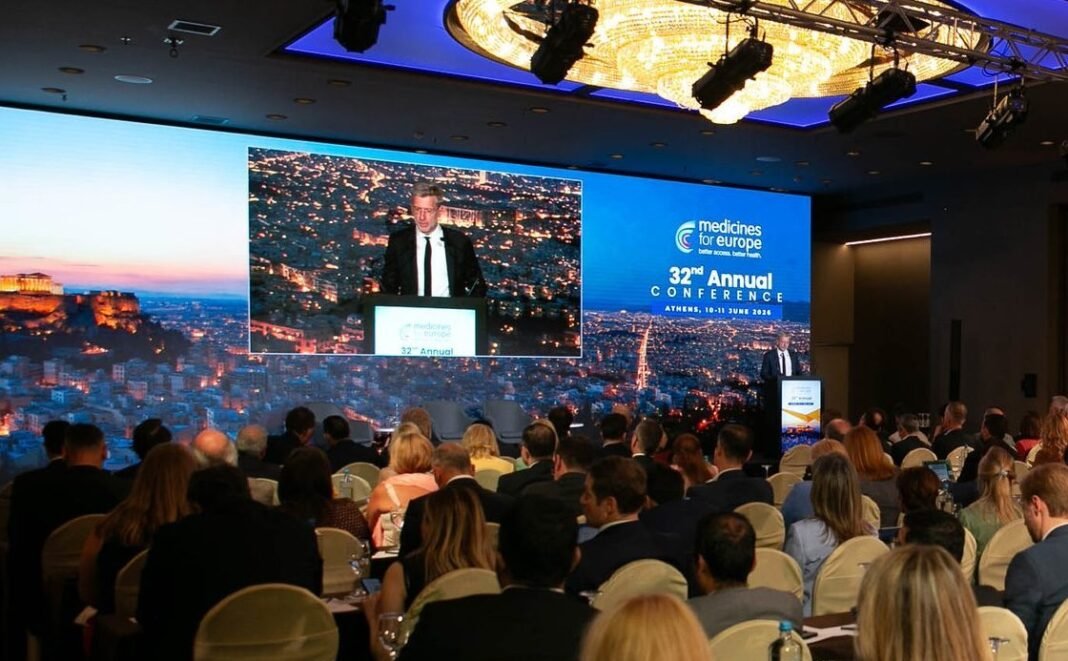
Europe must decide whether it wants to remain a pharmaceutical producer or become increasingly dependent on imports, political leaders and industry representatives warned at the recent Medicines for Europe Annual Conference in Athens, as discussions on strategic autonomy, supply security and industrial competitiveness have moved to the centre of the EU health agenda.
At a time when the EU is reassessing its dependence on external suppliers for critical medicines and pharmaceutical ingredients, the central message emerging from the conference was that the off-patent medicines sector should no longer be viewed solely as a cost-containment tool for health systems but as a strategic asset for Europe’s economic resilience and health security.
The sector currently supplies around 70% of medicines used across Europe, while supporting approximately 190,000 highly skilled jobs and more than 400 manufacturing sites throughout the EU.
For Greece, the debate carries particular significance. Over the past decade, the country has developed into an important pharmaceutical manufacturing and research hub in southeastern Europe, with 51 manufacturing facilities, 31 research and development centres and more than 15,000 direct jobs.
Minister of State Akis Skertsos described the industry as “one of the most dynamic sectors of the Greek economy” and “a strategic pillar of Europe’s resilience and competitiveness”.
“Strengthening Europe’s pharmaceutical production capacity is not only an economic imperative; it is also a matter of strategic autonomy and security,” Skertsos said. “Ensuring reliable access to critical medicines for European citizens is an essential component of a stronger and more resilient Europe.” He also linked Greece’s ambitions in the sector to its upcoming Presidency of the Council of the European Union in 2027, saying the country intends to contribute actively to shaping Europe’s future health and industrial agenda.
Theodore Tryfon, President of the Panhellenic Union of Pharmaceutical Industries (PEF) and vice-president of Medicines for Europe, argued that the geopolitical upheavals of recent years had fundamentally changed the role of the off-patent medicines industry. “Access to affordable medicines cannot be taken for granted – it must be actively secured,” Tryfon remarked.
“Resilient supply chains are not optional; they are a strategic imperative. A strong European manufacturing base is not a preference; it is essential for autonomy and stability.” As he explained, the off-patent medicines sector is no longer just a component of Europe’s healthcare systems. “It is a pillar of Europe’s health security and strategic autonomy.”
Greece’s model attracts attention
A significant part of the conference focused on Greece’s experience in supporting domestic pharmaceutical production through public-private partnerships and targeted industrial policies.
Health Minister Adonis Georgiadis pointed to the so-called “investment clawback” mechanism, which allows pharmaceutical companies to offset mandatory clawback payments through investments in production facilities, research and development.
According to Georgiadis, the scheme has already triggered more than €1.5 billion in investments with less than €500 million in public financing. “Now all these investments are starting to mature,” he said. “In the years to come, we will practically double the size of our internal pharmaceutical industry.”
The minister also highlighted Greece’s multi-winner procurement model, introduced during the financial crisis after single-winner tenders contributed to medicine shortages in hospitals.
Under the revised system, contracts are awarded to multiple suppliers rather than a single company, helping secure supply continuity while maintaining competition. “We are a country with the least shortages of medicines throughout Europe,” Georgiadis said, arguing that the model could offer useful lessons for other member states. The discussion comes as Brussels advances the implementation of the Critical Medicines Act, designed to strengthen pharmaceutical manufacturing and supply chain resilience within Europe.
Europe’s competitiveness challenge
For Steffen Saltofte, president of Medicines for Europe and CEO of Zentiva, Europe faces a fundamental choice. “Do we want to be a consumer or do we want to be a producer?” he asked during the opening panel discussion. Saltofte argued that the EU’s regulatory and pricing frameworks have failed to keep pace with a rapidly changing global environment, while competitors such as the United States, China, India and Japan are moving faster to attract pharmaceutical investment.
“If we do not have a foundation and a structure for off-patent medicines in Europe, it becomes very hard to continue serving our patients,” he said. He called for greater regulatory coherence, more collaboration between member states and reforms to pricing systems that, in some cases, have remained largely unchanged for decades.
The industry, he said, remains committed to investing in Europe but requires a more predictable policy environment. “We need the right framework, the right regulations and the right set-up,” Saltofte said. “Industry will contribute, but sustainability requires stability.”
Environmental rules under scrutiny
Another major theme was the growing concern among manufacturers regarding the Urban Wastewater Treatment Directive and broader environmental legislation affecting pharmaceutical production.
While speakers emphasised their support for Europe’s environmental objectives, they warned that implementation must be based on robust scientific evidence and fully consider potential impacts on the availability of medicines and industrial competitiveness.
Saltofte criticised the evidence underpinning some elements of the Urban Wastewater Treatment Directive in its current form, arguing that policymakers should engage in what he called “an adult conversation on facts” before imposing additional costs on manufacturers.
Georgiadis echoed those concerns, warning that introducing environmental measures without a comprehensive assessment of their industrial and healthcare implications could inadvertently undermine Europe’s own objectives on health security and strategic autonomy.
“If pharmaceutical production in Europe starts to decline, we will eventually face shortages,” he said. “We all want clean water, but we must find a way to achieve environmental goals without destroying our industrial base.”
Looking towards 2027
The conference repeatedly returned to the question of Europe’s long-term pharmaceutical strategy and the role Greece could play during its EU Council Presidency in 2027.
For both policymakers and industry leaders, the challenge extends beyond medicines alone. It touches on industrial policy, economic competitiveness, technological innovation and Europe’s ability to maintain strategic autonomy in an increasingly fragmented world.
Tryfon argued that Europe possesses the necessary scientific expertise, industrial capacity and talent to succeed, but requires greater alignment between governments, industry, patients and European institutions.
“Europe stands at a crossroads,” he said. “If it seeks genuine strategic autonomy, resilient health systems and security of supply, it must invest in its own productive base.”
[BM]
Source:
www.euractiv.com