



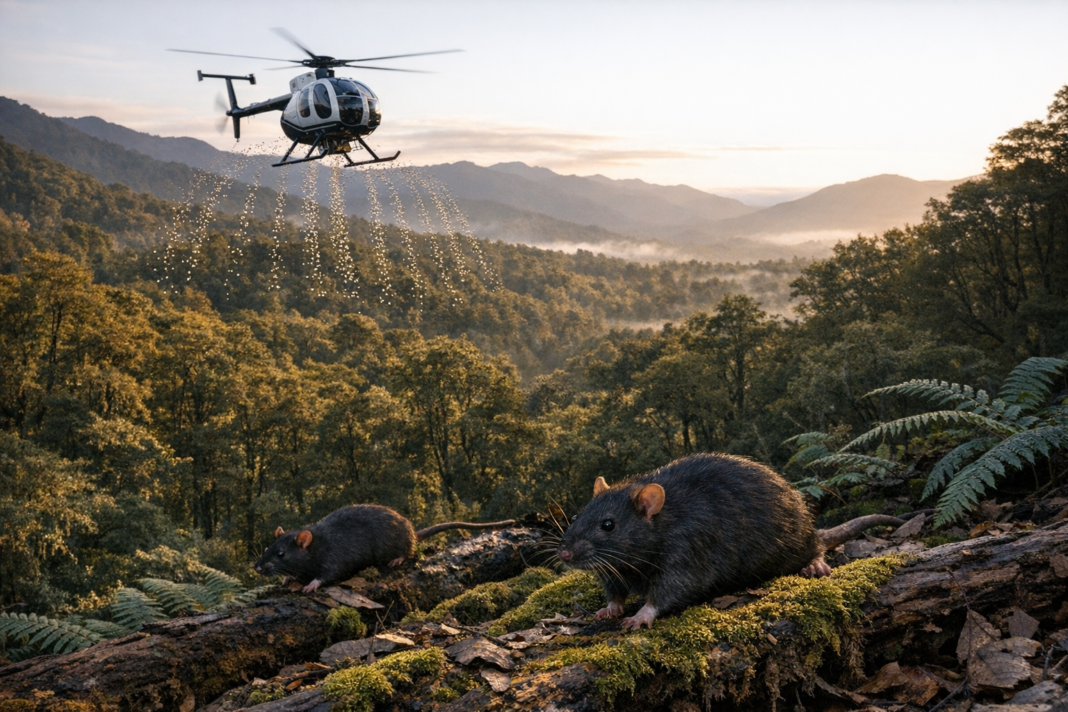
Long-term monitoring shows that aerial applications of 1080 sharply reduce numbers of rats and stoats across public reserves, but the recovery of those predators—particularly ship rats—occurs at different rates in different places. Researchers analysed 24 years of small-mammal tracking records collected across New Zealand‘s public conservation areas and found that, while initial population crashes are pronounced, rebounds to higher numbers can occur within a few years in some regions.
The dataset spanned multiple management operations and habitats, allowing the team to compare post-control trends over time. In many monitoring sites, counts of both rats and stoats fell markedly after aerial 1080 treatments, confirming the toxin’s short-term effectiveness. However, patterns diverged during the follow-up period: some localities saw persistent suppression, whereas others experienced rapid increases in ship rat detections that in some cases exceeded pre-control levels within a few years.
The variation in rebound timing between regions highlights limits to a uniform scheduling approach for landscape-scale pest control. Factors such as local habitat, food availability, predator community composition and connectivity to surrounding unbaited areas are plausible drivers of different recovery trajectories, and the study underlines the value of site-specific monitoring to inform the cadence of repeat operations. Blanket intervals between aerial treatments may leave some populations sufficient time to recover, while in other areas less frequent action could suffice.
For conservation managers and policymakers, the findings reinforce the importance of long-term surveillance to detect and respond to population rebounds before they undermine native-species recovery. Coordinated monitoring can help optimise the timing of control measures to local conditions and conservation goals. For information on national management frameworks and guidance on pest control in protected areas, see the Department of Conservation and related conservation resources available to land managers.
