



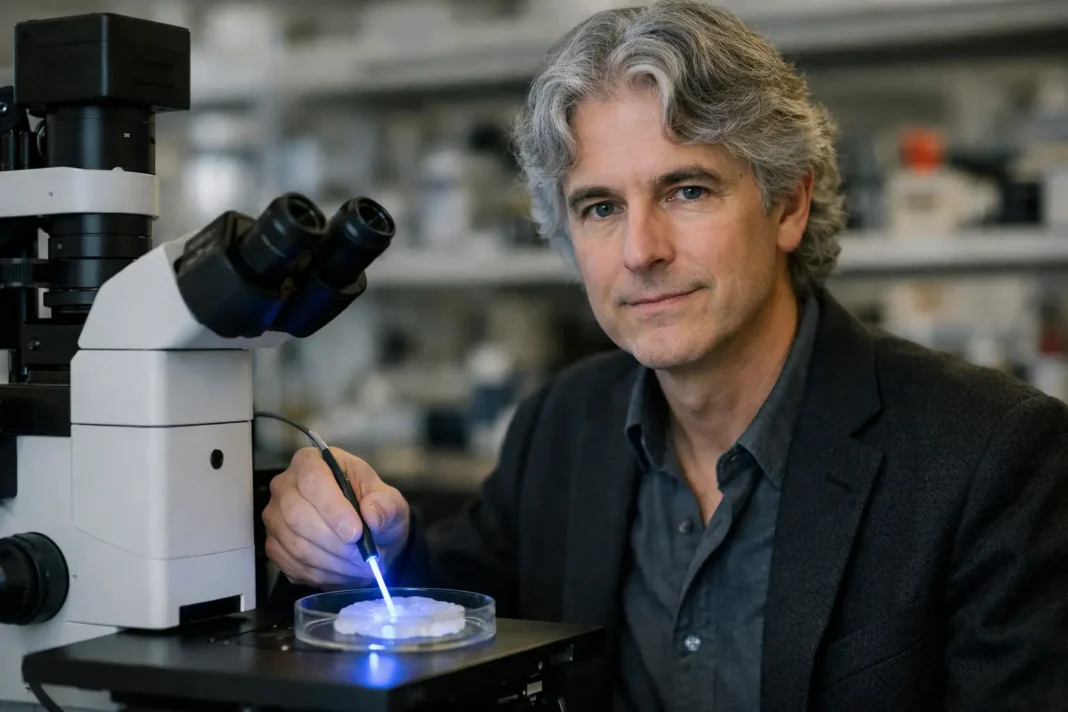
Karl Deisseroth, Nobel laureate and Stanford University professor described the rise of light-based techniques that allow scientists to activate and silence nerve cells with millisecond precision. He reflected on the clinical rotations that initially drew him to psychiatry and the subsequent laboratory work that helped establish a new experimental approach to probing the living brain. Deisseroth discussed these developments on The Conversation Weekly podcast following the 2026 Nobel prize in physiology or medicine, shared with Peter Hegemann and Georg Nagel.
At the centre of this work is optogenetics, a method that combines genetics and light-sensitive proteins to control neuronal activity. Deisseroth’s team adapted a light-activated gene originally characterised in single-celled pond algae by Hegemann and Nagel, enabling targeted control of defined cell populations in intact neural tissue. The technique gives researchers the ability to test causal links between specific neural circuit activity and behaviour, rather than relying solely on observational correlations.
Using optogenetic tools, investigators have identified cells and pathways involved in fundamental drives and complex behaviours: hunger and thirst, defensive aggression, parenting and nurturing, as well as components of anxiety, memory and motivation. These experimental results have clarified how discrete neuron types contribute to behaviour and emotional states, and have opened new pathways for basic research across psychiatry, neurology and behavioural neuroscience. The approach has been described by its practitioners as broadly applicable across model systems and brain regions, accelerating the pace at which hypotheses about circuit function can be tested.
Deisseroth also noted the translational potential of precise circuit interrogation while acknowledging limits to immediate clinical application. He has received support from the NIH and the Howard Hughes Medical Institute and was founder of MapLight Therapeutics; these disclosures were made public alongside his interviews. For listeners who wish to hear the full conversation and the scientist’s account of method development, the episode is available via The Conversation Weekly podcast, which outlines the trajectory from early clinical impressions to a tool that is reshaping experimental neuroscience.