



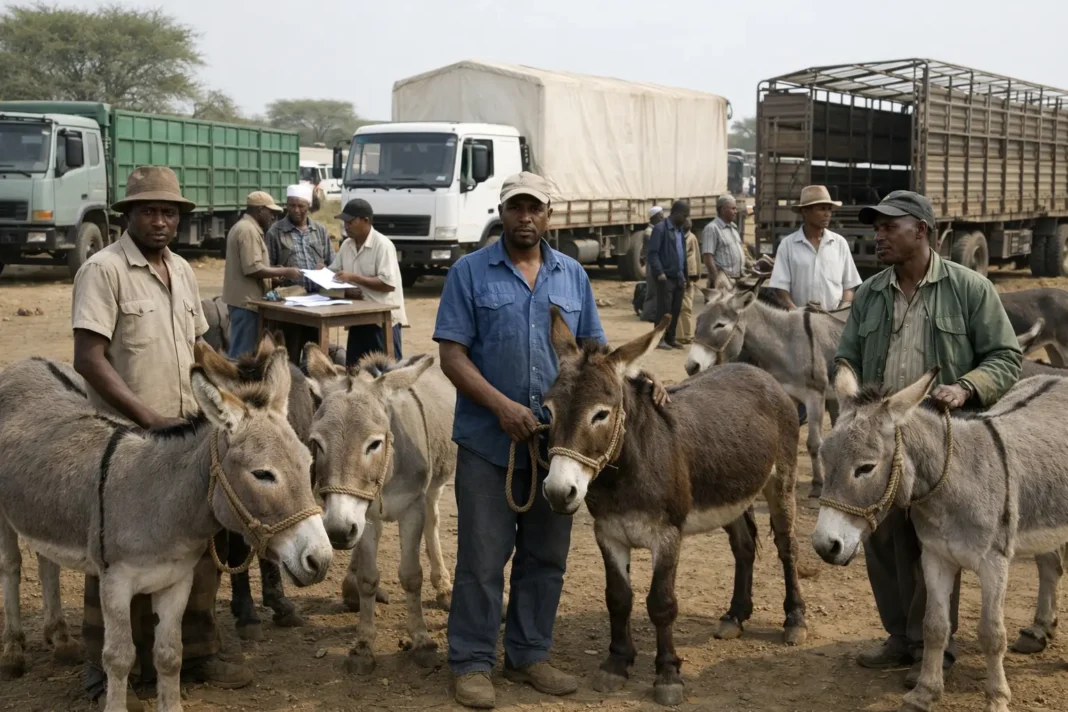
China’s appetite for donkey hides has turned a once limited trade into a major cross-border market involving millions of hides imported from Africa every year. The expansion, which has accelerated over the past 15 years, is the focus of a new book by Lauren Johnston, a specialist in China’s trade relations with the continent. Her work, China, Africa and the Market for Donkeys, examines the drivers behind the boom and the consequences of a trade that connects rural African livelihoods with Chinese demand.
The central fact behind the market is the rapid growth in demand for donkey hides, led mainly by China. In African countries, donkeys are not only animals of economic value but, in many communities, essential working animals used for transport and daily labour. That makes the trade different from many other livestock supply chains: the commercial value of the hide sits alongside the practical value of the living animal. Johnston’s research places that tension at the centre of a wider discussion about how global demand can affect local systems that depend on animals for mobility and work.
Lauren Johnston has spent several years studying the subject, bringing it into the broader field of China-Africa economic relations. Rather than treating the donkey-hide trade as a marginal issue, her book frames it as part of a larger pattern in which consumer demand, commodity extraction and rural economies are increasingly linked across continents. The market’s growth also raises questions about regulation, supply chains and the ability of local communities to manage pressures created by international buyers.
The relevance of the issue extends beyond the numbers. A trade measured in millions of hides each year can reshape perceptions of an animal often overlooked in economic analysis. It also highlights how demand in one market can create effects far from the point of consumption. For policymakers, researchers and animal-welfare organisations, the donkey-hide trade offers a case study in how global commerce can move quickly into areas where social, economic and livestock-management systems are not always prepared for sudden pressure.
Johnston’s new book gives the subject a dedicated place in the study of trade between China and Africa. Its publication comes as attention grows around the hidden consequences of specialised commodity markets, especially those involving animals central to rural life. By tracing the drivers and impact of the donkey-hide trade, the book adds context to a market that has expanded rapidly but remains little understood outside the communities and industries directly affected by it.

