



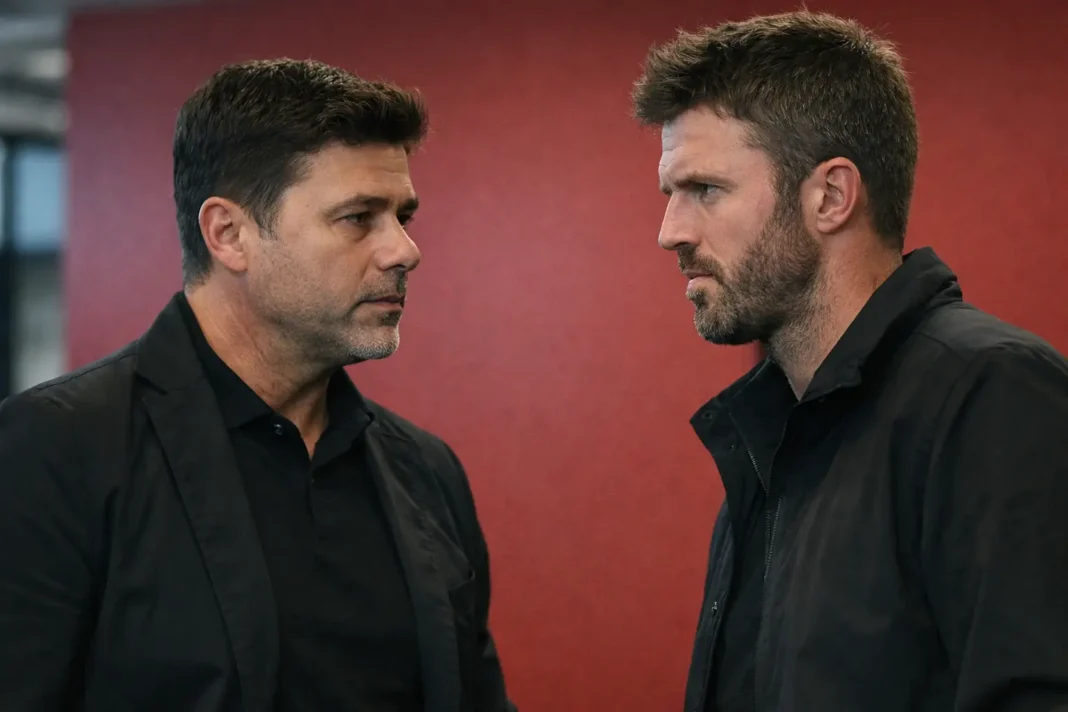
Manchester United’s search for managerial certainty has again brought Mauricio Pochettino into the centre of the conversation. The Argentine coach has been linked with Manchester United for much of the past decade, a period in which the club has repeatedly looked for a durable identity after the end of its most successful era. His name has endured because his reputation fits several of the club’s stated needs: clear coaching principles, experience with elite players and a record of developing teams over time.
Pochettino built much of that reputation in English football, where his work at Southampton and Tottenham Hotspur established him as one of the most admired managers in the Premier League. At Tottenham, he oversaw a side that regularly competed near the top of the domestic game and reached the Champions League final. He later moved to Paris Saint-Germain, adding experience inside a club where winning is treated as an obligation rather than an ambition.
For Manchester United, the attraction is not difficult to understand. The club has often balanced short-term pressure with a desire to rebuild something more coherent, and Pochettino’s profile sits between those demands. He is not a novelty candidate, nor simply a manager defined by trophies. His appeal lies in structure: teams that press with intent, young players given responsibility and senior figures expected to operate within a collective framework. Those qualities explain why the connection has survived changes in executives, squads and competitive circumstances.
Yet the situation also highlights the delicate position of Michael Carrick. A figure long associated with the club as both player and coach, Carrick has been placed in a difficult professional space: asked to provide stability while the wider debate focuses on who may come next. His contribution to United’s modern history gives him more than symbolic value. Whatever the club decides, the handling of Carrick matters because it reflects how United treats those who served during successful years and remained during more uncertain ones.
The next managerial decision will carry consequences beyond the name on the office door. United require authority, patience and a plan that can survive poor results as well as good ones. If Pochettino becomes the chosen figure, it would mark the culmination of a long pursuit rather than a sudden turn. If the club moves in another direction, the same questions will remain: how to reconnect performance, recruitment and identity at a team still measured against its own past.