



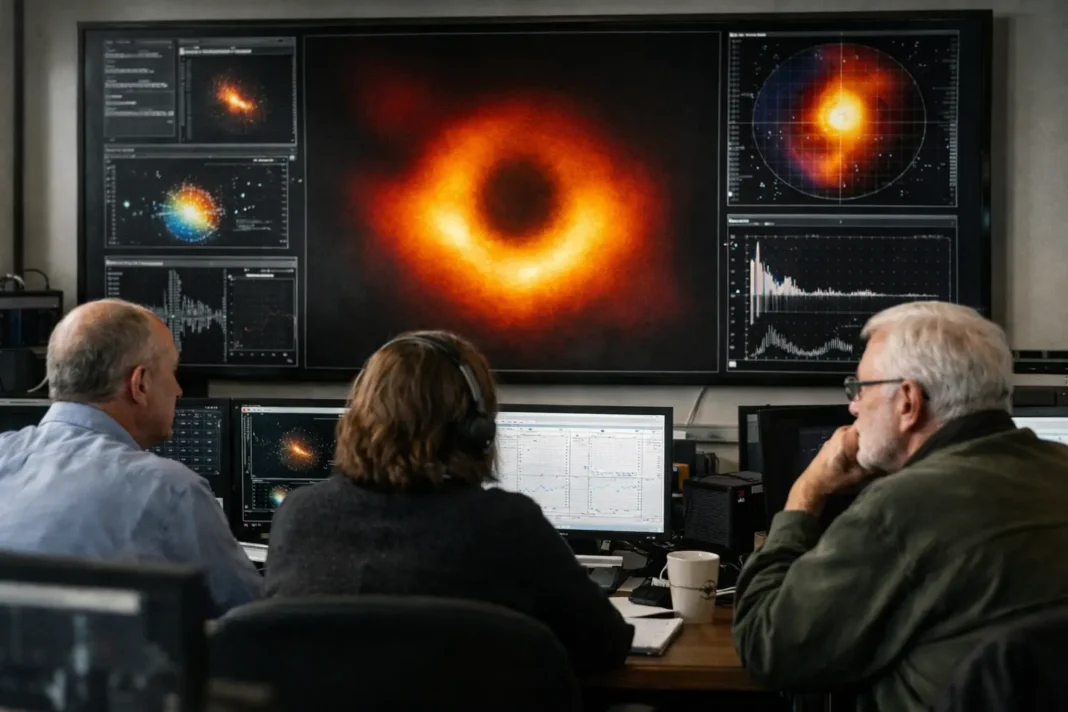
The first black hole image, unveiled on April 10, 2019, remains one of the most recognizable scientific pictures of the modern era. Produced by the Event Horizon Telescope Collaboration, it showed the object at the center of the galaxy M87, about 55 million light-years from Earth. A new independent study has now brought the image back into focus, not as a cultural symbol, but as a scientific result that can be tested, challenged and refined.
The importance of the review lies in the way such an image is made. The Event Horizon Telescope is not a conventional camera pointed at the sky. It is a planet-scale network of radio observatories that combines measurements from different sites to achieve extraordinary resolution. Because the observations are incomplete by nature, researchers rely on advanced image-reconstruction methods to turn radio data into a visual representation. That process makes independent checks essential, especially for an object as distant and extreme as a black hole.
The new work provides a separate assessment of the original result, addressing a central question: whether the famous ring-like structure is a stable feature of the data or a product of the techniques used to process it. In this context, independence matters as much as novelty. A result reached through a different route can strengthen confidence in the underlying observation, while also clarifying where uncertainties remain. The issue is not whether M87 contains a supermassive compact object, but how precisely astronomy can describe what the telescope network recorded.
M87 occupies a special place in modern astronomy because its central object offered the first direct visual evidence of the environment around a black hole’s event horizon. The 2019 image did not show the black hole itself, which by definition emits no light, but the bright emission from material and plasma shaped by intense gravity around a dark central region. That distinction is central to understanding both the power and the limits of the image: it is an interpretation grounded in data, not a snapshot in the everyday sense.
The renewed analysis underlines how major discoveries are consolidated in science. Landmark results are not frozen at the moment of publication; they are revisited as methods improve and independent teams examine the same evidence. For the public, the M87 image may remain an icon. For researchers, it continues to be a benchmark for testing instruments, algorithms and theories of gravity in one of the most extreme environments known.
