



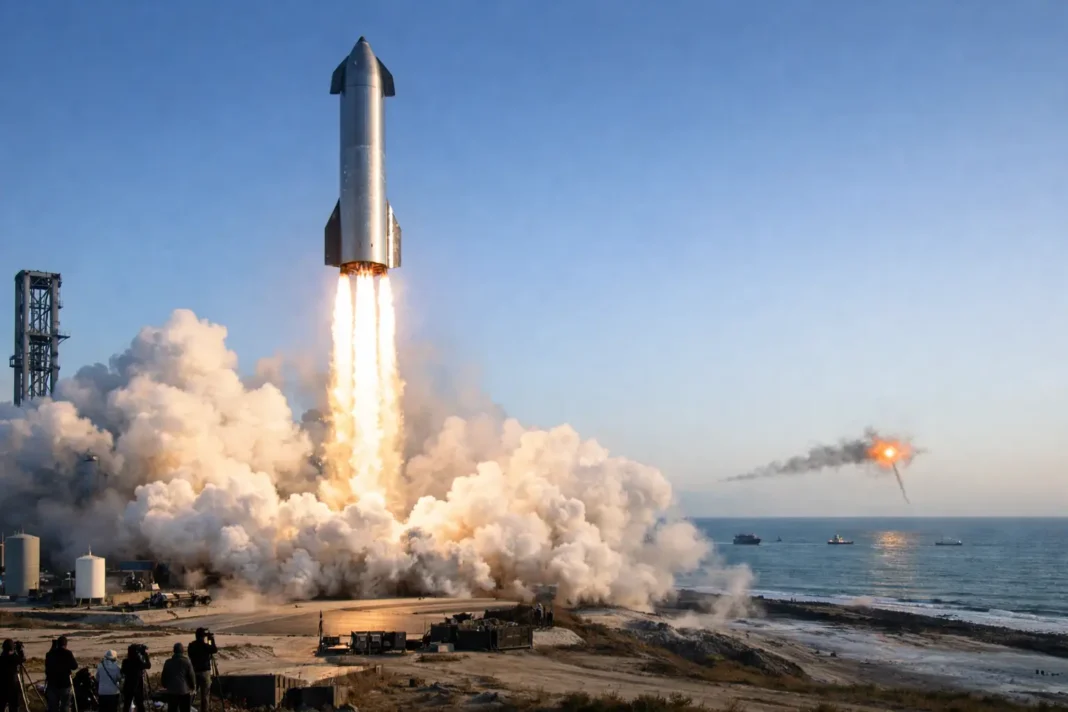
SpaceX’s latest Starship flight delivered a split outcome for the company’s reusable rocket programme: the spacecraft continued into orbit, while the booster was not recovered after exploding over the Gulf of Mexico. The test had been designed to mark a first for the system, with both stages of the vehicle targeted for capture and future reuse. The incomplete recovery underscores the technical distance between reaching space and routinely bringing back the largest elements of a launch vehicle.
SpaceX is developing Starship as a fully reusable launch system, combining a powerful booster with an upper spacecraft intended to fly again after missions. On this flight, the plan called for recovering both stages after separation, extending the method that has become central to the company’s approach to spaceflight. The spacecraft’s continuation into orbit marked progress for the upper stage, but the loss of the booster prevented the company from completing the planned recovery sequence.
The failed booster recovery matters because reusability depends on more than launch performance. A vehicle has to survive separation, descent, heating, engine operations and structural loads before it can be inspected, refurbished and prepared for another mission. The explosion over the Gulf of Mexico means that stage cannot be examined as reusable hardware after the flight. Even so, test flights of large reusable rockets are designed to gather engineering data from both successful and unsuccessful phases, shaping changes for later attempts.
Starship has become one of the most closely watched vehicles in the global launch industry because of its scale and its intended role in transporting heavy payloads beyond low Earth orbit. The system is also linked to future exploration plans: NASA has selected a version of Starship for lunar landing missions under the Artemis programme. That broader context gives each test flight significance beyond a single launch, particularly when it involves recovery procedures that are central to lowering operating costs and increasing flight cadence.
The latest mission therefore leaves a mixed record: an orbital continuation for the spacecraft, but no full demonstration of recovering and reusing both stages. For SpaceX, the path toward a fully reusable heavy-lift system remains dependent on proving that the booster can return intact after flight. Until that milestone is achieved, Starship’s development will continue to be measured not only by how far it flies, but by how reliably its major components come back.
