



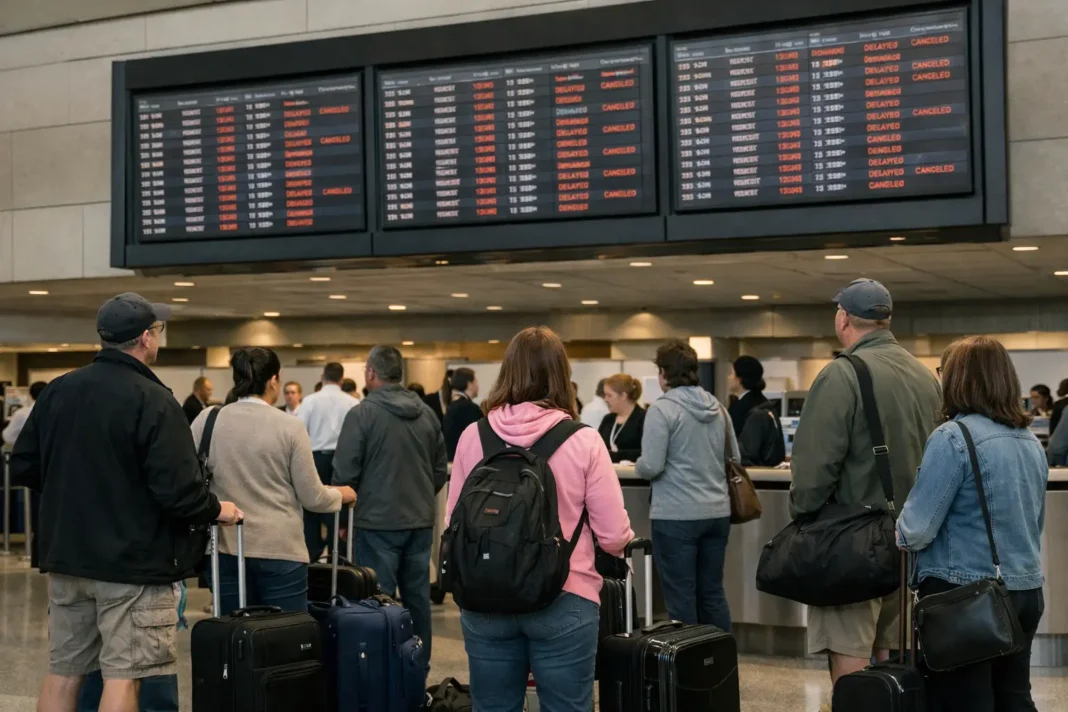
Flights across the United States began moving again after the Federal Aviation Administration lifted a nationwide ground stop that had temporarily halted air travel on Friday afternoon. The measure, triggered by a technology failure, left passengers waiting on aircraft and inside terminals as airlines paused operations and airports dealt with a sudden loss of normal traffic flow. The decision affected travel plans across the United States and created disruption that extended beyond domestic itineraries, as connecting flights and international schedules depend heavily on the US network.
Sean Duffy, the Trump administration’s transportation secretary, acknowledged that a technical failure led federal aviation officials to shut down the system and keep aircraft on the ground. Details about the precise nature of the failure remained limited after the nationwide restriction was lifted. The US Department of Transportation oversees federal transport policy, while the FAA manages the safety and operation of the national airspace system, making any broad interruption immediately significant for airlines, airports and passengers.
The lifting of the ground stop did not bring an immediate return to normal service. Airlines began resuming flights gradually, but the interruption created a backlog across schedules, aircraft positioning and crew assignments. In major airport terminals, travellers faced uncertainty over departure times, missed connections and revised travel plans. Some passengers were already aboard aircraft when the halt took effect, while others waited at gates without clear information during the early stages of the disruption. Such system-wide stoppages can continue to affect air travel even after the underlying restriction is removed, because delayed aircraft and crews must be reintegrated into a tightly timed network.
The incident underlined the dependence of modern aviation on federal technology and centralized traffic management. A nationwide ground stop is one of the most consequential tools available to aviation authorities, generally used when safety or system integrity requires immediate action. For the FAA, the next priority is restoring confidence in normal operations while clarifying what failed, how long the system was affected and what safeguards are in place to prevent a recurrence. For passengers, the practical effects are more immediate: rebookings, missed onward journeys and continuing delays as airlines work through the disruption left behind by the temporary shutdown.

