



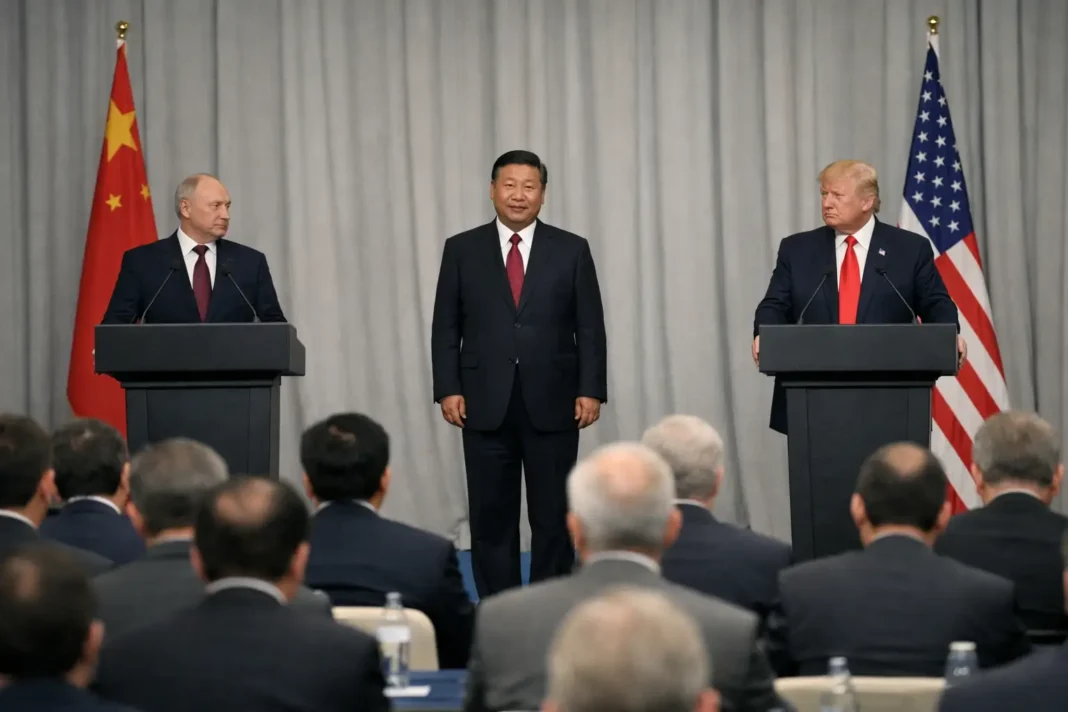
The first trilateral meeting between Xi Jinping, Vladimir Putin and Donald Trump gave Beijing a carefully staged diplomatic moment, but produced few concrete results. The three leaders met on Nov. 19, 2026, in Shenzhen, China, on the margins of the Asia-Pacific Economic Cooperation summit. The war in Ukraine, conflict in the Middle East and the strategic consequences of artificial intelligence were among the issues surrounding the encounter, yet the 90-minute discussion appeared to leave the most difficult questions unresolved.
The choreography mattered. Xi Jinping personally greeted Donald Trump on arrival in Shenzhen, a gesture rarely extended by the Chinese leader and amplified by an unusual public embrace. Inside the summit setting, images of the three presidents seated together placed Xi at the center, reinforcing China’s preferred message of stability and centrality in a changing international order. For China, the optics offered an opportunity to present itself not as a participant in a U.S.-led system, but as one of the principal managers of global affairs.
The policy outcome was narrower. The leaders endorsed language on reducing nuclear dangers, including the Cold War-era formula that a nuclear war cannot be won and must never be fought. That statement carries diplomatic weight because the United States and Russia still hold the largest nuclear arsenals, while China’s expanding capabilities are increasingly central to any future arms-control framework. Yet the declaration did not set out a mechanism for verification, limits or negotiations, leaving open the larger question of how nuclear weapons constraints could be rebuilt after the erosion of major treaties.
The meeting also touched on reform of the United Nations, an area where all three governments have reasons to seek change, though not necessarily the same kind. Beijing continues to seek greater influence in multilateral institutions, while Trump has repeatedly shown skepticism toward parts of the international system. More striking was what did not emerge. Ukraine was not addressed by name in a substantive way, and Europe’s absence limited any prospect of a meaningful discussion on the war. The conflict involving Iran also did not produce visible movement, despite its importance for Washington.
Comparisons with the 1945 Yalta Conference were therefore more visual than political. The official U.S. history of Yalta describes a wartime meeting among allied powers planning the end of the Second World War and postwar Europe. Shenzhen brought together leaders whose governments remain divided by rivalry, sanctions, war and competing visions of global order. The summit confirmed that China, Russia and the United States can share a table at the highest level, but it did not show that they are ready to share a settlement.