



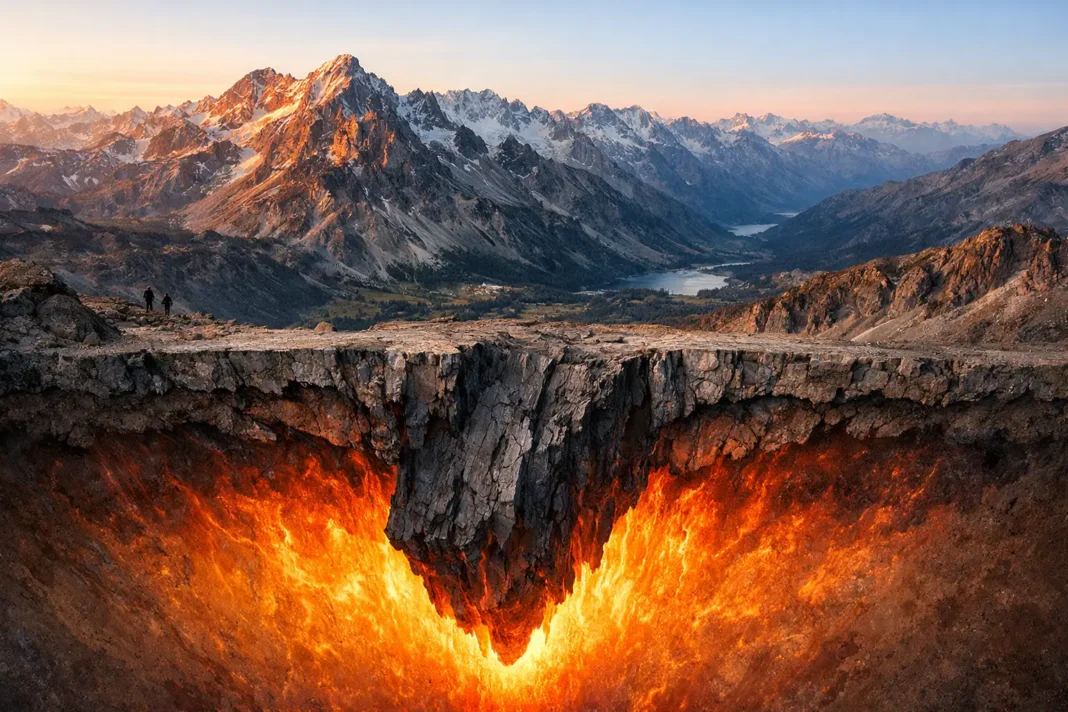
Deep beneath mountain belts, the forces that shape continents do not always push rock upward. In some regions, dense material at the base of the crust can become unstable, detach and descend into the mantle. This process, known as lithospheric dripping, offers a downward counterpart to the more familiar image of mountain building, where compression and uplift dominate the landscape visible at the surface.
The mechanism involves rock deep under the continental crust losing support and sinking hundreds of kilometers into the mantle. As it falls, it can pull part of the lithosphere with it. The lithosphere is the rigid outer shell of the Earth, made up of the crust and the uppermost part of the mantle. Its removal or deformation at depth can influence how continents evolve long after the surface expression of tectonic activity has formed.
Seismic imaging has pointed to this type of process beneath two well-known geological regions: the central Andes and California’s Sierra Nevada. These observations matter because they connect surface landscapes with hidden movements far below them. Mountain belts and volcanic arcs are often studied through features such as elevation, deformation and volcanism, but seismic images allow geologists to examine the deeper architecture that supports—or sometimes loses—those surface systems.
The significance of lithospheric dripping lies in the way it reframes continental change. Mountains are not only built by upward motion and horizontal squeezing; they may also be shaped by the loss of dense roots beneath them. When material detaches, the balance of mass and forces within the lithosphere changes. That makes the process relevant for understanding why some regions undergo major geological reorganization even without a simple surface explanation. Public agencies such as the United States Geological Survey describe seismic observations as a key tool for investigating structures inside the planet, including those hidden beneath continental interiors.
For Earth scientists, the idea also highlights the complexity of tectonic systems. A mountain range can preserve evidence of both uplift and removal, growth and loss. The sinking of dense lower-crustal rock into the mantle is not visible in the way a fault scarp or volcanic cone is visible, yet it can be part of the same geodynamic story. Lithospheric dripping therefore adds an important dimension to the study of continents: some of their most consequential transformations may begin not at the surface, but in the deep, unstable roots below.
