



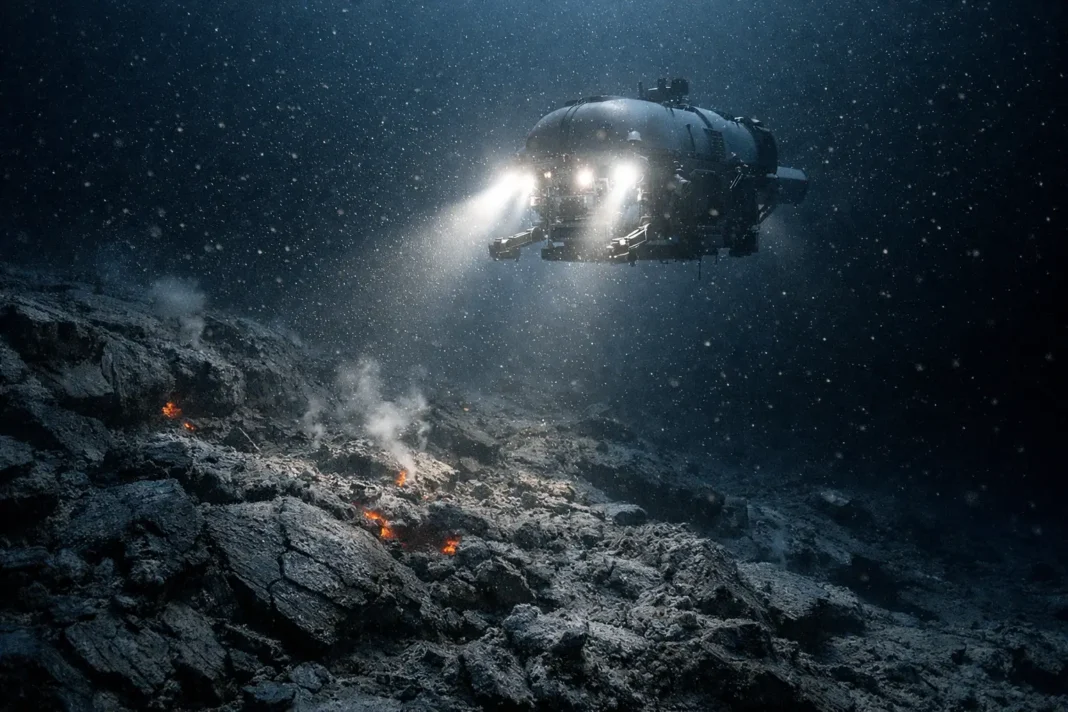
Far below the Pacific, a robotic submarine has brought new evidence from one of the least accessible places on Earth: the Mariana Trench. Samples collected around Challenger Deep, the trench’s lowest known point, indicate explosive volcanic eruptions at greater depth than previously documented anywhere in the ocean. The finding adds a striking geological detail to a region already defined by extremes of pressure, darkness and distance from the surface.
The Mariana Trench began forming about 52 million years ago, when the Pacific tectonic plate started sliding beneath the Philippine Sea plate. This process, known as subduction, created the deepest known valley on the ocean floor. Challenger Deep descends to nearly 11,000 metres below sea level, or about 36,000 feet, making it a central site for scientists examining how Earth’s crust behaves where one plate is forced under another.
The mission used a remotely operated vehicle to collect material from the area around the deep. At those depths, direct human observation is exceptionally difficult, so robotic systems play a crucial role in extending the reach of ocean science. The recovered samples revealed signs of underwater explosive eruptions, a form of volcanic activity taking place under immense water pressure. The evidence shows that explosive volcanism is not limited to shallower marine environments or land-based volcanic systems.
The discovery is important because it connects the trench’s exceptional depth with the powerful tectonic forces that built it. Subduction zones are among the most dynamic geological settings on the planet, shaping ocean basins, generating volcanic activity and recycling sections of crust into Earth’s interior. Evidence from Challenger Deep gives researchers a rare opportunity to examine how those processes operate at the deepest end of the marine environment, where sampling is scarce and every expedition can alter scientific understanding.
The findings do not provide a complete answer to why the Pacific Ocean trench reaches such an extraordinary depth, but they strengthen the link between deep-sea structure and volcanic processes. By recovering physical evidence from the abyss, the robotic vehicle has added a new chapter to the study of the Mariana Trench and underscored the role of advanced underwater exploration in revealing geological activity hidden far below the surface.
