



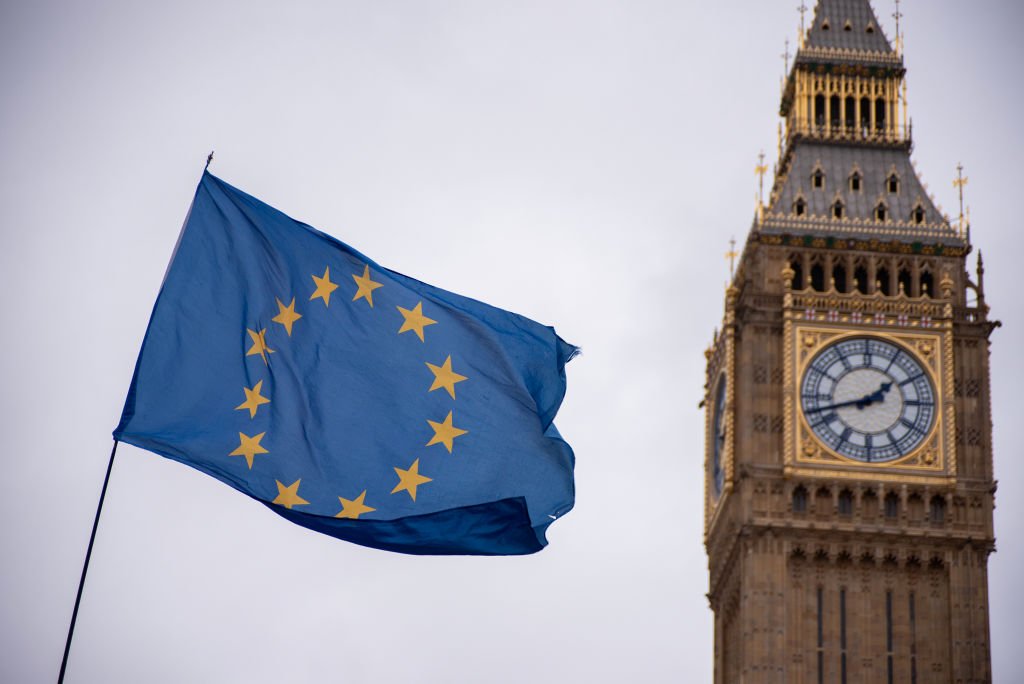
Not so long ago, no European leader would have dared turn up in London and publicly liken Brexit to amputating a healthy leg.
But when Finnish President Alexander Stubb did so on Tuesday in a speech at the Chatham House think tank in the capital, the room laughed and the moment barely registered beyond it.
That Brexit was a monumental act of national self-harm is now barely contested, even by many die-hard supporters.
A recent study by five respected economists concluded that leaving the EU had reduced UK GDP by between 6% and 8%. Polls show that 58% of Britons now regard Brexit as a mistake, versus 30% who still back it, while 52% would vote to rejoin.
Across London, just as Stubb was sitting down, UK Finance Minister Rachel Reeves was standing up to deliver her own verdict. In a lecture at City University, she made closer alignment with Europe the centrepiece of her growth agenda.
Brexit, she said, “did deep damage”. It has meant “higher costs for businesses, and therefore for higher costs in our shops”. “It has meant shrinking markets for UK exporters, and our strategic industries are exposed, as protectionist barriers rise.”
Yet these speeches were not merely the latest attempt to relitigate the 2016 referendum. The debate over how to deepen cooperation has taken on a new urgency amid the splintering of the global order and a widening transatlantic rift.
That rift has only accelerated since America embarked on an Iran war that Europe did not seek and was not consulted on. European leaders have found themselves under rhetorical assault from President Donald Trump for refusing to commit troops to a conflict they consider reckless and illegal under international law, and which they believe can only be resolved through diplomacy.
At the same time, they know deep down the Iran war will have grave consequences for the existential conflict on Europe’s eastern border – making it more likely that Washington will seek to impose a humiliating settlement on Ukraine, or simply abandon Kyiv altogether.
Meanwhile, Britain has discovered that its much-vaunted ‘special relationship’ with the US offers no protection against a capricious and vengeful president. Its dependencies on Washington – for security, trade, technology and finance – have been vulnerabilities.
Even though UK Prime Minister Keir Starmer allowed America to use British bases for defensive operations when the war in Iran had started, he has found himself subjected to a string of barbed insults, including the repeated observation, delivered with evident relish, that he is “not Churchill”, not least from Trump.
Yet if both Britain and the EU have powerful incentives to deepen cooperation, the path to doing so is strewn with obstacles that neither side has shown much willingness to clear.
A ‘reset’ announced with much fanfare last year has made little visible progress. A much-touted security and defence pact, intended as the cornerstone of the new relationship, was undermined at its very first test, when France led a successful effort to block British access to the EU’s SAFE defence loan programme. This came as a disappointment to many across the bloc, who felt that the demands of European security had been subordinated to national protectionism.
Similarly, agreements in principle to deliver a new sanitary and phytosanitary deal to reduce border friction and to link the UK and EU energy systems have stalled over technical details. And a much-heralded youth mobility scheme – a core EU demand – is currently held up by British reluctance to cut university tuition fees for EU students.
Given these difficulties on what were supposed to be the low-hanging fruit of the relationship, it is hardly surprising that the two sides are struggling to agree on an agenda for a follow-up UK-EU summit expected later this year.
Reeves signalled that she would like a broader deal covering a wider range of sectors, and that the government was willing to align with EU regulation to unlock access to the single market. “Now there are areas in which regulatory autonomy may be necessary, for sectors with unique characteristics or strategic importance for the UK. But that should be the exception, not the norm.”
To many in the EU, that will smack of the kind of ‘cherry-picking’ that Brussels consistently rejected. That said, some may be willing to be more flexible now. Brussels has already conceded a degree of selectivity in the ‘reset’, having agreed to allow UK participation in the single market for food and energy. Finland’s Stubb, in his speech, made a plea for pragmatism on both sides.
But others continue to take a harder line. Jean-Noël Barrot, the French foreign minister, also speaking on Tuesday, said that Britain would be “welcomed with open arms” if it sought to rejoin the customs union and single market, “with all associated privileges and duties”.
That was music to the ears of British pro-Europeans who believe those structures offer the route back to full membership. Yet those duties include paying into the EU budget, accepting the full acquis, and allowing free movement – all still neuralgic issues in the UK, and sure to be even more so in a subordinate status in which Britain had no say over the rules.
In fact, even sustaining Reeves’ commitment to alignment across most sectors will be a significant political and bureaucratic challenge. Regulations on both sides of the Channel have already diverged substantially in many areas, largely due to hyperactive EU policymaking on climate, energy, and technology. Bridging those divides will require a significant investment of political capital – which, for the current government, is in short supply.
The risk is that it exposes itself to considerable political pain for relatively modest economic gain.
Yet the broad consensus on both sides of the Channel – that closer cooperation is now an economic and strategic necessity – creates a genuine moment of political opportunity. Reeves acknowledges that seizing this will “require us to make, and win, the political arguments. And believe me, I am up for it.”
She would have more chance of winning those arguments – in Britain and in Brussels – if she acknowledged that the only sure way to get the UK-EU relationship back on its feet is ultimately to reattach that healthy missing limb.
Source:
www.euractiv.com