



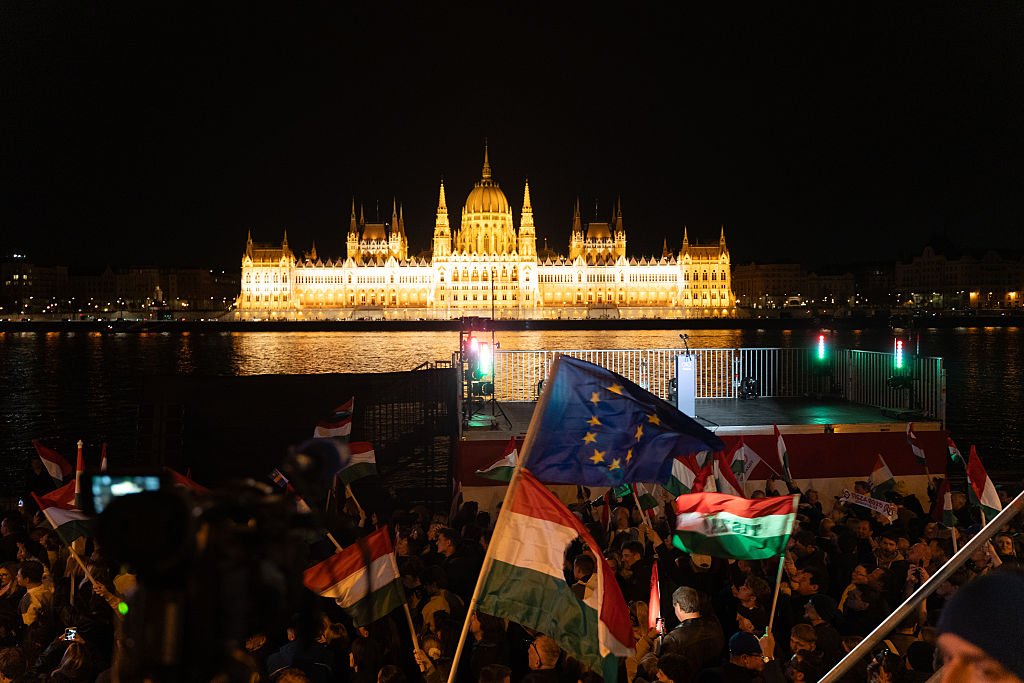

Hungary has chosen a new future – one without Orbán but with the European Union. After 16 years in power, Orbán has been voted out of office and has – surprisingly – conceded defeat. The scenes in Budapest on Sunday night felt like a national liberation: honking cars, music, people singing in the streets.
The songs and the numbers leave no room for doubt. Sunday’s election marks a historic turning point for Hungary – and for Europe. The Tisza party has secured a two-thirds majority. Fidesz has been reduced to 55 seats, with only marginal support from fringe allies. With a record turnout of 79.6%, Hungarian voters have delivered a clear and unmistakable message: they aim to dismantle a system that had hardened into a corrupt, entrenched regime.
The signal from Hungary goes far beyond its borders. It shows that citizens can defeat autocrats – even when institutions have been hollowed out and the playing field is deeply unfair. For years, Orbán served as a model for illiberal forces across Europe and beyond. His defeat will be watched closely by the right-wing populists Le Pen, Trump, and the AfD in Germany alike. The lesson is simple: when people unite, they can bring down autocrats – no matter how uneven the playing field.
Orbán’s defeat should also resonate here in Brussels. It is a reminder that European values are not abstract ideals but something worth fighting for – through words, certainly, but also through firmer measures when necessary, including the freezing of funds.
But this election is only the beginning of a long repair process. Hungary’s institutions have been deeply shaped by Orbán’s rule. The public prosecutor’s office, the judiciary, and much of the media landscape have been politicised. In his first speech after the results, Péter Magyar made clear that change must be swift. He called on key figures – including President Tamás Sulyok, Chief Prosecutor Gábor Bálint Nagy, and the heads of the Constitutional Court and Media Authority – to step down.
With a two-thirds majority, the new government has both the power and the responsibility to act. This mandate must be used to restore independence – not by replacing one set of loyalists with another but by rebuilding institutions that serve the public interest. An independent prosecutor’s office, a free media, and a functioning judiciary are the foundations of any democracy. They must now be re-established.
The good news is that the two-thirds majority obtained by Tisza will make it possible to launch these fundamental reforms quickly and effectively. Certain important decisions, such as joining the EPPO, can be taken as soon as the government takes office, and we expect this to be the case.
For the European Union, this moment requires both consistency and strategic engagement. Around €17 billion in EU funds under Cohesion Policy and the RRF remain frozen due to rule-of-law violations – roughly 8% of Hungary’s GDP. Of this, about €2 billion have already expired. In addition, around €16 billion are blocked under the EU’s SAFE mechanism.
These funds cannot and should not be released automatically. Conditionality must remain credible. The Commission must rightly insist on clear, verifiable progress in judicial reform before any money is unlocked.
At the same time, this is a moment for constructive engagement. A step-by-step approach is needed: as reforms are implemented and confirmed, funds should be gradually released. Magyar has signalled his willingness to deliver. Europe should respond with a clear and pragmatic pathway – one that rewards progress without ever compromising its principles.
There is also a broader lesson for the Union itself. For years, Hungary used its veto power to block common European decisions, particularly in foreign policy. This has weakened Europe’s ability to act. If the Union is serious about preventing future obstruction, it must now confront a structural issue: unanimity in key policy areas allows a single government to hold the entire Union hostage.
Moving beyond it is no longer a theoretical debate – it is a political necessity. We cannot afford to wait for the next autocrat to fill Orban’s place. At the same time, oversight must continue. The Article 7 procedure remains in place for good reason. If Hungary genuinely reforms, it can eventually be concluded – but only on the basis of concrete and lasting change.
Hungarian voters have done their part. They have ended an era and opened the door to democratic renewal. Now comes the hard part: dismantling networks of corruption, restoring independent institutions, and rebuilding trust – at home and in Europe.
This week, Hungary celebrates its return to the community of democracies. But whether this turning point becomes a lasting transformation will depend on what happens next – in Budapest and in Brussels.
Daniel Freund is a German MEP and part of the Greens/EFA group.
Source:
www.euractiv.com