



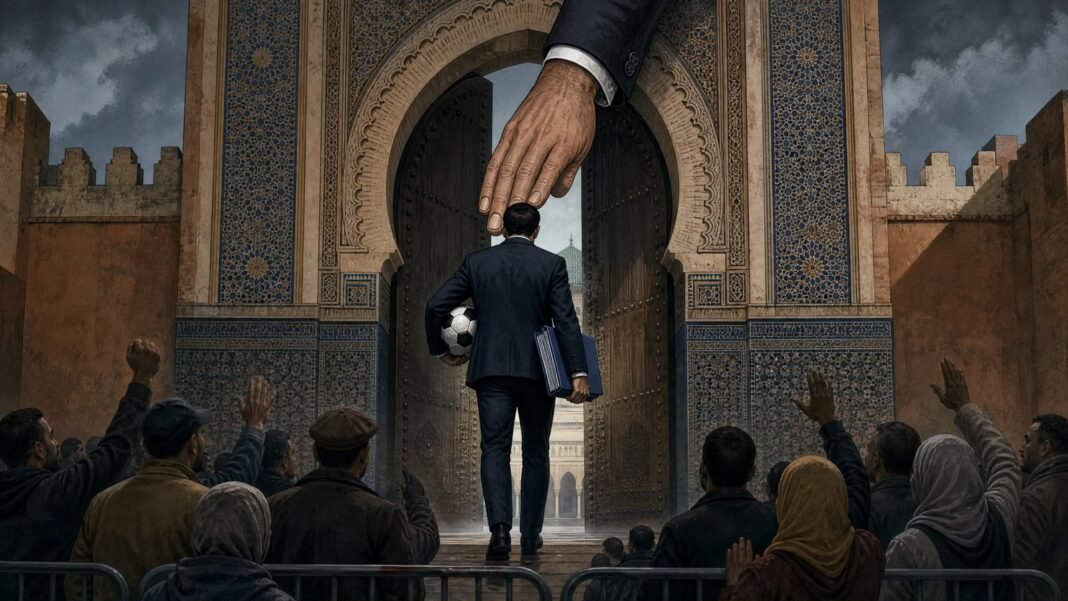
As the 2026 Moroccan legislative elections approach, rumors of Fouzi Lekjaa being pre-designated for the premiership are swelling. Behind the meteoric rise of the head of Moroccan football, an entire system of power capture stands revealed. By imposing top-down approved technocrats, the Makhzen does not merely hold universal suffrage in contempt; it stifles the aspirations of a people exhausted by social crises and thirsty for true sovereignty.
There is something deeply tragic in the way Morocco’s political future is taking shape. Nearly two years ahead of the 2026 legislative elections, the cards already seem stacked. In the reception rooms of Rabat, in controlled newsrooms, and across social media, a single name echoes like a prefabricated certainty: Fouzi Lekjaa. Delegate Minister for the Budget and head of the Royal Moroccan Football Federation (FRMF), the man has just officially joined the Authenticity and Modernity Party (PAM). It is a maneuver that has fooled no one. The message is clear: here is your next Head of Government. But who decided this? Certainly not the Moroccans. This chronicle of a nomination foretold is an insult to the intelligence of a people who have nonetheless proven their political maturity. By propelling a technocratic figure toward the summit of the executive before the first ballot has even been cast, the state apparatus—the Makhzen—perpetuates a dismal tradition: that of confiscating democratic choice.
The Illusion of the Technocratic “Savior”
History repeats itself, and Moroccan memory still bleeds from the previous experience. Consider 2021: Aziz Akhannouch, billionaire and leader of the National Rally of Independents (RNI), was brought to power through similar political engineering. He was presented as the providential manager—the man capable of running the state as one manages a flourishing conglomerate.
Three years later, the verdict is damning. Moroccans are suffocating under the weight of galloping inflation. Unemployment is ravaging the youth—one out of three active young people is left stranded—a water crisis is drying up the countryside, and purchasing power is now but a distant memory. Public hospitals lack everything, and schools continue to manufacture inequality. Akhannouch, propelled by top officials to “get the job done,” has above all demonstrated the limits of a governance disconnected from everyday realities.
Today, we are being served the exact same play with Fouzi Lekjaa. Because he balanced budgets and brilliantly orchestrated the Atlas Lions’ epic run at the 2022 World Cup, he is supposedly the providential figure to lead Morocco toward the 2030 World Cup. But since when does running a sports federation, no matter how prestigious, serve as a vision for society? A country of nearly 40 million souls, torn by gaping social divides, cannot be managed like a football tournament. Moroccans are not asking for air-conditioned stadiums; they demand bread, dignity, hospitals that heal, and schools that educate.
An Asphyxiating Democratic Deficit
What is at stake here goes far beyond the person of Fouzi Lekjaa. It is the very survival of the democratic ideal in Morocco. The 2011 Constitution, wrested by the streets during the February 20 Movement, promised a parliamentary monarchy where the ballot box would dictate political alternation. Yet, the reality is that of a facade democracy.
When political parties—meant to be the conduits of the popular will—are reduced to empty shells waiting to be parachuted a leader from the administration, the entire social contract collapses. By welcoming Lekjaa, the PAM is not recruiting a party activist; it is importing state backing to guarantee its victory. It is the triumph of bureaucracy over politics, of casting over elections.
This lock-in comes alongside an unstated climate of repression. How can we speak of free choice when the independent press has been systematically crushed? The convictions of investigative journalists like Taoufik Bouachrine, Soulaimane Raissouni, or Omar Radi—often under the guise of spurious morality charges—sent a chilling message to anyone daring to look power in the face. Reports from Human Rights Watch and Amnesty International describe an “ecosystem of repression” where dissent is crushed to maintain the illusion of seamless stability. In this forced silence, the preemptive appointment of a Prime Minister passes for a mere administrative formality.
The People Deserve Better
Does this country not deserve better? Do the Moroccans, who built this nation by the sweat of their brow, not deserve the fundamental right to freely choose those who govern them?
Wait for the elections. Let the parties debate, offer contrasting visions, and let every citizen decide in the privacy of the voting booth. This is called democracy. It is the vital minimum for a nation that claims a seat at the table of major emerging powers.
The strategy of mega-projects and international visibility—high-speed trains, mega-ports, the 2030 World Cup—makes for a magnificent showcase. But a showcase does not feed a people. If development does not trickle down, if it does not translate into tangible social justice and a scrupulous respect for human rights, it is nothing more than a mirage.
Morocco stands at a tipping point. Continuing down the path of power confiscation by a technocratic elite risks a permanent rupture between the state and society. Anger is brewing—silent, but deep. It is time to return power to those to whom it rightfully belongs: the Moroccan people.
Democracy is not a luxury reserved for others. It is the sole guarantee of genuine social peace. It is up to us, as citizens, to reject pre-scripted outcomes.
Isaac Hammouch is a Belgo-Moroccan journalist and writer. Author of several books and numerous op-eds, he analyzes societal issues, governance, and contemporary global transformations.