



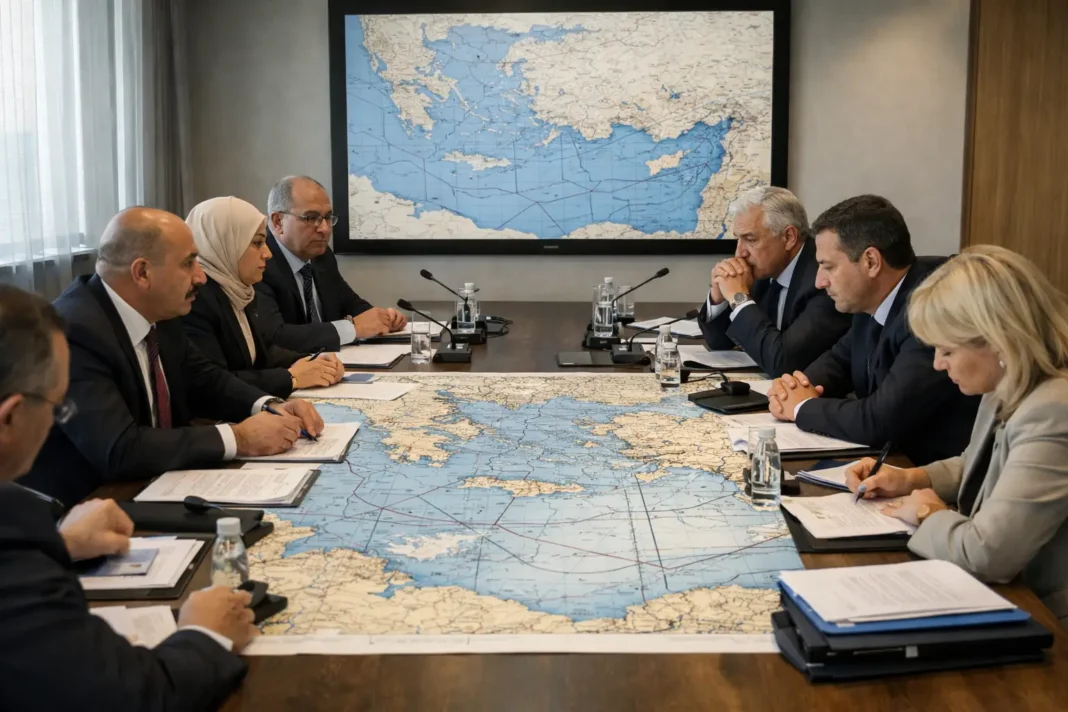
A planned maritime reset between Turkey and Libya is adding a new layer of tension to the already contested politics of the Mediterranean. The two countries intend to redefine maritime boundaries as part of a proposed economic corridor, a move that has immediately triggered strong objections from Greece and placed the European Union more directly into the dispute.
The issue is sensitive because maritime boundaries determine access to sea routes, potential energy zones and the legal space in which states can regulate economic activity. In the eastern and central Mediterranean, such questions are rarely technical alone. They sit at the intersection of sovereignty, regional influence and competing diplomatic alignments. A corridor linking Turkish and Libyan interests at sea therefore carries consequences beyond bilateral cooperation, especially when nearby states view the arrangement as affecting their own maritime claims.
Greece’s opposition reflects a broader concern that any redrawing of sea boundaries without wider regional agreement could undermine existing positions in the Mediterranean. Athens has long treated maritime delimitation as a core national interest, and its response signals that the Turkey-Libya initiative will not remain confined to talks between Ankara and Tripoli. The dispute also tests the EU’s role, since Greece is a member state and maritime stability in the Mediterranean is tied to European trade, migration management and energy security.
For Turkey, the plan reinforces its effort to expand economic and strategic reach across the Mediterranean. For Libya, participation in such a corridor may offer a way to strengthen external partnerships and assert maritime relevance. But the diplomatic cost is evident: the initiative risks deepening existing divisions with Greece and complicating EU relations with Ankara and Tripoli. Without a mutually accepted framework, the corridor could become another contested line on a map rather than a stabilising economic project.
The immediate significance lies less in the technical detail of the proposed boundaries than in the political reaction they have generated. Mediterranean maritime disputes tend to persist when legal interpretations, national interests and regional alliances move in different directions. The Turkey-Libya plan has already widened the circle of concern, showing how a bilateral maritime arrangement can quickly become a European diplomatic challenge.
