



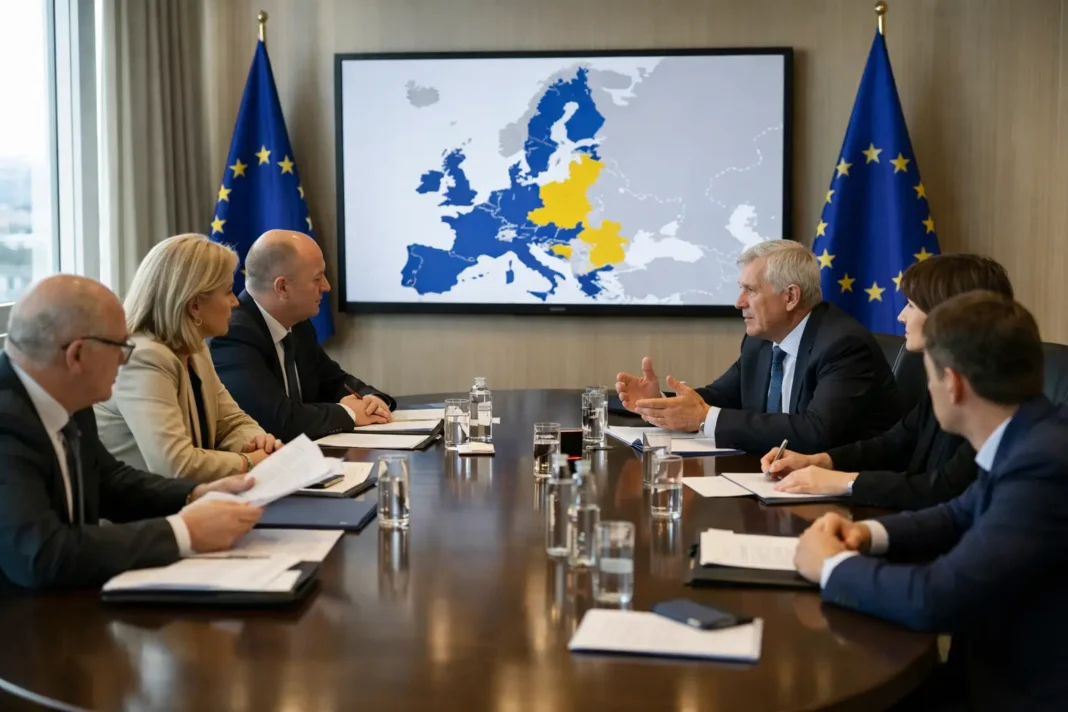
Making enlargement acceptable has become a priority for the European Commission, which this week circulated a set of ideas intended to speed up and smooth the process of bringing new countries into the bloc. The initiative seeks to reduce political friction among current members while keeping accession conditions intact. Among the states discussed are several Balkan aspirants and war-torn Ukraine, whose application continues to shape debates over the pace and terms of enlargement.
The package presented by the Commission frames the challenge as both technical and political: it aims to clarify procedures, propose flexible sequencing of reforms and consider temporary safeguards so that new members can integrate without immediately assuming all institutional burdens. Brussels argues such mechanisms could make the path to membership more predictable for candidate governments, and more acceptable for capitals worried about short-term costs and governance standards. Observers note that the Commission emphasises conditionality remains central to any approach.
Member states have long been divided over enlargement. Concerns cited in internal discussions include institutional capacity, budgetary impacts, migration management and adherence to rule-of-law benchmarks. Those sceptical about rapid expansion stress the need for robust monitoring and clear sanctions where commitments are not met. Proponents counter that a clearer, more modular accession framework could help the European Union manage enlargement without compromising cohesion, by allowing tangible benefits to flow as specific benchmarks are achieved.
The Commission’s proposals will now be debated in Brussels and in member-state capitals, where political appetite varies. Any formal change to accession practice requires agreement among existing members, meaning the coming months will be crucial for translating ideas into policy. For countries like Ukraine, the discussion is more than procedural: it is tied to questions of security, reconstruction and long-term European integration. The outcome will influence not only the future map of the bloc but also how the EU balances enlargement with internal solidarity and institutional resilience.